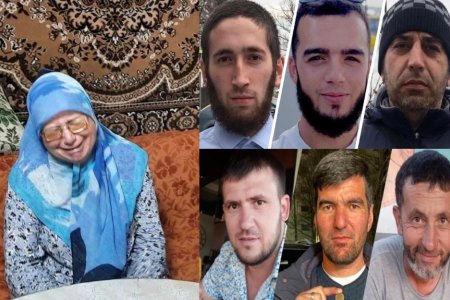
88 years after Crimean Tatar historian Shukri Seitumerov’s grandfather was executed during Stalin’s Terror for so-called ‘counter-revolutionary terrorist propaganda’, a Russian prosecutor has demanded a 17-year sentence against Shukri’s youngest son Abdulmedzhit Seitumerov (b. 1999) on equally flawed ‘terrorism’ charges without any crime. Abdulmedzhit’s mother, Lilia has already heard such demands three times, with the same Southern District Military Court in Rostov (Russia) having already passed massive sentences against Abdulmedzhit’s two elder brothers, Seitumer Seitumerov (1988) and Osman Seitumerov (b. 1992) and their maternal uncle Rustem Seitmemetov (b. 1973). All of the men are recognized political prisoners whose ‘trials’ differ only in their imitation of judicial process from the notorious troika used to sentence the brothers’ great-grandfather to death in 1938. In all cases, a guilty verdict is tragically predetermined from the moment armed FSB burst into the family’s home, with only the size of the sentence in any way a variable.
Nor is the variation in sentence linked to differences in the charges or impugned activities. Russia began staging conveyor-belt ‘trials’ against Crimean Muslims in 2015 and swiftly turned such arrests and trials into a weapon aimed at crushing Crimean Solidarity and the Crimean Tatar human rights movement in general. While the charges and virtually all aspects of the ‘trials’ have not changed, the sentences have become longer and longer. Russia has also begun targeting women, including Esma Nimetullayeva (b. 1986) whose husband, Remzi Nimetulayev (b. 1985) is on trial together with Abdulmedzhit Seitumerov. The couple have five small daughters: Aishe (b. 2009); Anife (b. 2019); Adile (b. 2013); Yasmina (b. 2016) and Alime (b. 2020), with Russia now seeking to imprison both parents, who are not accused of any recognizable crime, to up to 19 years. .
Russia claims that these trials are about ‘fighting Hizb ut-Tahrir’, a transnational Muslim party which is legal in Ukraine, but which a highly secretive Russian supreme court ruling in 2003 labelled ‘terrorist’. It was, in fact, clear by October 2017 that Crimean Tatar civic journalists and activists from the vital Crimean Solidarity human rights initiative were being targeted, with this receiving international condemnation after the arrests of 25 civic journalists and activists on 27 March 2019.
When even such brazen arrests and ‘trials’ on flawed ‘terrorism’ charges for Crimean Solidarity failed to crush such solidarity, Russia essentially dropped all pretence. By declaring Crimean Solidarity and 11 prominent lawyers, defending political prisoners, civic journalists and activists, ‘foreign agents’, Russia forced the movement to terminate its activities. This did not stop the Russian justice ministry from expanding the list of those facing direct persecution as ‘involved in Crimean Solidarity’ to 137 men and women, including some political prisoners and their families.
Three months before a Russian prosecutor claimed there to be grounds for sentencing Abdulmedzhit Seitumerov to 17 years on spurious ‘terrorism’ charges, Russia’s justice ministry added him to the list of “participants in Crimean Solidarity. In so doing, it effectively acknowledged that Abdulmedzhit’s civic activism in support of political prisoners was the real reason for his arrest on 24 August 2023. Nor was Abdulmedzhit the only member of his family to be targeted. Shukri Seitumerov was also added, as was the brothers’ 74-year-old uncle Enver Seitmemetov who is also a historian. He was recently prosecuted in occupied Crimea for entirely truthful remarks in an interview about the Deportation of the entire Crimean Tatar people in May 1944.
As reported, armed enforcement officers carried out multiple ‘searches’ in the early hours of 24 August, arresting six Crimean Solidarity civic activists: Ruslan Asanov (b. 1975); Seidamet Mustafayev (b. 1995); Remzi Nimetulayev (b. 1985); Abdulmedzhit Seitumerov (b. 1999); Ametkhan Umerov (b. 1986) and Eldar Yakubov (b. 1980). All of the men had previously faced administrative prosecution for peaceful acts of solidarity with other political prisoners.
Although the charges are under Russia’s ‘terrorism’ legislation, the FSB made no pretence of looking for anything except ‘prohibited religious literature’. The FSB, in fact, normally bring such material and then claim to have found it, with this the ‘evidence’, together with flawed ‘expert assessments’ from FSB-loyal ‘experts’ of innocuous conversations and the ‘testimony’ of secret witnesses, used to sentence people to up to 20 years’ maximum-security imprisonment.
Ruslan Asanov and Remzi Nimetulayev were both charged with the more serious under Article 205.5 § 1 of Russia’s criminal code (organizing a cell of an organization declared ‘terrorist’), with prosecutor e the other four men are charged, under Article 205.5 § 2, with taking part in this. All are accused in addition of ‘planning a violent uprising’ (Article 278).
On 14 September, prosecutor Ye. Tsotsorina demanded 19-year sentences against Ruslan Asanov and Remzi Nimetulayev and 17 years against Seidamet Mustafayev; Abdulmedzhit Seitumerov; Ametkhan Umerov and Eldar Yakubov. In all cases, the first three years would be in a prison, the harshest of Russia’s penal institutions, with the remainder of the sentence in a maximum-security prison colony.
This is despite the fact that none of the men is accused of any specific crime. ‘Judge’ Roman Victorovich Saprunov has already taken part in many such flawed ‘trials’ and, in this one, has already demonstrated his attitude by, for example, accusing the men of ‘dragging out the case’ by trying to cross-examine a secret witness and demonstrate that he is lying. He has also blocked questions from the defence which highlight suspicious irregularities and discrepancies in testimony. During the last two hearings he has rejected all applications from the defence, however obviously valid.
The next hearing is scheduled for 12 October 2026, with it, unfortunately, conceivable that Saprunov will try to ‘expedite’ the long sentences that he already knows he will be passing.