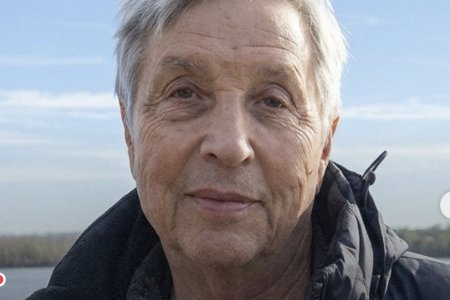
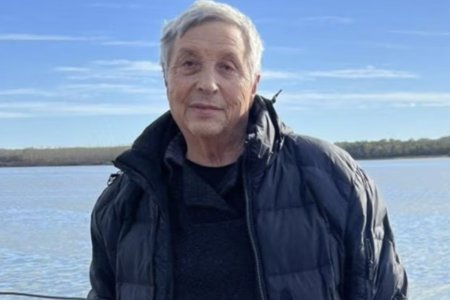
Russia’s show trial of its oldest Ukrainian political prisoner is coming to an end with the prosecutor on 16 September demanding an incredible 22-year sentence against 77-year-old Volodymyr Ananiev. Even taking into account the almost three years that Ananiev has already spent in Russian captivity, that would still mean he was 96 when released. If, that is, he were to survive so long in the appalling conditions of a Russian maximum-security prison colony, which is most unlikely.
In quoting a spokesperson from Russia’s notorious Southern District Military Court in Rostov on the sentence demanded, TASS chose to omit any mention of Ananiev’s age. Nor was there anything about his limited mobility, although this made the claimed ‘plot’ dubious even back in February 2024. There are other standard omissions, in particular, the fact that the only ‘evidence’ against Volodymyr Ananiev is that provided by the two other Ukrainians seized around the same time whose ‘confessions’ were almost certainly extracted through torture.
TASS describes Ananiev as the third defendant in a case involving an allegedly planned attempt on the life of the Russian-installed Crimean head Sergei Aksyonov. The same Southern District Military Court first sentenced Oksana Shevchenko to ten years on 14 May 2025, and then her common-law husband Volodymyr Bodnar to 13 years’ maximum-security imprisonment on 23 June 2025.
The prosecution is claiming that, in February 2022 a Ukrainian national, “against whom criminal proceedings have been initiated separately, created an organized gang in order to carry out an act of terrorism in Crimea. The gang included Voldomyr Bodnar and Oksana Shevchenko. They were supposed to carry out surveillance of the routes and movements of Aksyonov’s work car in order to plan and carry out the attempt on his life. Later Volodymyr Ananiev was recruited into the gang.”
Bodnar is alleged to have brought a remote-controlled explosive device, transmitter and radio from Zaporizhzhia oblast to be used to blow up Aksyonov’s car. “The defendants” are claimed to have hidden the explosive in a garage in Simferopol which Shevchenko had earlier rented. They purportedly following Aksyonov’s movements from rented premises with CCTV footage.
It is telling that even here, where state-controlled TASS is reporting the effective death sentence demanded against Volodymyr Ananiev that no adequate allegations are made to justify any such sentence, nor even to adequately explain what Ananiev was allegedly “recruited” to do. In fact, for the first ten months after Ananiev was seized on 2 February 2024, he was accused only of ‘the illegal purchase, transfer, sale, possession or movement of explosive devices’ under Article 222.1 § 1 of Russia’s criminal code. In November 2024, the Crimean Human Rights Group learned that a second charge had been added, of abetting in the planning of ‘a terrorist attack’ (Article 205.1). Judging by the court details, the explosives charges are the same, but the other charge is slightly different, and inexplicable. Instead of Article 205.1, Ananiev is charged with Article 205 § 3b – an act of terrorism or plan to commit such an act, with part 3b where the actions led to a person’s death. In this case, there is no real evidence that there ever was a plan to kill Aksyonov and certainly nothing to suggest that there was a fatal outcome.
Yet the prosecutor demanded a 22-year maximum-security sentence, with the first five years in a prison, the harshest of Russia’s penal institutions, as well as a fine of 650 thousand roubles. Such a fine would mean that Ananiev’s wife could not even send money to buy food and other vital supplies which you need to survive in Russian prisons, as any money in his account would be taken to pay this shocking fine.
Volodymyr Ananiev (b. 10.08.1949) already had health issues when seized by the FSB in occupied Crimea on 2 February 2024 and can even be seen on the FSB propaganda videos walking with the help of a stick, due to problems with his knee joint. His health has gravely deteriorated in Russian captivity, and he is now also suffering from a glaucoma, as well as spinal, muscular and kidney problems, requiring proper medical treatment which he will certainly not be receiving in the Rostov SIZO [remand prison]. Such failure to provide medical care is tantamount to medical torture, and Ananiev is also being subjected to brutal isolation tactics, with his wife Hanna Sviatnenko reporting that she has not once been allowed to speak with her husband.
Although Ananiev is well-known as a civic activist and publicist in Crimea, he had long been based in Kyiv and was only visiting a friend in Crimea when seized by the FSB. It was only on 5 February that the FSB were reported by Russian propaganda media as claiming that they had ‘thwarted’ plans to carry out a ‘terrorist attack’ with Ananiev shown on the FSB video as one of the alleged ‘plotters’. That same day, Ananiev was formally charged and remanded in custody.
That leaves three days in Ananiev’s case when he was held by the FSB incommunicado and without any procedural status at all. It is likely that Bodnar and, perhaps, Shevchenko were held under total FSB control, without contact with a proper lawyer for even longer. It is precisely during such periods of isolation that detainees are typically shown on videos supposedly ‘confessing’ to whatever charges the FSB are laying. In virtually all cases where a person later receives access to an independent lawyer, they retract such ‘testimony’ and describe the torture used to extract it.
Oksana Shevchenko, who was 45 when seized, was sentenced on 14 May 2025 to 10 years’ medium-security imprisonment, as well as a 500-thousand rouble fine. The sentence was passed by ‘judge’ Denis Vasilievich Stepanov from the Southern District Military Court. Just over a month later, on 23 June 2025, Volodymyr Bodnar (b. 1974) was sentenced to 13 years’ maximum-security imprisonment and the same 500-thousand rouble fine. ‘Judge’ Konstantin Igorevich Prostov ordered that Bodnar serve the first three years in a prison, with the remainder in a prison colony.
The ‘case’ against Volodymyr Ananiev was passed to the same Southern District Military Court in Rostov, under presiding ‘judge’ Denis Aleksandrovich Galkin
The nature of this ‘trial’ can be seen in the way inconvenient testimony from the key prosecution witness was changed from one hearing to the next. On 25 November 2025, this witness stated clearly that he was seeing Volodymyr Ananiev for the first time and was not acquainted with him. By 10 February 2026, the same witness claimed to have “not understood the question” and withdrew the testimony that clashed with the prosecution’s case. If, as seems likely, this supposed ‘witness’ was Bodnar, the switch is of critical importance. Since he is in Russian captivity, it would be extremely easy to put pressure on him to change the testimony, with ‘judge’ Galkin well enough versed in the ways of these political trials, to know not to ask questions.
The next hearing is scheduled for 21 October 2026.
It is extremely likely that Volodymyr Ananiev has been targeted for his pro-Ukrainian position and his civic activism. Please help to publicize this travesty of a trial, as he cannot survive years in Russian captivity.