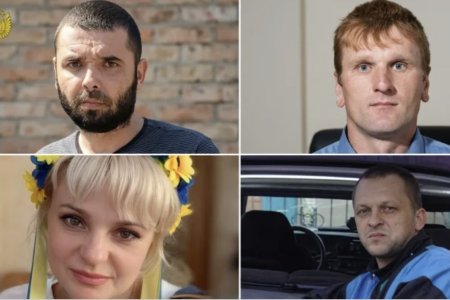
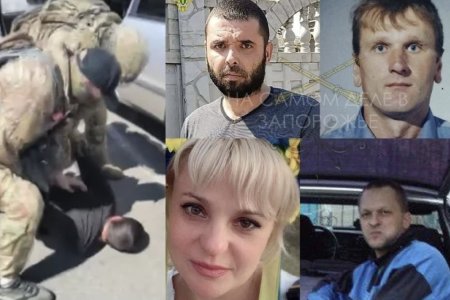
Russia’s Southern District Military Court has sentenced Ihor Haranin from Melitopol to life imprisonment and Serhiy Harkusha, Serhiy Yevtushenko and Olena Roi to 25 years over alleged involvement in attacks on Ukrainian traitors collaborating with the Russian invaders. As usual, the aggressor state which invaded and is occupying Ukrainian territory, claimed that partisan resistance to the invading power constituted ‘terrorism’. The four Ukrainians all gave detailed descriptions of the torture used to extract their ‘confessions’ or, more accurately, their signatures to alleged ‘confessions’ they didn’t even read. It was spelled out to the court that the torture was so bad that you will sign whatever they thrust in front of you.
Russia claimed that a targeted attack on two collaborators on 27 April 2022 that killed Oleksandr Mishchenko, installed by the Russians as ‘deputy head of the Melitopol police,’ and injured his colleague Yuriy Akimov was ‘an act of terrorism’. The same was asserted about an earlier attack on 15 November 2022 which only injured Dmytro Trukhin, a collaborator installed in a leading position within the occupation administration. The four Ukrainians were also accused of having, from February to May 2023, planned an attack on a third collaborator, Roman Pshennychny, installed by the Russians as deputy head of police for occupied parts of Zaporizhzhia oblast. Pshennychny apparently refused to take part in the ‘trial’ or view himself as an aggrieved party.
The country which launched a full-scale invasion of Ukraine in February 2022 claimed that “an unidentified individual” had, in February 2022, created “a terrorist organization in order to carry out terrorist activities and to plan and carry out terrorist attacks in Melitopol and that the defendants had joined this.”
Russia would, under any circumstances, be in violation of international law by prosecuting Ukrainians from occupied territory under Russian legislation and forcibly moving them to Russian prisons. Here, however, the cynical violations go much further as Ukrainians, accused of acts of resistance against legitimate targets actively serving the invading state, were charged under Russia’s ‘terrorism’ legislation. All were accused of ‘involvement in a terrorist organization’ (Article 205.4 § 2) and, to varying degrees, of carrying out or planning ‘acts of terrorism’ (Article 205 §§ 2 & 3. There were also explosives charges under Articles 222.1 and 223.1.
Serhiy Harkusha, who was claimed to be the leader of the supposed ‘terrorist organization’, was seized by the Russians on 27 April 2023, with Ihor Haranin seemingly taken prisoner that same day. 46-year-old Olena Roi is a Ukrainian medic, whose husband, as she stated in court, was killed defending Ukraine’s territorial integrity on 19 March 2022. It is not clear when she, or Serhiy Yevtushenko, were taken prisoner. The description of Olena Roi (and, sometimes, Serhiy Harkusha) as ‘Russians’ is doubtless based solely on the citizenship which the invaders make it difficult to live without on occupied territory.
Although all four Ukrainians retracted ‘confessions’ which had been extracted through torture, they did not all deny some of the charges. Serhiy Harkusha, for example, admitted involvement in the fatal attack on Mishchenko, but denied the other alleged episodes and stressed that Serhiy Yevtushenko had not been a member of the supposed ‘terrorist group’. In fact, it is clear from the indictment, that Yevtushenko was not even alleged to have taken any active role in the supposed ‘terrorist organization’. Neither that, however, nor Yevtushenko’s very aggressive form of sugar diabetes which means that he should never have been imprisoned, let alone subjected to torture and other ill-treatment, made any difference to the court. He too was charged with ‘involvement in a terrorist organization’ and sentenced to 25 years, a sentence he would be unlikely to survive.
In his final address, Ihor Haranin shredded to pieces the ‘terrorism’ charges. He reiterated that he was a citizen only of Ukraine. “On 24 February, when the full-scale invasion of Ukraine by Russian forces began, as I have already told you and stated in writing, the President of my country declared martial law. I was mobilized and arrived in Zaporizhzhia then later was sent, on orders from the commander, to carry out intelligence tasks in Melitopol. I have nothing to do with terrorism, nor with terrorist organizations.” Neither he, nor those he is alleged to have been in a ‘terrorist organization’ would have every considered any kind of attack on civilians. “Because these are our citizens, our children, and we would never have pursued any terrorist aims so as to not, God forbid, hurt civilians. I was given lawful orders by my command to eliminate legitimate military targets which were not, in any way, Russian citizens or military servicemen of the Russian Federation. They were only collaborators, citizens of Ukraine who had betrayed their oath to their country and, therefore, became for Ukraine legitimate military targets.”
All of the defendants told the court of the torture to which they had been subjected and accused the ‘lawyers’ appointed by the prosecution of having taken part in the fabrication of their supposed ‘testimony’. They had, they stated, signed their so-called ‘confessions’ in 2023, under torture, without a defence lawyer being present and without having been formally detained. Although this was denied by the two ‘lawyers’ questioned by the court - Serhiy Kostyshak and Oleksandr Tsokalo, and the ‘investigator’ Denis Gubin, their inability to answer certain questions corroborated the defendants’ accusations.
All of this was ignored by both Russian prosecutor Sergei Aidinov and ‘judge’ Kirill Nikolaevich Krivtsov. That cannot be called a surprise since both men have been involved in sentencing a large number of Crimean Tatar and other Ukrainian political prisoners and prisoners of war to huge terms of imprisonment despite evidently fabricated evidence and flawed charges.
During the previous hearing on 10 September, Aidinov demanded life sentences for all three men and a 28-year-sentence against Olena Roi. On 16 October 2026, Kirill Krivtsov sentenced only Ihor Haranin to particularly harsh-regime life imprisonment, with Serhiy Harkusha and Serhiy Yevtushenko sentenced to 25 years’ maximum-security imprisonment. In all three cases, the first five years are to be in a prison, the harshest of Russian penal institutions. Massive one-million rouble fines were imposed on Haranin and Yevtushenko but not mentioned against Harkusha. Olena Roi was also sentenced to 25 years but in a medium-security prison colony – the harshest available in the case of women prisoners. In her case, Krivtsov imposed a 500 thousand rouble fine.
The sentences will be appealed however these proceedings are trials in name alone with their outcome predetermined from the outset. It is vital that Ukraine manages to get the four added to the prisoner exchange list.