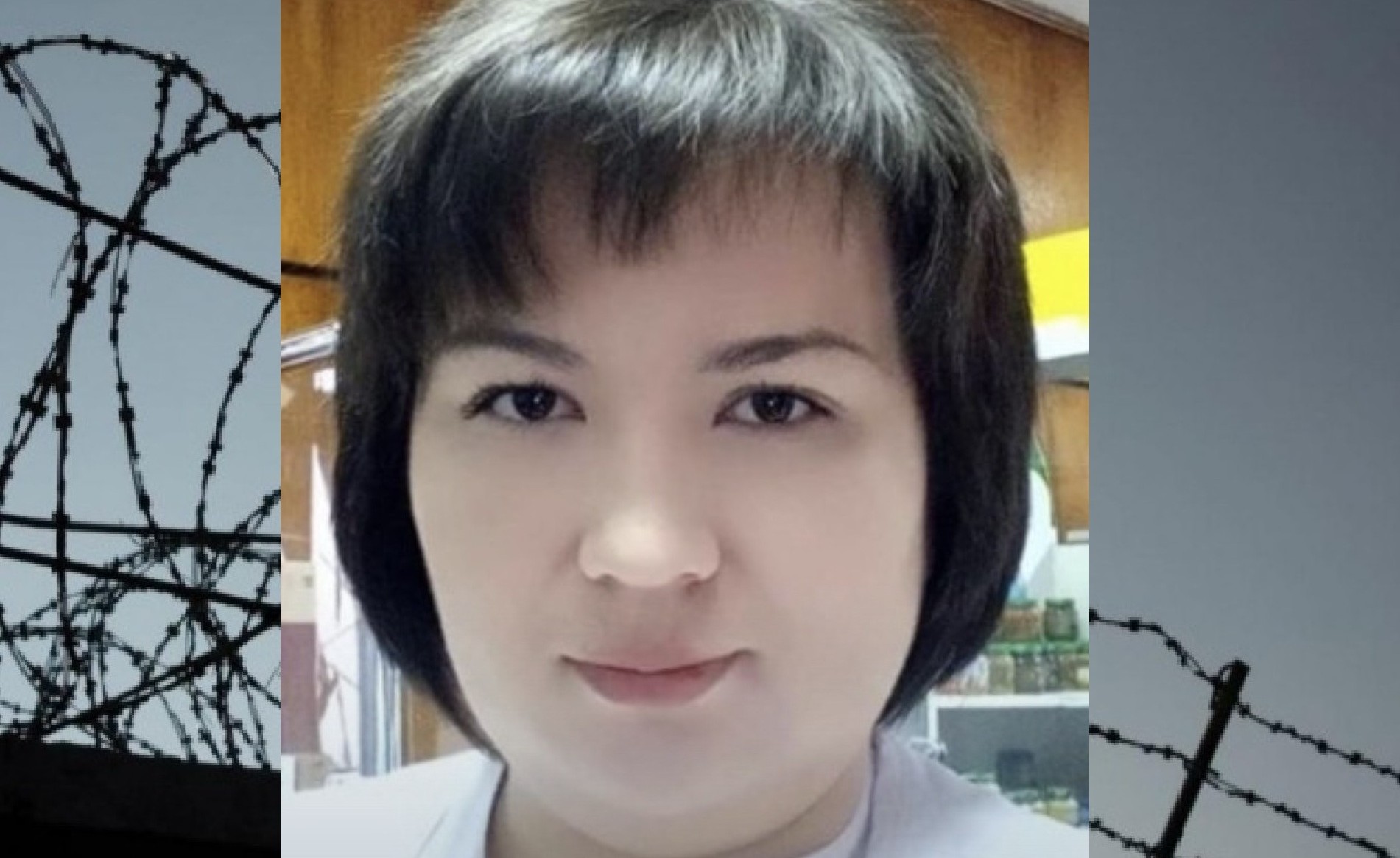
Russia’s occupation ‘Crimean high court’ has passed a horrific 15-year sentence against Niyara Ersmambetova six months after the 38-year-old mother of two was abducted from her home. The ‘trial’ on supposed ‘treason’ charges was held behind closed doors before a ‘judge’ who has already been involved in the political persecution of civic journalist and human rights defender Iryna Danilovych and at least two other political prisoners.
Although the ‘court’ website does not provide any information about the person sentenced, Crimean Process has learned through its own sources that it was Niyara Ersmambetova who was ‘on trial’, and that the prosecution had demanded 18 years.
She was accused of having helped the partisan resistance movement ATESH and passed on information about a fuel depot and about the location of anti-aircraft defence systems. Russia used the fact that it has made it impossible, especially for a mother with two children, to live in occupied Crimea without taking Russian citizenship as pretext for calling this ‘state treason’, under Article 275 of Russia’s criminal code.
All of these ‘trials’ are in violation of international humanitarian law which prohibits an occupying power from imposing its legislation on occupied territory. They also breach just about every aspect of the right to a fair trial. These are ‘trials’ in name alone, as the conviction is, effectively, predetermined, with it quite immaterial how obviously fabricated the ‘evidence’ is, and how compelling the grounds for believing that ‘confessions’ were obtained through torture. With respect to the ever-mounting number of ‘trials’ on treason or spying charges, there is no way of even really knowing what the charges were, and what grounds were brought for bringing them. The name of the defendant is often concealed, any hearings are held behind closed doors and, in those isolated cases where the defendant has an independent lawyer, the person is forced to sign a non-disclosure commitment and faces criminal prosecution if this is breached.
Nor was the secrecy only over the ‘trial’, with this one of very many arrests that seemed much more like an enforced disappearance. As reported, Niyara Ersmambetova was seized by the FSB in May 2025, just seven days after the funeral of her mother. Her 16-year-old son and 9-year-old daughter were left with their grandfather, who is 70 and has Grade II disability status. It was Niyara, working as a chemist, who had provided for the entire family.
Citing the Crimean human rights initiative Irade, Crimean Tribunal reported in July 2025 that Niyara Ersmambetova had been in SIZO No. 1 in Simferopol for at least two and a half months, and was accused of collaborating with one of the resistance movements in occupied Crimea. At the time, only the claim that she had passed on information about a fuel depot was mentioned. Crimean Tribunal wrote that this was at least the thirtieth ‘arrest’ on charges either of ‘treason’ or of planning acts of sabotage in occupied Crimea just in the previous six months. “Considering the mass nature of detentions; the widespread use of torture; the lack of access to independent lawyers and the closed nature of the trials on such charges, the grounds for the accusation seem dubious. In this case, there are indications of illegal deprivation of liberty which are considered war crimes.”
The Memorial Support for Political Prisoners Project clearly agrees. While the secrecy in such cases makes it difficult for Memorial to apply its normal criteria for recognizing political prisoners, they swiftly added Niyara Ersmambetova to their list of people whose prosecution is very likely politically motivated.
Crimean Process also points to another infringement, namely the clear bias and lack of independence of the ‘court’, and the involvement in passing the sentence of Natalia Kulinskaya. This individual may well have been promoted to the occupation ‘Crimean high court’ from the ‘Feodosia municipal court’ because of her role in the persecution and 7-year sentence against Ukrainian civic journalist and human rights defender, Iryna Danilovych. Kulinskaya was willing to ignore clear evidence backing Danilovych’s statement that she had been abducted, not ‘arrested’ and the evident nonsense of the FSB’s attempt to claim that Danilovych had ‘voluntarily’ remained in their basement, with a bed, a shower, food, etc. She also paid no heed to the sheer insanity of the claim that Danilovych had carried ‘explosives’ in her glasses case both to and from her night shift as a nurse. On 28 December 2022, Kulinskaya handed down the entire 7-year sentence demanded by ‘prosecutors’ Dmitry Lyashchenko and Yulia Matvyeya, although she had clearly understood how flawed the indictment was as she removed the totally unsubstantiated (and surreal) claim that Danilovych had “purchased” the explosives (see: Ukrainian political prisoner issues urgent appeal over ‘Gestapo-like’ treatment in Russian women’s prison
On 22 July 2025, Kulinskaya (at the occupation ‘Crimean high court’) sentenced 29-year-old Ismail Shemshedinov to 13 years maximum-security imprisonment, also on ‘treason’ charges. The young Crimean Tatar, who had only recently become a father, had been abducted and held incommunicado for a year and a half, with the FSB constantly denying any knowledge of his whereabouts. It is worth noting that the sentence was reported by both the occupation ‘prosecutor’ and by the notorious collaborator Aleksandr Talipov’s Crimean SMERSH Telegram channel. The latter made it quite clear that Shemshedinov had been targeted for supporting Ukraine and opposing Russia’s occupation of Crimea. Shemshedinov was claimed to have “spoken out against Russia on social media and written anti-Russian commentaries” (see: Abducted Crimean Tatar father sentenced to 13 years for ' anti-Russian posts' and opposing Russia’s war against Ukraine
Crimean Process reported earlier that an unnamed person, sentenced on 6 August 2025, to a massive 18-year sentence by Kulinskaya on ‘treason’ charges was Oleksandr Osadchy, a 31-year-old businessman from Feodosia. He had been abducted and held incommunicado from at least February 2024 in SIZO No. 2, one of the remand prisons opened after Russia began its full-scale invasion of Ukraine. SIZO No. 2 is believed to be under the control of the FSB and is being used to imprison Ukrainian political prisoners and civilian hostages. Russia’s information blockade and the scale of repression on occupied territory have made any verification impossible, and other human rights groups have suggested that Osadchy is still imprisoned, awaiting ‘trial’.
For information about Victoria Strilets and her daughter Oleksandr, as well as (probably) about Oleksandr Osadchy, see: Mother and daughter sentenced to 12 years in Russia’s conveyor belt ‘treason trials’ in occupied Crimea