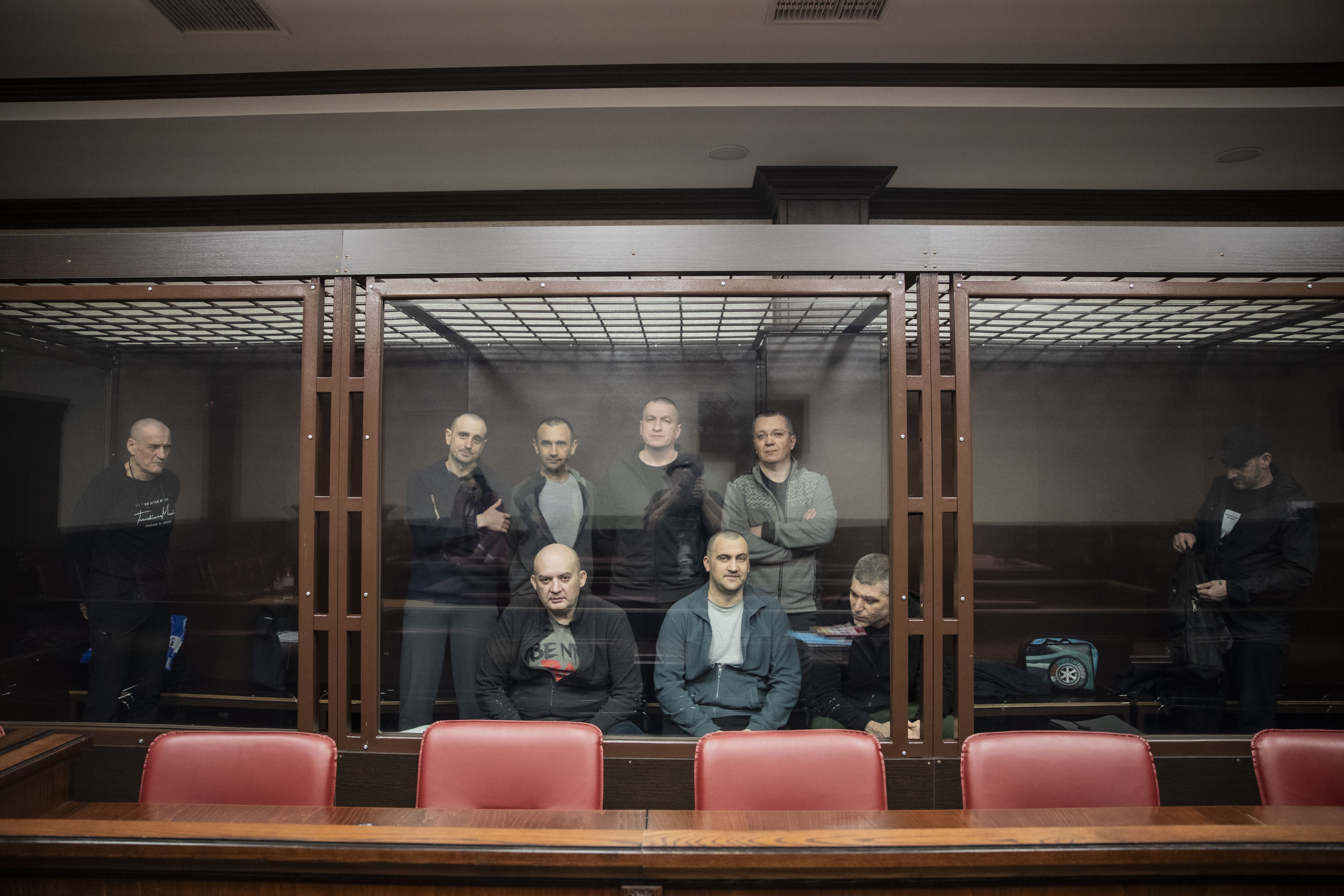
Russia’s notorious Southern District Military Court in Rostov has sentenced nine men abducted from Kherson in the summer of 2022 to terms of imprisonment, worse even than those demanded by the prosecutor. The aggressor state, which was then illegally occupying Kherson, charged Ukrainian citizens living in their own country with ‘planning acts of international terrorism’ and purportedly doing so on instructions from Ukraine’s Security Service [SBU]. The only ‘evidence’ against any of the men was that extracted through torture while the nine were held incommunicado.
All nine men were sentenced on 30 January 2026 to terms of maximum-security imprisonment, with the first five years in each case in a prison, the harshest of Russian penal institutions. It is unclear when these sentences are likely to be calculated from, as the men were all held incommunicado for a long time before Russia announced their ‘arrest’.
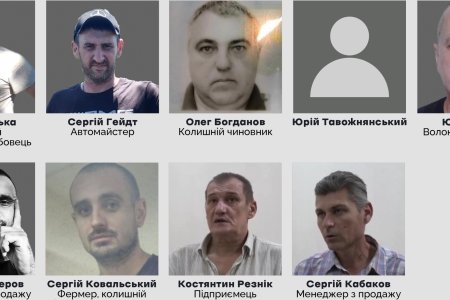
Kostiantyn Reznik (b. 1964) 20 years
Serhiy Kabakov (b. 1974) 20 years
Yuriy Tavozhniansky (b. 1980) 18 years
Oleh Bohdanov (b. 1972) 18 years
Serhiy Heidt (b. 1981) 17 years
Serhiy Kovalsky (b. 1990) 17 years
Serhiy Ofitserov (b. 1976) 17 years
Yuriy Kayov (b. 1984) 14 years
Denys Lialka (b. 1988) 14 years
They were handed down by presiding judge Kirill Nikolaevich Krivtsov and two colleagues. Krivtsov has already taken part in sentencing a huge number of Crimean Tatar and other Ukrainian political prisoners to long terms of imprisonment, and there were never any illusions about the outcome of this supposed ‘trial’.
The nine Ukrainians were seized by Russian soldiers at various times in July and August 2022. They were held incommunicado for at least two months in the illegal torture prisons that Russia set up in occupied Kherson, before first being taken to occupied Crimea and then to the Lefortovo SIZO [pre-trial detention centre] in Moscow. All were charged with ‘an act of international terrorism’, under Article 361 § 1 of Russia’s criminal code, and with ‘involvement in a terrorist organization’ (Article 205.4 § 2). Bohdanov; Kabakov; Reznik and Tavozhniansky faced extra charges under the same Article 361 § 1, with these of ‘planning an act of international terrorism’. The distinction seems rather arbitrary given the lack of any real evidence that the nine Ukrainians, or indeed anyone else, were implicated in actual attacks, with all the charges effectively of planning a supposed series of ‘terrorist attacks’ in occupied parts of Kherson oblast.
Among the supposed ‘terrorist attacks’ that the men were accused of was an attempt on the life of Kyrylo Stremousov, a Ukrainian collaborator installed by the Russians as so-called ‘deputy head of the military-civic administration’ and other Russian-installed collaborators. Stremousov was, undoubtedly, a legitimate target of attack, as were the Russian invaders he served. Even were Russia not in violation of international law by abducting Ukrainians from (then) occupied territory and prosecuting them under Russian law, the attempt to call any such planned attack ‘an act of international terrorism’ would be manifestly absurd. The relatively new Article 361 of Russia’s criminal code describes such an ‘act’ as an explosion, act of arson or other actions, committed outside Russia and jeopardizing the life, health, freedom or inviolability of Russian citizens “for the purpose of violating the peaceful co-existence of states and peoples, or aimed against the interests” of Russia. The aggressor state was doing anything but ensuring ‘peaceful co-existence’ and any ‘Russian citizens’ targeted had no right to be in Kherson.
The timing was also profoundly suspicious, with Stremousov killed on 9 November 2022, three months after the men were seized, but a day after Russian state media claimed that the nine men had been “arrested”. The men were referred to as “saboteurs from Ukraine’s Security Service, having planned terrorist attacks against local officials”. The FSB asserted that the men had joined a ‘sabotage gang created by SBU officer Samir Shukorov on 5 August that year and that they had received instructions to blow up Stremousov’s car. According to the FSB, Yuriy Kayov was supposed to prepare a homemade explosive device, filled with bolts.
Not only are there no grounds for claiming that the men were members of ‘a terrorist organization’, but there is nothing to suggest that most of them even knew each other. Serhiy Kovalsky and Denys Lialka may well have been targeted because of their former or recent role in Ukraine’s Armed Forces. Serhiy Ofitserov, in turn, could have been seized because he is Kovalsky’s uncle, but may well have angered the FSB because he has Russian citizenship, yet held a strongly pro-Ukrainian position. Yury Kayov was likely targeted because he had helped patrol the district after Russia’s full-scale invasion, and had then become a volunteer, working under the auspices of the Ukrainian Red Cross, getting humanitarian aid – food, medicines – from Zaporizhzhia to hospitals, etc. in occupied Kherson, as well as helping to evacuate people who urgently needed medical assistance. He was seized on 5 August 2022 however it was only on 6 October that year that the FSB admitted that he was in their custody. He has provided harrowing details of the torture he endured during those first months (details here). Serhiy Kovalsky and Denys Lialka were probably seized because of their former or recent role in Ukraine’s Armed Forces, while Ofitserov, who, due to family circumstances, has Russian citizenship, may have been targeted for his openly pro-Ukrainian position.
The ‘trial’ began in December 2023, with the defendants denying the charges, and telling the court about the torture which they had endured. Yury Kayov earlier provided shocking details of the torture to which they were subjected during the first two months. He had been savagely beaten and tortured with electric currents, and saw at least one other civilian hostage, and Denys Lialka tortured. He was suspended by handcuffs, being held in that position until he lost consciousness. There were eight or nine such rooms in this torture chamber basement, Kayov said, and he believed there to have been four or five such ‘basements’ in occupied Kherson.
“The torture was constant, from 6 in the morning until 10 in the evening. They would bring people and take them away. We were tortured and interrogated twice a day. They periodically took us away to different places, filmed staged videos (of the detention)”. They were also taken upstairs to a room containing the so-called ‘material evidence’ which Kayov says, he was forced to hold, so as to leave fingerprints, etc. on them. The men were also subjected to a mock execution, with two men taken from the cell, “and shot”, with the others left to believe that they were awaiting their ‘turn’. There was also a sadistic form of ‘Russian roulette’ which their captors played, using the men as targets. These same captors also occasionally took the men out and tortured them as a form of ‘self-assertion’. He was later told that a prisoner had died in another cell.
Kayov also recounted how an 11-year-old boy had been held prisoner in this hell for two weeks. “He spoke Ukrainian and cried at night. He was also taken to the torture room, but I don’t know whether they beat him.”
Russia’s FSB are notorious for holding people incommunicado, without any charges having yet been laid. Such periods are especially dangerous and are typically used for extracting ‘confessions’ (sometimes multiple variants) and fabricating evidence.
After charges have been formally laid, there is normally a degree of safety from direct torture, even if the conditions remove intolerable and tantamount to such torture. Here, however, the men’s refusal to be cowered, and the active role played by their lawyers, clearly riled the prosecution. It was learned in early April 2025, that the men were facing torture to try to force them to give up independent lawyers. Despite the men even being moved to another SIZO, one increasingly notorious for the torture of prisoners, the men remained defiant and their lawyers filed formal complaints. These are, unfortunately, fairly formal, given the complicity of all Russian players, including presiding judge Kirill Krivtsov who, for example, refused to have the men’s injuries from torture recorded.
These sentences are not final, and appeals will certainly be lodged. This was, however, a show trial, with all Russian courts likely to show the same disregard for the men’s rights.