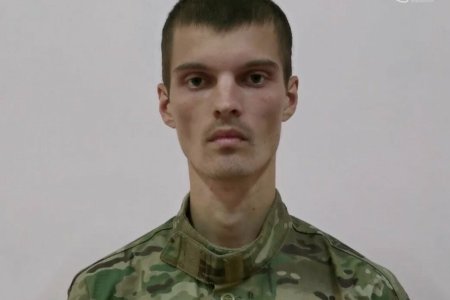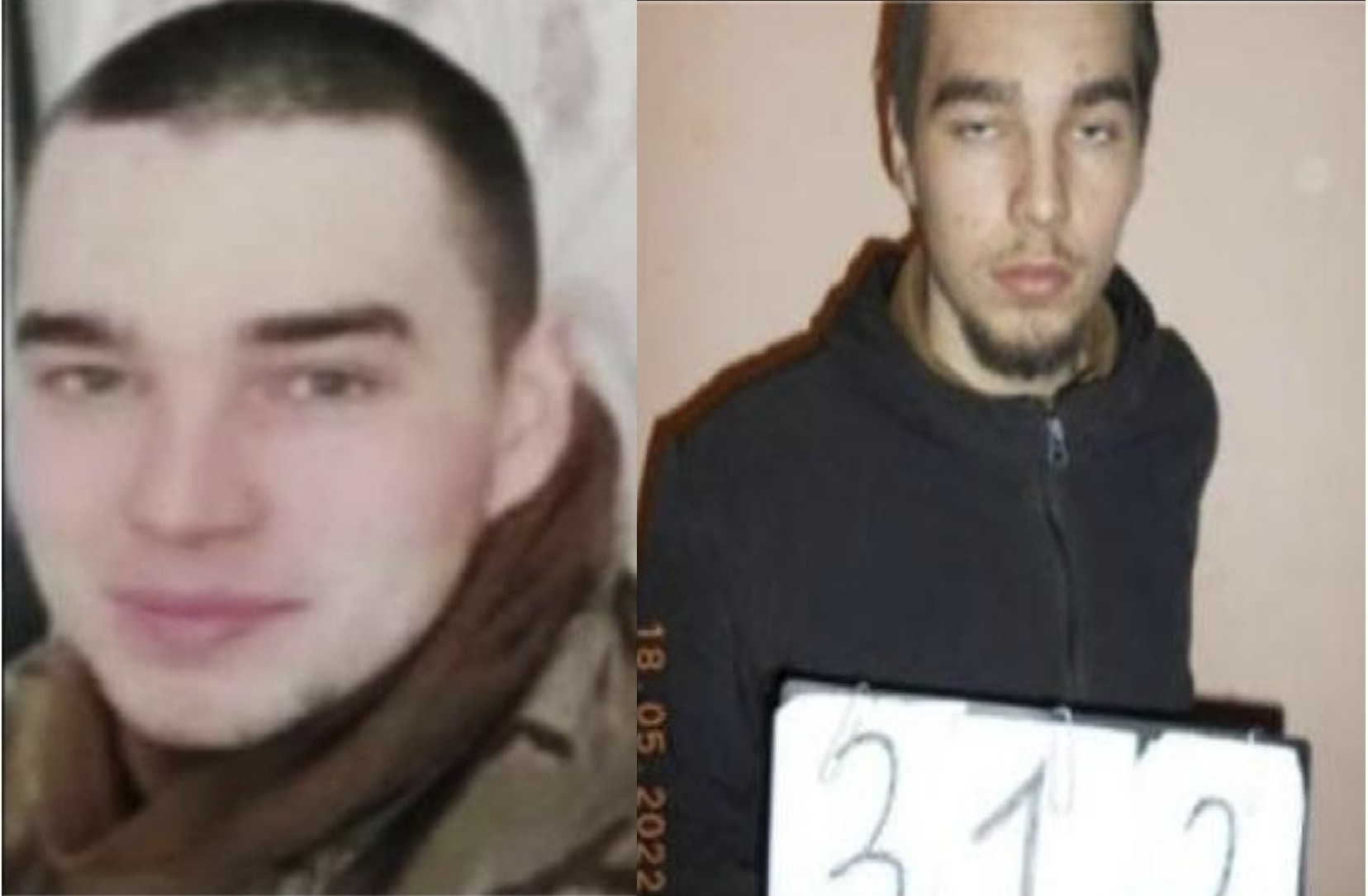
Ukrainian prisoner of war Bohdan Trofimiuk is only 23, yet he has spent over four years in Russian captivity and is reported to be unable to walk after particularly savage beating in a Russian prison. The brutality did not stop there, with Russia having since staged one of its cynical ‘trials’ of Ukrainian POWs, claiming that Bohdan’s defence of Mariupol as part of a regiment within the Ukrainian Armed Forces constituted ‘involvement in a terrorist organization’.
Bohdan Trofimiuk (b. 6 September 2002) is from Slavuta in Khelmnytsky oblast and trained to be a car mechanic after finishing school. He was just 18 in September 2020 when he chose to serve in Ukraine’s Armed Forces and, seemingly, followed a friend in joining the Azov Regiment. Speaking with KHPG’s Iryna Skachko, Inna Trofimiuk stressed that this was a conscious choice for her son, to serve and defend his country and its independence. Inna says that her son was responsible and mature for his age and carried through his decision. He left for Kyiv on 1 February 2021 and was already in Mariupol, where the Azov Regiment was based, three weeks later.
He was in Mariupol when Russia launched its full-scale invasion of Ukraine and began its siege of the city. He received two shell shock injuries, one on 1 March, the second, more severe, on 9 April. It was, in fact, from other lads from Slavuta that his mother learned of the injuries as Bohdan had said nothing, not wanting her to worry. Like all those whose loved ones were in Mariupol during those terrible months, she was frantic with anxiety, praying that her son would not be killed.
Bohdan, thankfully, survived but was taken prisoner on 17 May 2022, when he and other Ukrainian defenders were ordered by Ukraine’s Military Command to withdraw from the besieged Azovstal Steel Works. Russia’s apparent commitment to swiftly return the prisoners of war, in accordance with international law, soon proved to be so many empty words, with very many of the defenders of Mariupol, like Bohdan, still imprisoned over four years later.
From Azovstal, Bohdan and the other POWs were taken to the notorious Olenivka prison where the conditions alone were tantamount to torture. Bohdan was able to phone his mother just two times. She recalls that he spoke unnaturally slowly during the first call, which she assumes was because he still needed medical treatment for the former shell shock. That may be the reason, but Russia has savagely tortured the vast majority of Ukrainian prisoners of war, especially those taken prisoner while defending Mariupol. The second call, two days later, on 18 June lasted only seconds, and was the last direct contact between Inna and her son. Since then, like very many other relatives of prisoners of war and civilian hostages, she has received crumbs of information about Bohdan from other POWs whom the Russians finally released in prisoner exchanges.
In September 2022, for example, one of Bohdan’s commanders was freed and was able to pass on the most important information that Bohdan was alive and was recovering from his injuries. This was just over a month after the almost certainly deliberate explosion at Olenivka which killed over 50 Ukrainian prisoners of war, and Inna, like other mothers, would have been going through hell not knowing whether Bohdan was alright.
It was in July 2023 that Inna learned from a young man who had been imprisoned with Bohdan in the Horlivka prison colony (in occupied Donetsk oblast) that Bohdan was unable to walk. He had stopped walking after being so savagely beaten during the so-called ‘reception’ (rus. «приёмка») of prisoners that his fellow POWs feared that he would not survive. He seems to have been in a coma for some time, and it was thanks to a medic who had been with the men at Azovstal that he finally regained consciousness but does not appear to have walked since then.
The wife of one of the other prisoners, released in a 2023 exchange, phoned Inna and spoke of how her husband was grateful to Bohdan. “That it was my son who had such a strong character that , even bedridden, he provided support to the lads, helped their psychological state.”
In September 2024, several prisoners who had been in the same prison as Bohdan contacted Inna after their release. She learned from them that Bohdan was still not walking and was even in a wheelchair with the other POWs helping him. She believes he was taken to another prison in Altai region at the end of 2024 but was at the Saransk SIZO [remand prison] No. 1 in Mordovia in 2025. Bohdan was held in Saransk when Russia staged its blitzkrieg ‘trial’ at the beginning of 2026.
These are conveyor belt ‘trials’ and sentences, with Russia using a politically motivated Russian supreme court ruling from 2 August 2022 which declared the Azov Regiment within Ukraine’s Armed Forces, to be ‘a terrorist organization’. The ruling was widely understood to be a ploy aimed at justifying Russia’s revenge against imprisoned Ukrainian defenders of Mariupol, many of whom were from the Azov Regiment. Prisoners of War have protected status; and international law clearly prohibits their prosecution for military service. Russia’s use of surreal ‘terrorist’ charges against POWs also runs roughshod over the fundamental principle that the law is not retroactive since the vast majority of POWs against whom such charges have been laid, including Bohdan Trofimiuk, were taken into Russian captivity months before the Azov Regiment was declared ‘terrorist’.
The charges, based solely on that flawed ruling, are under two provisions of Russia’s criminal code. Article 205.4 punishes for supposed ‘involvement in a terrorist organization’, while Article 205.3 is supposedly about ‘undergoing training in terrorist activities’. There is effectively no possibility that ‘judge’ Andrei Vasilievich Slepukhin was unaware that the nine sentences he churned out against Ukrainian POWs during the first week of February 2026 violated the Third Geneva Convention and the men’s basic right to a fair trial. On 6 February 2026, Slepukhin convicted Bohdan Trofimiuk of ‘involvement in a terrorist organization’ and ‘training in terrorist activities’ and, seemingly, sentenced him to 16 years’ maximum-security imprisonment. There was no attempt to even imitate a real trial with hearings before sentence was passed. The ‘lawyer’ he had was provided by the prosecution, and his mother has learned that he rejected her services immediately after the sentencing. No consideration was taken of Bohdan’s age, nor his evident need of proper medical care, with this the direct result of the torture to which he was subjected in Russian prisons.