Mediazona reports that over a thousand Russian citizens have been murdered or beaten to death by Russian soldiers since 2022, with the perpetrators evading punishment by returning to the front. Where sentences are passed, these are often more lenient than would otherwise be the case, with the victim’s criticism of Russia’s war against Ukraine on several occasions treated as an ‘extenuating circumstance’.
Mediazona’s study has looked in many cases at professional soldiers, not the huge numbers of convicted criminals, including many murderers, recruited from prison colonies. A separate study recently found that just in the first six months of 2025, as many as 25 thousand men had criminal proceedings terminated, or sentences waived by agreeing to kill Ukrainians.
Russia began recruiting convicted prisoners in the summer of 2022. This was initially presented as Yevgeny Prigozhin recruiting for ‘his’ Wagner private military company’. The latter had, however, worked closely with the Russian defence military in both Ukraine and Syria, and the recruitment was clearly in agreement with the Kremlin, whose leader, Vladimir Putin, was, after all, responsible for signing the prisoners’ pardons. By 2023, the defence ministry had taken over, and, as of 2025, there have been reports that men who do not want to agree to fight are subjected to beatings and / or threatened with additional sentences if they don’t sign the military contract.
In 2024, Russia broadened its scope with a new law allowing men to agree to fight in Ukraine at any stage of proceedings, with cases simply dropped if this is at criminal investigation level. It is also significantly easier to put pressure on men in SIZO [remand prison] and to threaten them with substantially increased charges if they refuse to ‘cooperate’.
It is because of this recent law that soldiers are escaping punishment for even the most violent crimes newly committed by agreeing to go or return to the front. With criminal investigations terminated, the families of victims are left with a situation where nobody has been held to answer for their relative’s murder and with no chance of even the pitiful amounts of compensation that would normally be awarded. Mediazona writes that families very often only learn that the person convicted of their loved one’s murder has been released when they discover that compensation orders have been revoked.
While killers, rapists and perpetrators of other violent crimes may never spend more than a few days in detention, Ukrainians, abducted from occupied territory, as well as Russians who speak out against the war are being sentenced to 15-20 years, or more, on fictitious ‘terrorism’, ‘sabotage’ or ‘spying’ charges, or imprisoned for 7 years or more for telling the truth about Russian war crimes. Unlike in most cases where a sentence was for a real crime, such political prisoners have zero chance of being released early, except in inter-state prisoner exchanges. It has also become tragically clear that even gravely ill Crimean Tatar or other Ukrainian political prisoners will not be released even where Russian legislation prohibits their imprisonment.
Mediazona scrutinized ten prosecutions which did result in sentences passed against Russian military servicemen. Nine of the men did not serve any term of imprisonment, but returned to the front, where many either received serious injuries, or are classified as missing in action.
In all the cases examined, the soldiers had been drunk when they killed their victim. According to Russia’s criminal procedure code, that is an aggravating circumstance, yet in no case did it influence the sentence. The courts, however, had treated the fact that the killers’ victims had criticized Russia’s so-called ‘special military operation’ [its war of aggression against Ukraine] as an extenuating circumstance. It was deemed, Mediazona writes, “the victim’s unlawful behaviour”
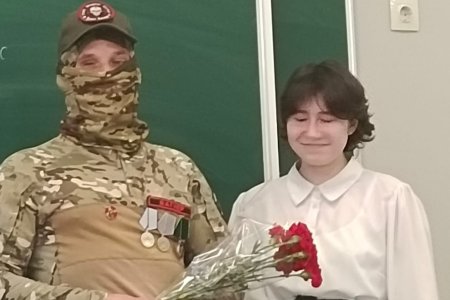
The Russian authorities have largely failed to avoid publicity in especially shocking cases where former rapists and killers were released and then killed again after returning from Ukraine. With respect to professional soldiers, the discipline appears to be greater, with Mediazona noting that the court press services seldom reveal any information about soldier prosecution. When asked, several courts asserted that they did not provide details which would make it possible to identify former or current “participants in the special military operation” or their families. Russia treats all such ‘participants’ as war ‘heroes’ and even sends many of them into schools to ‘teach children about courage’. The courts’ sudden reticence is, clearly, about concealing embarrassing information, not about protecting the soldiers’ privacy. The reticence is clearly contagious, with such cases seldom reported by local or national media.
It is much harder to even follow such cases where prosecution is terminated at criminal investigation stage.
Russia is notorious for treating fighters as cannon fodder, and the chances are clearly high that men who avoid long sentences or prosecution by agreeing to fight against Ukraine will be killed in action. The Russian defence military has long done away with the original deal offered to convicted prisoners which saw many able to return, free and ‘pardoned’, after a relatively short amount of time. They will, however, be released if badly injured, with this also applying to those first-time confessed killers, even those accused of horrific crimes.
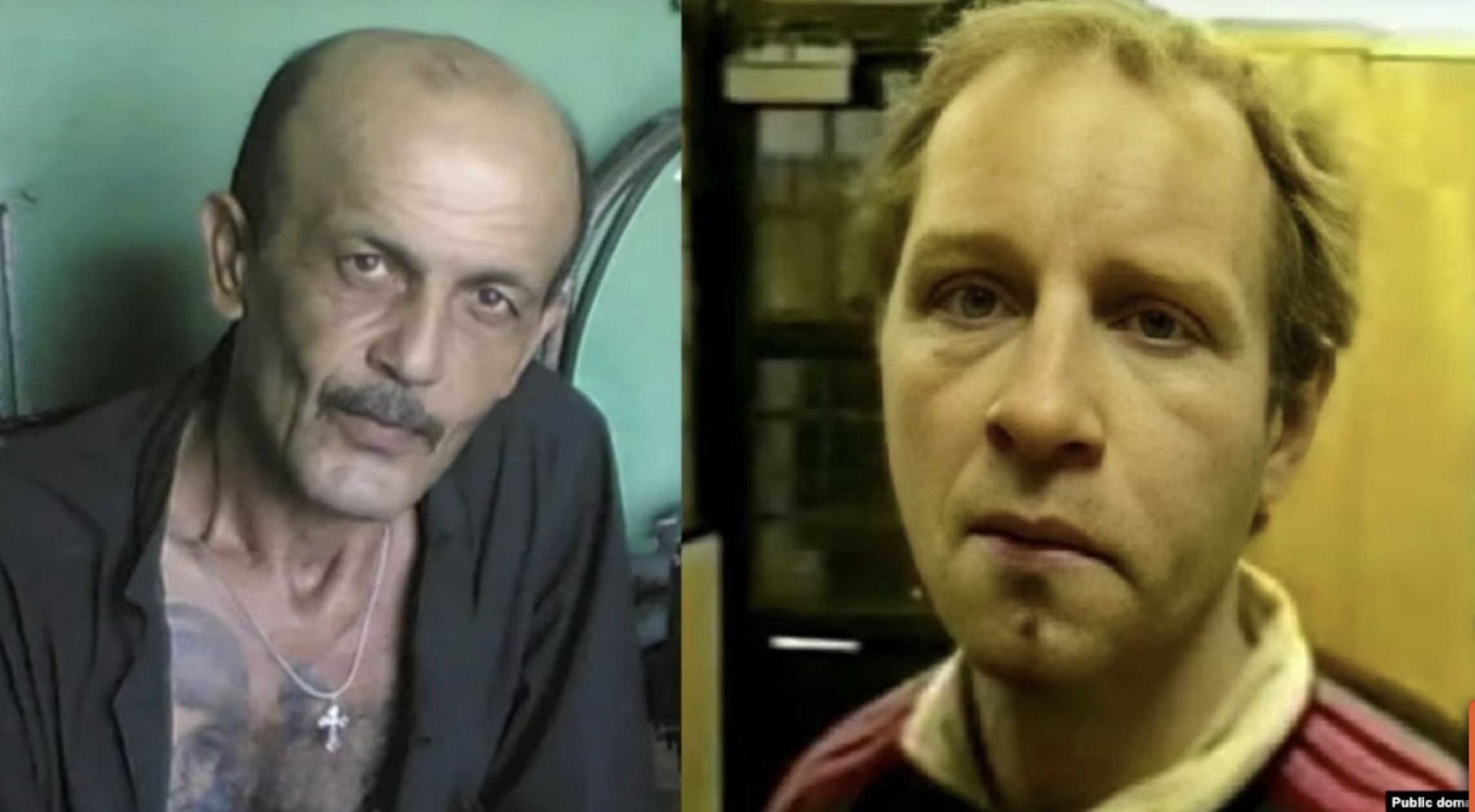
They include Alexander Gook, a 49-year-old lawyer from Sverdlovsk oblast, who almost certainly killed and dismembered 42-year-old Olga Soroka and murdered her six-year-old son. Olga’s head was found in a compost heap, with Gook believed to have dumped other parts of her body in plastic bags and dumped them, together with the child’s body, in a rubbish bin.
The victims’ families are appalled that Gook was never even put on trial with the ‘case’ terminated soon after charges were laid against him.
In an article entitled ‘Machine guns issued to maniacs’, Siberian Realities described how, for example, two multiple killers had been taken on by Russia’s defence ministry. The latter, in 2025, signed a contract with 64-year-old Vagan Sarafyan, who was awaiting trial for a double murder, with this only a couple of years after he served an 18-year sentence for another murder.
Serial killer Yuri Gritsenko was a year younger when, in 2024, he signed a contract with the defence ministry, with this enabling him to end a 22-year sentence slightly early. Because of his physical state of health, he was not sent into battle but added to a medical evacuation unit. No concern appears to have been felt about the wisdom of sending a person who had already served a 9-year sentence for one murder when, in 2001, he attacked at least 15 women in Moscow and Moscow region, killing four of them. The attacks were savage and carried out with a hammer.
See also
Gruesome murders as ‘collateral damage’ in Russia’s use of criminals for war against Ukraine
Prisoners beaten, threatened with new sentences to force them to fight Russia’s war against Ukraine
Russia' s new ' elite' : hired killers, murderers and violent rapists freed to fight against Ukraine
Agree to kill Ukrainians and Russia will free all but political prisoners