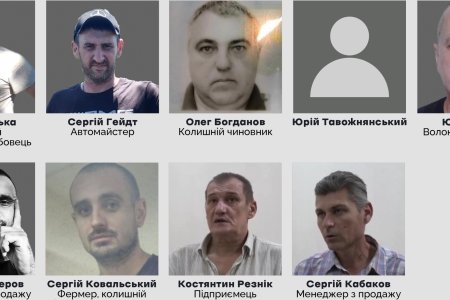
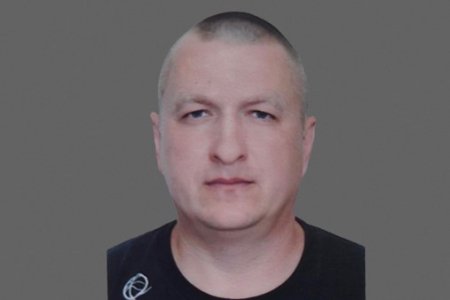
A Russian prosecutor has demanded sentences of 15 to 19 years against nine men abducted from Kherson in the summer of 2022, held incommunicado and tortured for the ‘confessions’ used as sole basis for grotesque charges’. The ‘Kherson Nine’ political prisoners, most of whom did not know each other before their abduction, have described in detail the torture they endured both in the first months, and more recently, in Russian SIZO, or remand prisons. The entire ‘case’ if of extraordinary illegality, with the Russian invaders having abducted Ukrainian citizens from Ukrainian territory and accused them, under Russian legislation, of ‘international terrorism’ (Article 361 § 1 of Russia’s criminal code) and of ‘involvement in a terrorist organization’ (Article 205.4 § 2.
Russia introduced ‘acts of international terrorism’ to its criminal code back in 2016 but seems to have only begun using it after its full-scale invasion of Ukraine. An ’act of international terrorism’, according to Article 361, refers to an explosion, act of arson or other actions, committed outside Russia and jeopardizing the life, health, freedom or inviolability of Russian citizens “for the purpose of violating the peaceful co-existence of states and peoples, or aimed against the interests” of Russia. The scope for abuse of this charge, like many others used in political trials, is massive. You can be convicted under this article for “a threat to commit such actions”, with such a ‘threat’ likely to be backed solely by ‘evidence’ or ‘testimony’ obtained by the FSB while a person was under their total control and without access to a lawyer.
The FSB accused the defendants of planning “a series of terrorist attacks” in occupied Kherson oblast, including attempts on the life of Kyrylo Stremousov, a Ukrainian collaborator installed by the Russians as so-called ‘deputy head of the military-civic administration’ and other Russian-installed collaborators.
Stremousov was killed three months later on 9 November 2022, two days before the liberation of Kherson and a day after the nine men’s ‘arrests’ were announced, with this, in turn, many months after the actual abductions.
It was only on 8 November 2022 that Russian state media claimed that the nine men had been “arrested”, although the accompanying video was clearly from the summer of that year. The men were referred to as “saboteurs from Ukraine’s Security Service, having planned terrorist attacks against local officials”. The FSB asserted that the men had joined a ‘sabotage gang created by SBU officer Samir Shukorov on 5 August that year and that they had received instructions to blow up Stremousov’s car. According to the FSB, Yuriy Kayov was supposed to prepare a homemade explosive device, filled with bolts. The charge of ‘international terrorism’ does not withstand scrutiny. Stremousov was an entirely legitimate target, and even if the aggressor state wanted to justify the use of Article 361 by asserting that the attempt might have killed civilians, these should, according to Russia’s description of ‘international terrorism’, have been Russians – those very Russians who were in Kherson as invaders, and were therefore also legitimate targets.
The men’s ‘trial’ began in September 2023 at the notorious Southern District Military Court in Rostov. The presiding judge Kirill Nikolaevich Krivtsov, and prosecutor (at least earlier) Sergei Aidinov having taken part in many politically motivated ‘trials’ in which convictions and long sentences are guaranteed. There are, unfortunately, no grounds for hoping that this travesty of a trial will be in any way different.
On 15 January 2026, the prosecutor demanded the following sentences, with the first five years in a prison, the harshest of Russia’s penal institutions, with the remainder in maximum-security prison colonies.
Oleh Bohdanov (b. 1972) 18 years;
Serhiy Heidt (b. 1981) 16 years;
Serhiy Kabakov (b. 1974) 19 years;
Yuriy Kayov (b. 1984) 15 years;
Serhiy Kovalsky (b. 1990) 16 years;
Denys Lialka (b. 1988) 15 years;
Serhiy Ofitserov (b. 1976) 17 years;
Kostiantyn Reznik (b. 1964) 19 years;
Yuriy Tavozhniansky (b. 1980) 18 years.
Aside from Serhiy Ofitserov and his nephew, Serhiy Kovalsky, who were both abducted on 3 August 2022, it is likely that none of the other men even knew each other, Kayov was likely targeted because he had helped patrol the district after Russia’s full-scale invasion, and had then become a volunteer, working under the auspices of the Ukrainian Red Cross, getting humanitarian aid – food, medicines – from Zaporizhzhia to hospitals, etc. in occupied Kherson, as well as helping to evacuate people who urgently needed medical assistance. He was seized on 5 August 2022 however it was only on 6 October that year that the FSB admitted that he was in their custody. He has provided harrowing details of the torture he endured during those first months (details here). Serhiy Kovalsky and Denys Lialka were probably seized because of their former or recent role in Ukraine’s Armed Forces, while Ofitserov, who, due to family circumstances, has Russian citizenship, may have been targeted for his openly pro-Ukrainian position.
All of the men have been firm in denying the baseless accusations against them and have spoken of the torture to which they were subjected. It is, unfortunately, quite possible that such refusal to be cowered, and openness about the torture have led to the men facing effective reprisals. It became clear in early April 2025 that the men were facing torture to force them to give up independent lawyers (see: Lawyers of nine Ukrainian political prisoners abducted from Kherson demand action over their systematic torture in Russian captivity)
The next hearing is scheduled for 28 January.