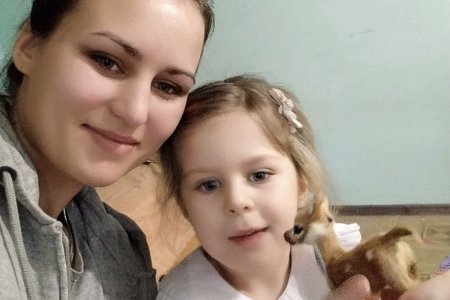
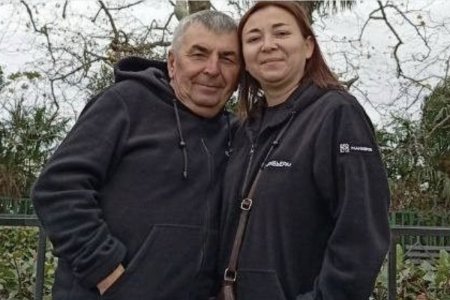
Two more victims of Russian enforced disappearances have ‘been found’ – both in Crimean occupation ‘courts’. 15 months after seizing Sakha Manhubi and then denying any knowledge of her whereabouts, Russia’s FSB have formally accused the young single mother of ‘state treason’. The young woman’s ‘arrest’ comes just days after 53-year-old Yevhen Hudenkov from Sevastopol was sentenced to 17 years, with the sentence effectively the first information about Hudenkov since news of his disappearance in October 2024. There remains either minimal or no information about a number of other Crimeans, both men and women, who vanished after armed searches or similar actions by the occupation enforcement bodies.
Yevhen Hudenkov
Crimean Process reported on 27 January 2026 that the Russian occupation ‘Sevastopol city court’ had found Yevhen Hudenkov guilty of ‘state treason’ under Article 275 of Russia’s criminal code, as well as of possession of explosive devices (Article 222.1 § 3b). He was sentenced to 17 years’ maximum-security imprisonment, as well as a 400 thousand rouble fine.
The most striking aspect of this case, Crimean Process notes, is that information was first circulated by volunteers from ‘Lisa Alert’ about Hudenkov’s disappearance on 29 October 2024. In exactly the same way, information was circulated about the disappearance of Dmytro Myskov in September 2024.
As reported, 45-year-old Myskov, who is from Sevastopol, was sentenced by the same occupation ‘Sevastopol city court’ to 14 years’ maximum-security imprisonment on 26 August 2025. He was accused of having passed on information about the places of deployment of Russian Black Sea Fleet ships from July to September 2024, with this supposedly for Ukraine’s Security Service.
The sentence against Hudenkov was yet another of those passed by Russian ‘judge’ Danil Zemlyukov, who was illegally brought to occupied Crimea from the Altai region in the Russian Federation. This individual was responsible for passing horrific 12-year sentences against Victoria Strilets, who has MS, and her daughter Oleksandra Strilets. Both sentences were recently upheld despite Victoria’s condition and the fact that Oleksandra has two small daughters, one of whom was in intensive care when Oleksandra was first taken prisoner. Zemlyukov also recently massively increased the politically motivated sentence against Yellow Ribbon activist Ksenia Svietlishyna.
All of these supposed ‘trials’ take place behind closed doors, with an ever-increasing number, as in the case of Hudenkov, against people who had been held totally incommunicado for over a year. The charges are also very near identical from ‘trial’ to ‘trial’, with the main difference being in the specific dates that the ‘spying’ / ‘treason’ is alleged to have occurred. In this case, Hudenkov was claimed to have been recruited by a member of Ukraine’s Military Intelligence for ‘confidential cooperation against the security of the RF’ from January 2023 to October 2024. He was supposed to have photographed and collected information about anti-aircraft positions of the RF armed forces and passed these to Ukraine’s Military Intelligence. He was also accused of having moved explosive devices and substances from a hiding place to his home and then placed them in another hiding place.
Sakha Manhubi
Crimean Tribunal is, doubtless, correct in calling 28-year-old Sakha Manhubi the first Karaim political prisoner in occupied Crimea. Citing the Irade Human Rights Initiative, Crimean Tribunal reported on 2 February 2026 that the occupation ‘Kievsky district court’ in Simferopol had, over the last few days, remanded Manhubi in custody on ‘treason’ charges, under Article 275 of Russia’s criminal code.
Russia’s FSB had, thus, held the young woman in captivity, totally incommunicado and without any formal status for almost exactly 15 months. As reported, Sakha was bringing up two small children, a son and daughter, by herself, with her parents looking after the children while she was at work. She disappeared on 2 November 2024, with her mother later learning that she had been taken away by men in masks who provided no explanation but were clearly from Russia’s FSB. They had carried out a search of the apartment before taking the young woman away.
Sakha’s mother reported her apparent abduction to the occupation police. Having heard nothing from them in a week, she phoned to ask if her daughter had been reported as missing. It was only then that she was told to come in and given a piece of paper saying that her daughter had been taken away by Russia’s FSB. Over the following six months, the family’s formal requests for information went unanswered by the FSB, yet when they then approached the occupation ‘police’ they were told that the latter “do not divulge information linked with the FSB”. From then on, they sent questions to the occupation prosecutor, the military prosecutor and even the ombudsperson, receiving only fob-off replies. There was, however, a response, finally, from the FSB, denying any knowledge of Sakha Manhubi.
Unofficially, the family were told that the FSB had received three anonymous denunciations against Sakha. The current Russian regime has reinstated and positively encourages Soviet-era denunciations, however this would not explain why the young woman was held in isolation for over a year, before charges were laid.
It cannot be said that the charge is any great surprise, but only because it has become a standard weapon of Russian persecution on all occupied territory. It was also known several months ago, through a person briefly held in a cell with Sakha, that she was held in SIZO No. 2, one of two remand prisons which the Russians opened after the full-scale invasion of Ukraine. SIZO No. 2 is believed to be under the control of the FSB, and to be used for political prisoners.
Lera Dzhemilova
It seems that, after holding people incommunicado and denying their imprisonment for months or longer, the occupation regime is willing to boast of such persecution more than once. 28-year-old Lera Dzhemilova had been held incommunicado for almost a year when ‘judge’ Anna Khinevych from the occupation ‘Crimean high court’ sentenced her to 15 years on 20 August 2025. The same mystery ‘treason’ charges were applied here too, and then reported again, on 30 January 2026, as though the sentence had only just been passed. Since the notorious Crimean SMERSH and Russian propaganda media mention that the sentence has come into force, there was possibly an appeal ‘heard, and typically rejected, by the same occupation ‘Vrimean high court’.
The sentence against Lera Dzhemilova is of particular concern as the young woman suffers from epilepsy and should not be in the appalling conditions of Russian / Russian occupation captivity.
Crimean Tribunal noted that human rights groups are aware of at least 20 Crimeans who are being held incommunicado after enforced disappearances. The number may, unfortunately, be much higher.
See:
Niyara Ersmambetova
Abducted Crimean Tatar mother of two sentenced to 15 years on Russia's cynical ‘treason’ charges
Lera Dzhemilova
Anatoliy Kobzar
From enforced disappearance to imprisonment: Anatoliy Kobzar found after 19 months of Russian lies
Ismail Shemshedinov
Oleh Platonov and Natalia Poliukh
Russian FSB abduct Crimean couple, place their child in care
Tamara Chernukha
Serhiy Hrishchenkov
Ruslan Mambetov Crimean Tatar sentenced to 18 years in Russian secret ‘trial’ where only torture is near certain
Roman Hryhorian Ukrainian seized in Crimea and sentenced to 12 years for donations to Ukraine's defenders
Victoria Strilets and her daughter Oleksandr Strilets
Oksana Senedzhuk Russia rubberstamps 15-year ‘treason’ sentence against 58-year-old Crimean activist Oksana Senedzhuk
Liudmyla Kolesnikova Russian FSB abduct Ukrainian from her mother’s funeral in occupied Crimea
Nina Tymoshenko Russia’s most savage sentence yet against 66-year-old Ukrainian woman from occupied Crimea
Serhiy Lykhomanov
Russia sentences abducted Crimean to 15 years in second secret ‘trial’ on same absurd charges