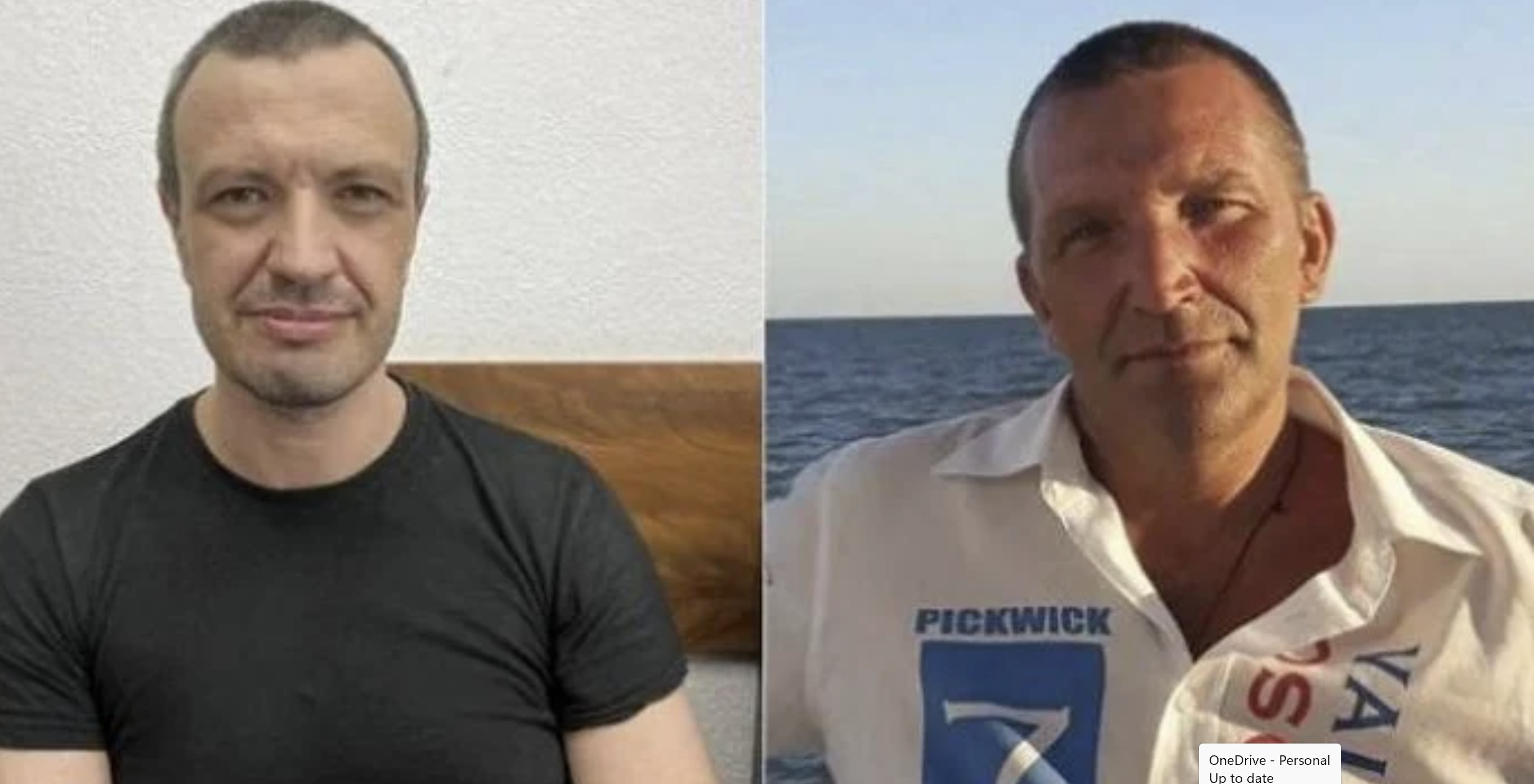
Russia’s supreme court has upheld a 12-year sentence passed two years after Vitaliy Rastorhuev was abducted by an invading army from his home in Berdiansk and tortured into ‘confessing’ on video to ‘attempting an act of international terrorism’. The court chose to ignore not only Russia’s manifest violation of international law, but also such telling discrepancies as the fact that the prosecution later claimed that Rastorhuev had been ‘arrested’ at the end of December 2022, almost six months after the videoed ‘confession’.
Vitaliy Rastorhuev (b. 09.10.1976) and his friend, Volodymyr Kryvtsun (b. 17.04.1970) were abducted from occupied Berdiansk on 13 July 2022. Both men disappeared, with nothing known of their whereabouts until June 2023, when the Crimean Human Rights Group learned that they were being held in the notorious SIZO No. 2, one of the new remand prisons Russia opened after its full-scale invasion of Ukraine in 2022. SIZO No. 2 is believed to be under the control of Russia’s FSB and is used solely for the huge and ever-increasing number of political prisoners.
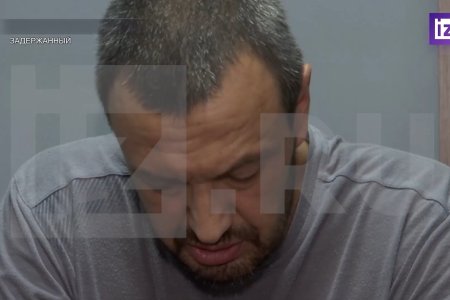
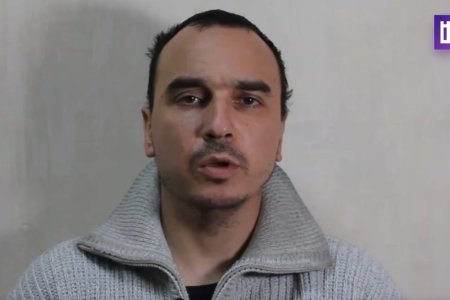
Rastorhuev had, however, been shown on a propaganda video posted by Russian media in August 2022, ‘confessing’ to plans to blow up the car of Oleksandr Saulenko, a collaborator, appointed by the Russian invaders as head of the occupation ‘Berdiansk military administration’ on 16 July 2022.
Saulenko and another collaborator, referred to by Rastorhuev as Borovko, were entirely legitimate targets, however there is every reason for scepticism about such ‘confessions, and not only because they were made when Rastorhuev was held incommunicado, without any official status, and therefore under the absolute control of his captors. He was seemingly only formally remanded in custody for the first time on 30 December 2022, with the months or longer that a person is held in such legal limbo typically used to extract ‘confessions’ through torture.
The ‘confession’ also seemed to ‘tick off’ all the requirements for applying the relatively new Article 361 of Russia’s criminal code, i.e. ‘an act of international terrorism’. The Russian state-controlled RIA Novosti report claimed to be quoting Rastorhuev himself in asserting that he had been planning to detonate the bomb near the Mayak House of Culture. He had allegedly asserted that “the plan was not to eliminate Saulenko and Borovko. On that date, a city event was planned at the Mayak House of Culture which was to be attended by civilians, including people living in Russia.” The FSB also invariably extracts ‘confessions’ that imply a mercenary motive or similar, rather than patriotism, for why a person works for Ukraine’s SBU or Military Intelligence. In this case, Rastorhuev had supposedly been offered help both in getting his family out of occupied territory and “with a large loan”.
Although the indictment was passed to Russia’s Southern District Military Court on 8 August 2023, nothing more was really heard until 18 April 2024 when both Rastorhuev and Kryvtsun were convicted of ‘planning an act of international terrorism’ under Article 361 § 1 (and 30 § 3) of Russia’s criminal code. Rastorhuev was sentenced to 12 years’ ’ maximum-security imprisonment, Kryvtsun, as alleged ‘accomplice, to 11 years. Presiding ‘judge’ Aleksei Abdulmazhitovich Magomadov and two colleagues from the Southern District Military Court ordered that the first three years of each sentence be in a prison, the harshest of Russia’s penal institutions.
Both sentences were upheld by the Vlasikha military court of appeal in Moscow region on 5 November 2024.
The cassation appeal rejected on 2 April by Russia’s supreme court appears to have been lodged only by Vitaliy Rastorhuev.