Russia has added the Kharkiv Human Rights Protection Group [KHPG], numerous organizations linked with Memorial, including the vital Memorial Support for Political Prisoners Project, and OVD.info to its notorious register of so-called ‘terrorists and extremists’. The move, like previous attempts to crush Memorial and other human rights organizations, is clearly aimed at silencing voices in defence of Russia’s ever-mounting number of political prisoners, including those from occupied parts of Ukraine.
The ‘Register of Terrorists and Extremists’ is compiled by Russia’s Rosfinmonitoring and has long contained a huge number of recognized political prisoners. For organizations working in Russia or, unfortunately, occupied parts of Ukraine, inclusion on the register means the blocking or freezing of bank accounts, financial and other assets; a ban or restrictions on financial and banking operations and on business activities. While inclusion on the register does not, in theory, mean that a person is legally designated a ‘terrorist’ or ‘extremist’, try explaining that to the FSB if they arrest you for reposting or quoting something which the given individual or organization has published. The First Department [Pyerviy Otdel] Human Rights Initiative notes that media, donors or simply those who use a particular website can face criminal prosecution for ‘financing an extremist or terrorist organization’ if the FSB find any evidence of cooperation. While subscribing is not (for the moment) prohibited, a repost can be claimed to constitute the circulating of ‘extremist information’, etc. In August 2025, a Russian court sentenced Sergei Davidis, Head of the Memorial Support for Political Prisoners Project, to six years for calling Ukrainian prisoners of war charged with supposed ‘terrorism’ political prisoners. It was claimed that Davidis has been ‘justifying terrorism’. While Davidis’ sentence was, thankfully, passed in absentia, any Russian or Ukrainian from occupied territory posting truthful information either about that ‘trial’ or about the persecution of Ukrainian POWs could themselves end up imprisoned. This has happened on countless occasions in occupied Crimea, with Crimean Tatar civic journalists like Remzi Bekirov, Seiran Saliyev, Osman Arifmemetov and Crimean Solidarity coordinator Server Mustafayev sentenced to massive terms of imprisonment after they refused to be silenced.
In its previous attempts to crush International Memorial and the Memorial Human Rights Centre in 2021, the Moscow Prosecutor’s Office claimed that the latter organization’s materials contained “elements of the justification of extremism and terrorism”. Here too, this referred to the organization’s list of political prisoners, as well as material on individual cases where, for example, Crimean Tatars and other Ukrainians are imprisoned as Jehovah’s Witnesses or for alleged involvement in Hizb ut-Tahrir.
After both organizations were forcibly dissolved, the Memorial Human Rights Centre’s work was largely continued by the Memorial Support for Political Prisoners Project. On 18 February 2026, after the International Memorial Association was declared ‘an undesirable organization’,, the Association’s board explained that, in 2023, “members and staff of the liquidated International Memorial who left Russia, together with European Memorial organizations, established the International Memorial Association under Swiss jurisdiction in order to continue their work in exile, under conditions of war.”
Then, on 9 April 2026, Russia’s supreme court declared something dubbed “the International Memorial Public Movement’ an ‘extremist organization’. Its ‘hearing’ was behind closed doors, with the case classified as ‘top secret’ and the Memorial lawyer not allowed to be present. The Memorial Human Rights Defence Centre issued a statement immediately, pointing out there is no organization of that name, but recognizing that the lack of clarity was likely to be deliberate. “This will create the preconditions for subsequent repression in Russia against any “Memorial-affiliated” organisations, their participants, and supporters.”
Following the news on 4 June, the Memorial Support for Political Prisoners Project noted that Rosfinmonitoring had added over 30 organizations, including theirs, to the ‘register of terrorists and extremists’, presumably viewing all of them as “structural sections of the non-existent ‘International Memorial Public Movement’. The list of organizations has shown that the scale of the lawlessness is even greater than feared, with civic organizations and initiatives included that have nothing to do with Memorial.
This is true of OVD-Info, whose many years of human rights, educational and information work “have well-earned them the gratitude and support of millions of people.”
It is wrong also in the case of the Kharkiv Human Rights Protection Group, which is a completely separate organization. That, however, is less important as KHPG is a Ukrainian civic organization existing in a country which does not use courts and criminal prosecutions to try to crush human rights activities and freedom.
The seriousness of the situation and the danger people could be in because of the new developments are reflected in the disclaimer that the Memorial Support for Political Prisoners Project has been posting on material and on its website since the 17 April ruling. The statement reads that “All assessments of the criminal prosecution of specific people, including the recognition of people deprived of their liberty as political prisoners, express the position of our Project. Such assessments are not based on the opinion and assessments of those persecuted themselves, nor their relatives, friends or lawyers, and do not assume their agreement or approval. Information about the factual circumstances of specific criminal cases, posted on our Project’s resources, were obtained from open sources, and similarly do not assume, nor require the consent of people mentioned in them, or their representatives.”
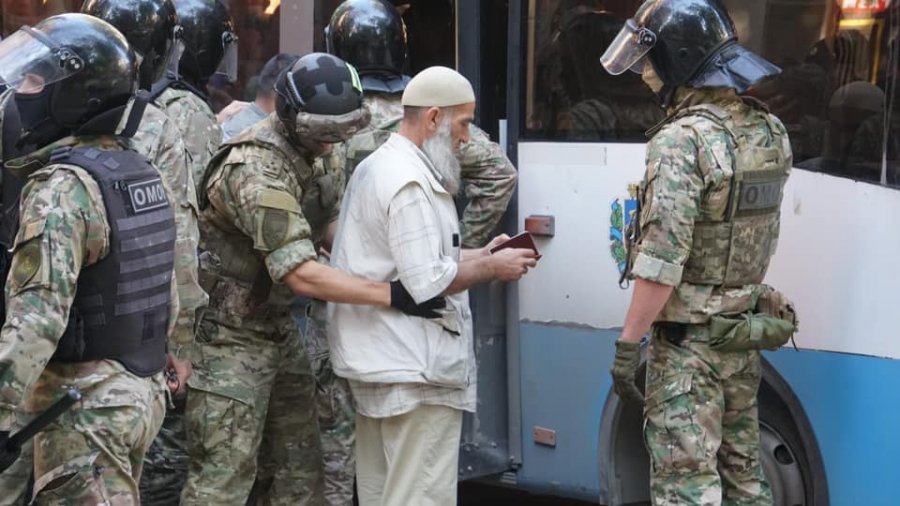
The methods Russia uses to crush dissent and voices in support of victims of repression have long been seen in occupied Crimea, where the FSB have resorted to monstrous charges, resulting in sentences of up to 20 years, against members of the Crimean Solidarity human rights movement, and where some Crimean Tatar and other Ukrainian civic activists were abducted and never seen again. On other occupied territory, Russia has so clamped down on information and on any freedom of speech that it is often extremely hard to find out even the names of victims of persecution.
This is very clearly what Russia is trying to achieve. It is critically important that Russia is prevented from succeeding and that those living beyond the reach of Russian repression make sure that the victims are known and that pressure is brought to bear to secure their release.