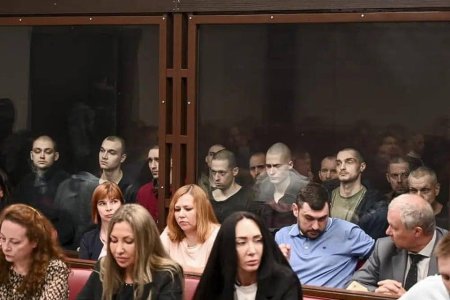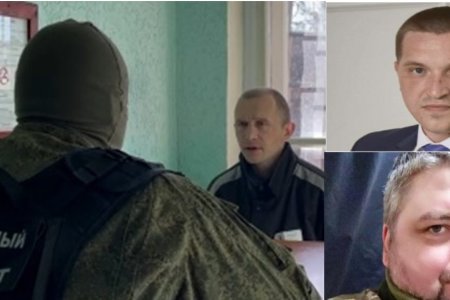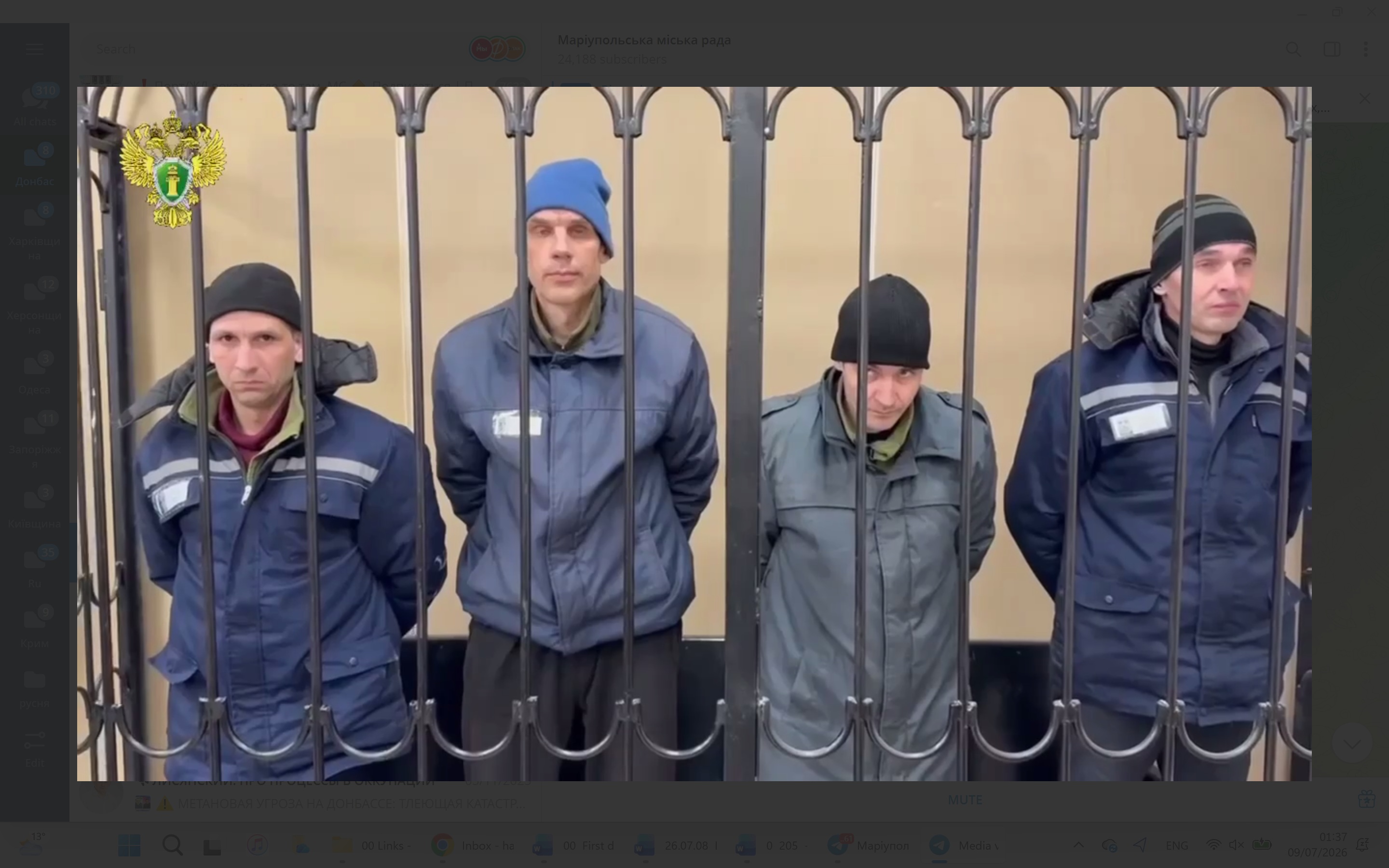
Russia has yet again used an illegal occupation ‘court’ to sentence Ukrainian prisoners of war to life imprisonment for defending their country. Volodymyr Baraniuk, Commander of Ukraine’s 36th Separate Marine Brigade and a recognized Hero of Ukraine, his deputies Dmytro Karmiankov and Vitaliy Yaroshenko, as well as Mykola Biriukov, Commander of the 501st Marine Brigade, were all taken prisoner in April 2022 while defending Mariupol. There have been many such ‘trials’ over the past two years, including of Baraniuk’s subordinates, with the charges especially cynical in that prisoners of war are essentially accused of the war crimes which Russia itself committed against the civilian population in Mariupol.
The aggressor state, which was mercilessly bombing residential buildings, hospitals and the Mariupol Drama Theatre where over a thousand civilians were seeking shelter, accused the Ukrainian POWs of shelling residential buildings and civilian infrastructure. It claimed that the commanders had issued “criminal orders” to their subordinates, telling them to use civilians as human shields, block civilians from fleeing the city and killing civilians, supposedly for supporting Russia’s war of aggression (referred to as its so-called ‘special military operation’). They claimed that the four defendants were responsible for the death of 93 civilians, with a further 46 injured. They were also accused and, accordingly, convicted of causing damage to 87 residential sites and other places of civilian infrastructure.
There was, however, one curious, almost Freudian slip. The ‘investigation’ and ‘court’ had, supposedly established that, in 2022, the Ukrainian commanders had organized the encirclement of the north part of Mariupol “in order to violently retain the Kyiv regime’s power.” The only possible reason for trying to “violently retain” control is that somebody else is seeking to violently seize power. Russia can bandy about terms like “Kyiv regime” as much as it likes. It does not change the fact that the Ukrainian commanders were seeking to defend Ukrainian territory from those violently invading it. There is ample evidence from the time that it was Ukraine, international bodies and observers who were desperately pleading that Russia allow civilians to escape its siege of the city and that it was Russia that effectively blocked such attempts. It was also claimed that the commanders’ subordinates had killed those who “opposed the actions of the Kyiv regime”. This, too, has been a frequent claim in previous ‘trials’. Most often any such accusations are backed solely by videoed ‘confessions’ of prisoners of war, which are cited even where the person retracts them in court.
By January 2025, over 100 Ukrainian marines had been subjected to fake ‘trials’ and sentenced to huge terms of imprisonment, with this figure likely to be much higher now. As reported, the marines and other defenders of Mariupol –members of the Azov Regiment in particular, are typically accused of Russia’s war crimes in its relentless bombing and shelling of civilian targets in Mariupol. The ‘trials’ are usually, if not always, based solely on videoed ‘confessions’ which were almost certainly extracted through torture. Russia’s systematic and widespread torture of Ukrainian prisoners of war has been documented by, among others, the UN Human Rights Monitoring Mission in Ukraine and the UN’s Independent International Commission of Inquiry on Ukraine.
Freed prisoners of war have said that marines taken prisoner in 2022 have been subjected to particularly savage torture. While other defenders of Mariupol have also received horrific treatment, the reprisals against the 36th Separate Marine Brigade may well be in connection with the marines’ refusal in 2014 to betray their oath back in 2014, when Russia invaded Crimea.
Volodymyr Baraniuk (b. 4.08.1978); Dmytro Karmiankov (b. 20.05.1981); Vitaliy Yaroshenko and Mykola Biriukov (b. 5.04.1986) were all illegally charged under several articles of Russia’s criminal code (with murder; use of prohibited means of warfare; damage of property, etc.). While Russia’s Investigative Committee claimed that during ‘the initial investigation’, Dmytro Karmiankov and Mykola Biriukov, partially “admitted guilt”, the Media Initiative for Human Rights has learned that, during the trial, at least Baraniuk and his two deputies all denied the charges
The sentences were passed on 7 July 2026 by ‘judge’ Oleg Vladimirovich Krivenkov from the so-called ‘Donetsk people’s republic high court’, after a ‘trial’ lasting 11 months where everything except the announcement of sentences took place behind closed doors.