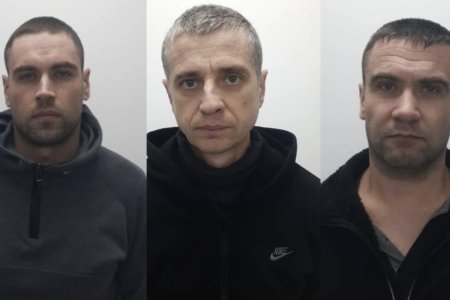
Russia’s Southern District Military Court has passed massive 20- and 15-year sentences against two very young men from occupied Zaporizhzhia oblast on charges that would in no way match the alleged actions even had these taken place. That, however, is also in question not least because the supposed rail sabotage could not have happened, as the railway tracks in question were not in use, something the two young men would have certainly known.
The indictment against Pavlo Hortenko (b. 8.12.2002) and Yevhen Chukhno, who is believed to be a year older was passed to the Southern District Military Court in October 2025. In reporting this, the Memorial Support for Political Prisoners Project wrote that Hortenko was known to have been seized no later than December 2024, but on suspicion of ‘spying’. In fact, it appears that both men have been in Russian captivity since April 2024, with it quite unclear how long they were held incommunicado before charges were laid. Such periods where a person has no official status and has not been formally acknowledged as being in detention are especially dangerous and are typically used by the FSB to extract ‘confessions’ through torture and other forms of duress.
RIA-South notes that almost no information was available about the ‘case’ until the sentences were passed. Nothing, in fact, until the sentences were reported with the lack of information, doubtless, deliberate. The press service report on 14 July 2026, announcing the sentences gives both men’s names in full, yet the site which provides information about the progress of the case concealed the men’s names, making it impossible for anybody interested to attend hearings. There had been no reports earlier of ‘arrests’, no videoed ‘confessions’ or supposed ‘investigative measures’ at the alleged ‘crime scene’.
The Memorial Support for Political Prisoners Project knew only enough about the case to see grounds for including Chukhno and Hortenko on its list of ‘Other victims of political repression’ where there are strong grounds for suspecting political motivation and irregularities
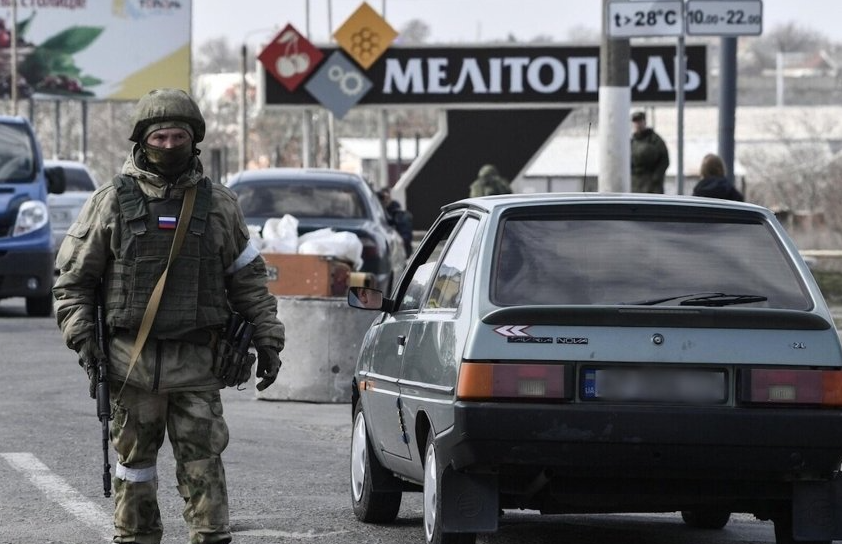
The indictment was passed to the Southern District Military Court in October 2025, with this, seemingly, the first information that became available. The two men were claimed to have been planning an act of sabotage on railway tracks near occupied Melitopol. The specific charges were of an attempted act of international terrorism, under Article 361 §§ 1 and 2 of Russia’s criminal code; of possessing explosives (Article 222.1 §§ 1 and 4); and of involvement in a terrorist organization (Article 205.4 § 2).
The indictment, as reported by prosecutors and a court from the country which launched a full-scale invasion of Ukraine in February 2022, would be comical were the situation not so serious. It was claimed that “during the period from 24 February through March 2022, other persons on Ukrainian territory and acting in the interests of Ukraine’s Security Service [SBU] and other Ukrainian armed forces against the interests of the Russian Federation, created a terrorist organization.” Chukhno supposedly joined this ‘terrorist organization’ in March 2022 and promised to “carry out the instructions of the heads of the terrorist organization aimed at carrying out an act of international terrorism on the territory of the Zaporizhzhia oblast of Ukraine – an explosion on the railways at the moment when trains carrying freight of the Russian armed forces was passing”.
The Russian invaders are thus claiming that railway partisans, allegedly or actually, seeking to disrupt Russia’s illegal movement of its weapons, military hardware and personnel through occupied territory, were engaged in ‘international terrorism’. According to Article 361 of Russia’s criminal code, which the occupying state has no right to apply on occupied territory, this refers to “an explosion, act of arson or other actions, committed outside Russia and jeopardizing the life, health, freedom or inviolability of Russian citizens “for the purpose of violating the peaceful co-existence of states and peoples, or aimed against the interests of Russia.”
The prosecution claimed that Chukhno had needed to find an ‘accomplice’ and used persuasion and threats to bring Pavlo Hortenko in, with the latter supposed to have taken explosive devices from a hiding place and organized another.
As mentioned, the problem with this indictment is not just in the cynical illegality and absurdity of the charges. In the vast majority of dubious ‘sabotage plots’ in occupied Crimea, the FSB has claimed to have thwarted them in time. Here the alleged explosion which the men are alleged to have planned on railway lines near the village of Trudove did not take place because the railway line was not in use – something that both the men themselves, and the supposed ‘terrorist organization’ giving them instructions, must have known.
There were around eight hearings in this so-called ‘trial’, so at least one of the men rejected the charges. There is no information as to whether they had independent lawyers, and every reason to assume a whole range of irregularities. The ‘trial’ took place before ‘judge’ Aleksandr Vasilievich Generalov, an individual who has already taken part in numerous politically motivated sentences against Crimean Tatar and other Ukrainian political prisoners.
Yevhen Chukhno was sentenced to 20 years’ maximum-security imprisonment, with the first five years in a prison, the harshest of Russia’s penal institutions. The Ukrainian who has been in Russian captivity since April 2024, was also fined a massive 750 thousand roubles.
Pavlo Hortenko was sentenced to 15 years’ maximum-security imprisonment, with the first five years in a prison. He was ordered to pay a 600 thousand rouble fine.
The sentences can and should be appealed, although in all such cases, the convictions and sentences appear to be predetermined.