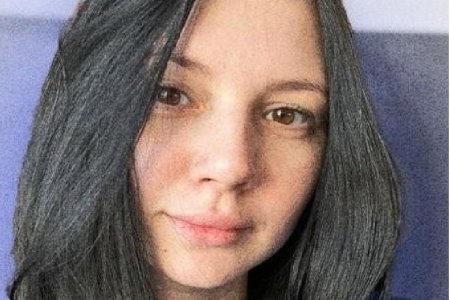
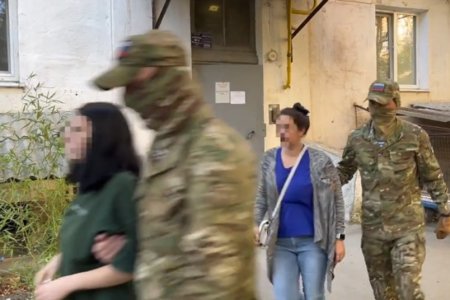
Baby Lera was in a neonatal intensive care unit when a Crimean occupation ‘court’ sentenced her mother, Oleksandra Strilets (b. 28.06.2000) and grandmother, Victoria Strilets (b. 29.03.1983), to 12 years for supposed ‘treason’. Both women were taken into custody immediately although even the Russian legislation illegally applied against them allows for a mother’s sentence to be deferred until a child reaches 14, and Oleksandra had two small children, Lera who was just three months, and five-year-old Solomiya. She now has one. Lera died, aged just 18 months, the morning after she was discharged from hospital. Her father, Maksym, who informed Novaya Gazeta of her death, will be forced to bury their daughter alone, as Oleksandra is imprisoned in Russia, over two thousand kilometres from her family and home in Sevastopol.
Oleksandra Strilets and her mother had originally been charged, on 3 October 2024, with the less serious ‘passing on information of a confidential nature’, under Article 275.1 of Russia’s criminal code. Lera was born premature in March 2025, dangerously small, weighing just 500 grams and with chronic lung disease (bronchopulmonary dysplasia). Lera’s critical state may have been one of two reasons why this was among the small number of cases where the FSB did not seek the women’s detention before the end of the ‘trial’. The other is that Victoria Strilets suffers from multiple sclerosis, a cruel and debilitating disease, which can only progress more swiftly and cause immense suffering and discomfort in the appalling conditions of a Russian prison colony. Neither condition, however, stopped them from escalating the charges to ‘state treason’ in June 2025, under Article 275. This carries a sentence of 12-20 years, with there not having been a single such acquittal, at least with respect to Ukrainians seized on occupied territory.
‘Treason’ and ‘spying’ cases carry an additional advantage for the FSB. The ‘trial’ is invariably held behind closed doors, and even where a person has access to a proper lawyer, the latter is forced to sign a non-disclosure agreement. There is, effectively, no way of finding out anything about the charges, except such information as is provided by the prosecution.
In this case, we know that there were two ‘hearings’ in total at the the occupation ‘Sevastopol city court’ – the first, lasting four hours, on 22 June 2026; the second – five hours, with that including the reading out of the sentence. The latter was passed by Daniil Zemlyukov, a Russian illegally sent to occupied Crimea from Barnaul in Russia.
The prosecution claimed, and Zemlyukov chose to accept, that Oleksandra Strilets “had decided, for remuneration, to cooperate on a confidential basis with representatives of Ukraine against the security of the Russian Federation.” She had, purportedly, also got her mother involved in this and had, in September 2023 passed photographs, taken by her mother, of sites of the Russian armed forces to a Telegram channel controlled by Ukraine’s Military Intelligence.
On 5 August 2025 ‘judge’ Daniil Zemlyukov, from the occupation ‘Sevastopol city court’ found Oleksandra and Victoria Strilets ‘guilty of ‘treason’ under Article 275 and sentenced both women to 12 years in a medium-security prison colony, to be followed by a year of restricted liberty. Although Oleksandra had been spending all her time with Lera, who was just four months old and in the intensive care unit, both she and Victoria were taken into custody in the ‘courtroom’.
The sentences were upheld on 21 January 2026 by the Russian Third court of appeal of general jurisdiction. ‘Judge’ Yelena Udod ignored Victoria’s progressing and very serious illness and also refused to defer the sentence in Oleksandra’s case on the grounds that “the children have a father.”