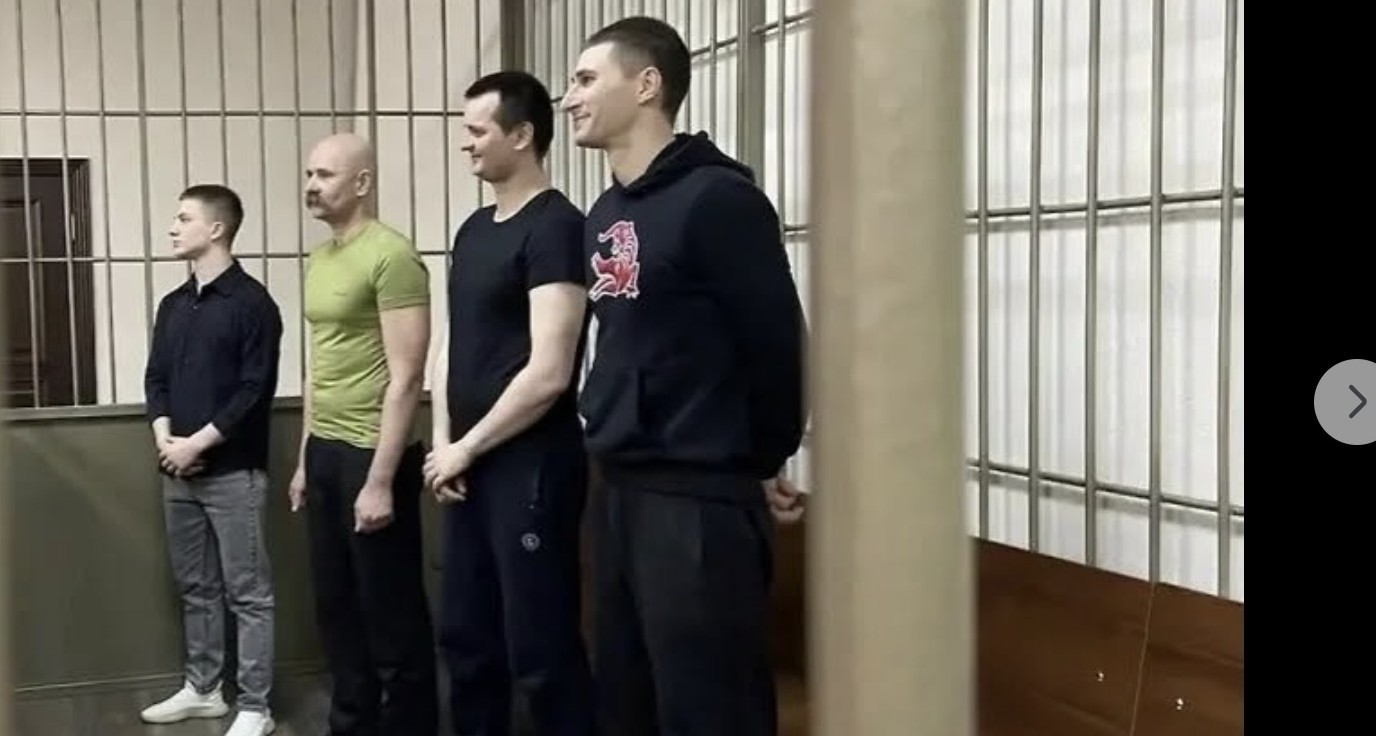
Russia’s Southern District Military Court has passed monstrous sentences from 17 to 28 years against four men abducted from occupied Melitopol back in May 2023 and imprisoned ever since. Kostiantyn Zinovkin, Hryhory Semykopenko and his brother Oleksiy Semykopenko, as well as Vladyslav Vidlatsky, who was just 18 when seized, were held incommunicado for a long time and almost certainly tortured to extract videoed ‘confessions’ which may well have served as the sole ‘evidence’ to back the Russian charges against them. They were accused of planning attempts on the lives of Russian-installed officials, with the aggressor state which has been unleashing terror and carnage against civilians since 24 February 2022 claiming that such alleged targeting of individuals actively serving the invaders constituted ‘terrorism’. The four men who clearly opposed Russia’s invasion were also charged with ‘spying’ for their own country, or, in the case of Vidlatsky who was just 17 and a s student when Russia invaded and probably forced to take Russian citizenship, and Zinovkin, with ‘treason’.
Oleksiy Semykopenko (b. 31.10.1980) was abducted together with his younger brother Hryhory Semykopenko (b. 2.02.1991) on 8 May 2023. Vladyslav Vidlatsky (b. 25.06.2004), an 18-year-old student, and his girlfriend, were seized on 10 May, with his girlfriend released after several days, totally traumatized. Kostiantyn Zinovkin (b. 22.10.1989) was seized on 12 May 2023, after leaving the house for the shop. His captors then used his keys to carry out something that bore no resemblance to the looting of Zinovkin’s home, than to a ‘search’. It is indicative of the methods Russia uses and, therefore, the grounds for caution in viewing any of their claims, that Zinovkin was one of the Ukrainians from Melitopol shown in a feature on a Russian state propaganda channel about six or seven Ukrainian journalists or Internet administrators of pro-Ukrainian channels. It is not clear how many months the men were held incommunicado and without any status before charges were laid, however it was only in November 2024 that it became clear that they were to be ‘tried’ together, at the Southern District Military Court in Rostov.
Oleksiy Semykopenko was ‘only’ charged with ‘spying’, under Article 276 of Russia’s criminal code, while Hryhory was charged with ‘spying’, and with ‘involvement in a terrorist organization’, under Article 205.4 § 2, and two counts of ‘planning an act of terrorism’, under Article 205 § 3b. Kostiantyn Zinovkin and Vladyslav Vidlatsky were charged with ‘treason’, under Article 275; with the same other charges, under Article 205.4 § 2 and Article 205 § 3b as Hryhory Semykopenko. They were also accused of explosives charges under Articles 222.1 and 223.1.
The only reason for the difference between spying and treason charges is the presence or absence of a Russian passport. In no case, can the taking of Russian citizenship be viewed as a matter of choice, with Russia using a variety of means of coercion to foist this on Ukrainian territory under its occupation.
The aggressor state’s prosecutor claimed that Hryhory Semykopenko; Vladyslav Vidlatsky and Kostiantyn Zinovkin had, in August 2022, joined a so-called ‘terrorist organization’ supposedly formed by Ukraine’s Security Service, with this, purportedly, planning to kill two Russian-installed ‘ministers’ in 2023. Vidlatsky and Semykopenko were supposed to have carried out surveillance, while Zinovkin was claimed to have prepared a homemade explosive device, disguised as a bottle, and to have left it in an urn. The FSB claimed that they had substituted a dummy for the original, with this, they asserted, the only reason for it not being detonated.
Oleksiy Semykopenko was claimed to have gathered information about one of the alleged targets while doing repairs for him.
Liosiena Zinovkina dismissed the accusations against her husband from the outset. Kostiantyn was a vegetarian because he didn’t want to kill animals, and here Russia was claiming he was involved in a plot to carry out killings. Valeria Vidlatska also rejected the claim that her brother was some kind of ‘terrorist’. She stressed that he “simply believed in his country’ and wanted to serve it.
The men clearly rejected some or all of the charges, and there were a number of hearings from November 2024 until 22 September 2026. None of these events, however, bear any real resemblance to proper trials, not least because a guilty verdict is essentially known from the outset. What was shocking, however, was the size of the sentences. ‘Judge’ Sergei Mikhailovich Gorelov, who has taken part in other political rulings, sentenced Kostiantyn Zinovkin to 28 years’ maximum-security imprisonment, with the first seven years in a prison, the harshest of Russia’s penal institutions. A fine of 600,000 roubles was also imposed.
Vladyslav Vidlatsky, who has been in Russian captivity since he was 18, was sentenced to 27 years’ maximum-security imprisonment, with the first six years in a prison and a 500 thousand rouble fine.
Hryhory Semykopenko was sentenced to 24 years’ maximum-security imprisonment with the first six years in a prison. His brother was sentenced to 17 years’ maximum-security imprisonment.
The sentences can and almost certainly will be appealed, however these are political trials, with the ‘judges’ appointed to both the Southern District Military Court and the Vlasikha military court of appeal in Moscow region essentially never doing more than reducing a sentence by a few months.