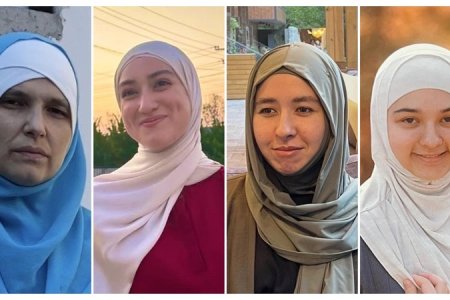
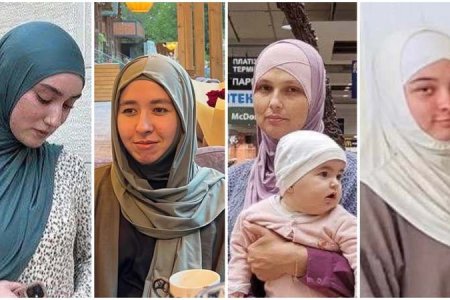
The preliminary hearing has taken place in Russia’s trial’ of four Crimean Tatar women on ‘terrorism’ charges based solely on a flawed and politically motivated supreme court ruling from 2003. Although this is the first time that Russia has targeted Crimean women, there is nothing else to suggest any other deviation from the conveyor-belt ‘trials’ it has used to sentence well over 100 Crimean Muslims, most of them involved in the Crimean Solidarity human rights movement to up to 20 years.
The preliminary hearing on 9 October was held behind closed doors at the Southern District Military Court in Rostov (Russia). The four women, 40-year-old Esma Nimetulayeva; 19-year-old Nasiba Saidova; Fevziye Osmanova (22) and Elviza Alieva (21) took part from SIZO No. 1, the remand prison in occupied Simferopol where they have been held since 15 October 2025. Although the judge assigned to the case, Artem Aleksandrovich Shalayev, seems new to these trials, nothing else points to any change of direction. The hearing was used to extend the four women’s detention for six months, and to organize the next hearing, on 23 October, if, by then, the women have been taken from Crimea to a SIZO in Rostov. There were never any grounds for remanding Esma Nimetulayeva, the wife of a political prisoner and mother of five underage daughters, and three very young women in custody for the past year, nor can there be for both extending their detention and taking them so far from their homes and families.
The preliminary hearing confirmed the grotesque nature of the charges against all four women. It was already clear that, like in all previous prosecutions, the charges are based solely on unproven allegations of involvement in Hizb ut-Tahrir, a peaceful, if controversial, transnational Muslim party which is legal in Ukraine, but which Russia’s supreme court outlawed as ‘terrorist’ during a highly secretive hearing in February 2003. All such prosecutions ignore the existence of a law on countering terrorism from 2006 and the fact that Hizb ut-Tahrir does not meet the requirements set out in that law for identifying an organization as ‘terrorist’. The 2003 ruling is treated as justification enough in this case for charging Esma Nimetulayeva with the more serious charge of ‘organizing a terrorist cell’, under Article 205.5 § 1 of Russia’s criminal code, with sentences presently up to 20 years and charging the other three women with ‘involvement in this entirely unproven ‘Hizb ut-Tahrir cell’ (Article 205.5 § 2).
The women are also charged, however, under Article 278 of Russia’s criminal code, with ‘actions aimed at violent seizure of power’. This second charge was reported by Russian human rights monitors to be used selectively in Russian cases, essentially as a punishment against defendants who did not ‘cooperate’ with the investigators. In occupied Crimea, where so many were targeted for their human rights journalism or activism, all cases since 2016 have included this second charge. It has not once been excluded by the court, although the armed and masked enforcement officers who burst into people’s homes never make any pretence of looking for anything but ‘prohibited literature’ and not one of the men or women on trial has ever been accused of any actual violence or plan to commit an act of violence. It seems safe to assume that here, too, the charge will simply be accepted despite the manifest absurdity of accusing four unarmed women of ‘actions aimed at violently seizing power’.
Since the outrage, peaceful protests in Crimea and international condemnation after the four women were taken prisoner on 15 October 2025, Russia has moved to totally crush the Crimean Solidarity human rights movement and silence the courageous civic journalists and lawyers who have ensured that the fabricated ‘evidence’ in these trials, the use of fake secret witnesses and planted ‘prohibited religious literature’ were reported. They have hopefully not succeeded but, in any case, it seems clear at this stage that there are no grounds for expecting the trial of the four women to be any different from the judicial travesties already seen.
Esma Nimetulayeva (b. 9 January 1986) is a confectioner who had, since August 2023, been the sole parent bringing up her and political prisoner Remzi Nimetulayev’s five daughters: Aishe (b. 2009); Anife (b. 2010); Adile (b. 2013); Yasmina (b. 2016); Alime (b. 2020).
Elviza Alieva (b. 29 May 2005) was a fourth-year student at the occupation Vernadsky federal university, specializing in management. She had also been working as a sales assistant in a Simferopol bakery.
Fevziye Osmanova (b. 24 May 2004) is from Orlivka, just outside Sevastopol and worked in a local shop.
Nasiba Saidova, who was born on 25 October 2026, is the youngest victim of Russia’s Crimean conveyor-belt ‘Hizb ut-Tahrir trials’ and Sadyk Urinbaev’s daughter. She was studying at a teacher-training college and also worked at a nursery.
All four women are listed as imprisoned for their religious beliefs and association by the US Commission on International Religious Freedom and by the Memorial Support for Political Prisoners Project.