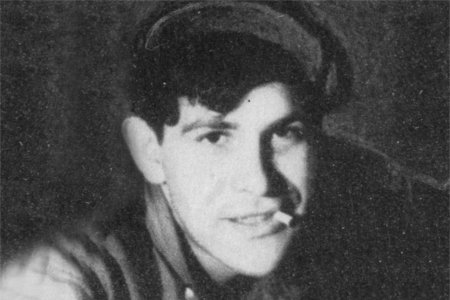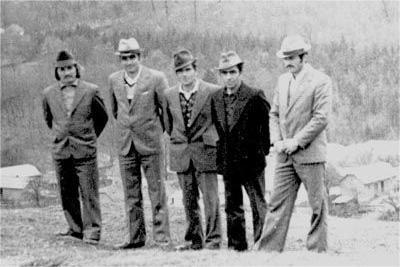
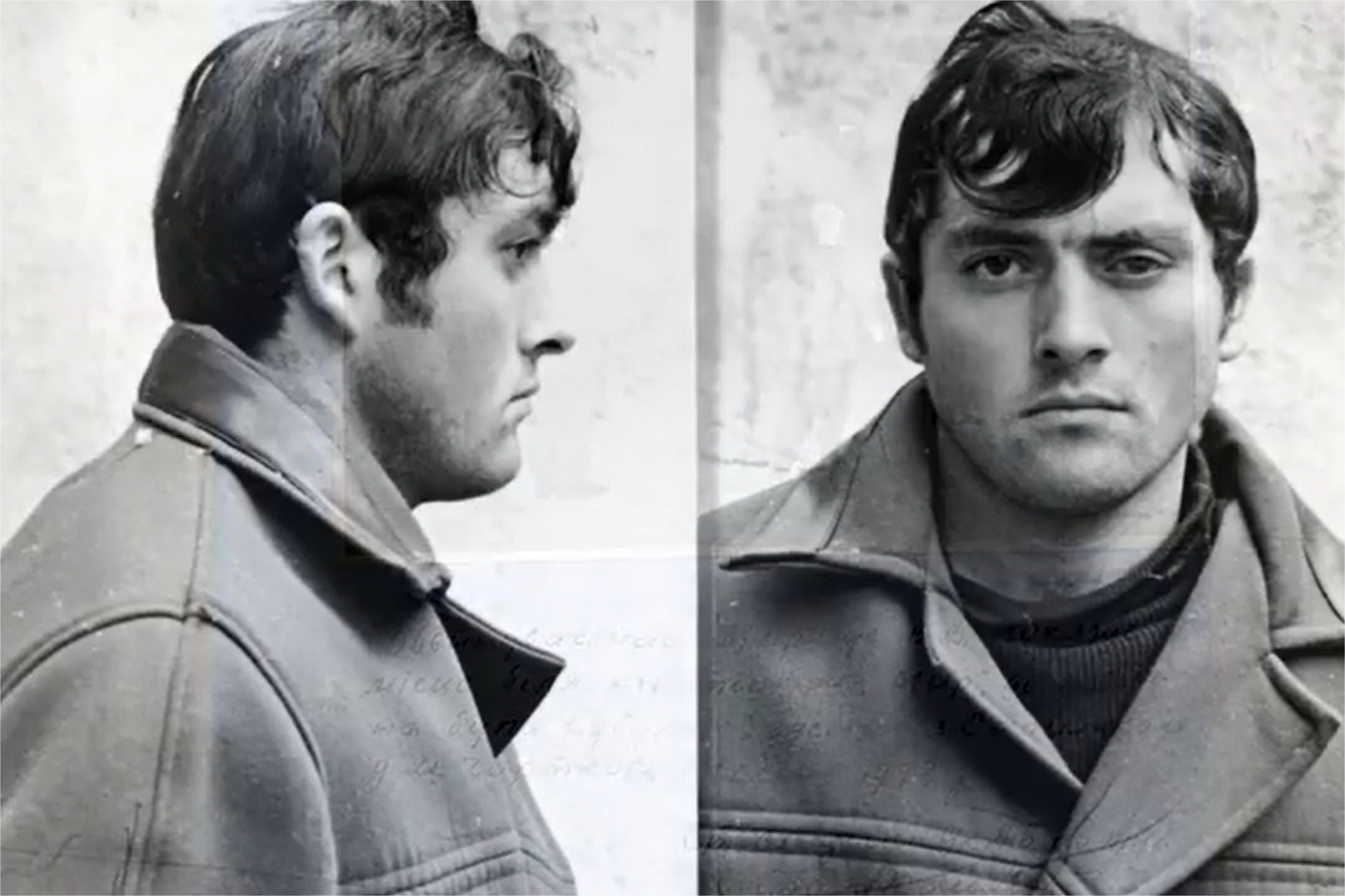
…On 5 November 1972, four young men from the village of Rosokhach in the Ternopil region—Volodymyr Marmus, Petro Vynnychuk, Petro Vitiv, and Volodymyr Senkiv—set off into the forest. They took with them candles, an icon of the Blessed Virgin Mary, and a cross. They found a quiet clearing.
‘It was the kind of place OUN members used to frequent,’ remembered Petro Vynnychuk. ‘There was a hideout nearby. We decided to take an oath, just like the OUN-UPA, to feel like the same kind of people. Volodymyr read the text by candlelight; all three of us knelt down. To be honest, we didn’t have a flag because the material to sew a Ukrainian flag wasn’t easy to come by. Four of us took the oath.’
The words for the oath were written by Volodymyr Marmus: ‘...Before the image of the Holy Mother of God, in the presence of my comrades, I solemnly swear to serve Ukraine faithfully, to fight for her independence...’ The oath ended with the words: ‘If I betray, let a friend’s hand strike me from the face of the earth.’
Later, five more young men repeated these same words: Mykola Marmus, Andriy Kravets, Mykola Slobodyan, Mykola Lysyi, and Stepan Sapelyak. The group’s first action coincided with the October holidays: the boys tore down the red flags that had been put up the previous day in their native Rosokhach.
‘Our second action followed this—it was to avenge the memorial mound created in honour of the Sich Riflemen, which people here had symbolsically built,’ said Petro Vynnychuk. ‘Local party organisers—at the behest of the district authorities, I believe—drove a military bulldozer here and destroyed the mound. So we told ourselves that it was worth getting revenge for that—to destroy the monument to the “liberator soldiers,” as they called these invading soldiers who brought enslavement to Ukrainian soil, not freedom. We damaged it right before their holidays—that was quite terrifying for them. This was done by Volodymyr Senkiv and Petro Vitiv—they went and damaged the monument.’
On the eve of the New Year, the boys listened to ‘enemy voices’ and heard on Radio Liberty that on 22 January, the Ukrainian diaspora in the USA intended to celebrate Ukraine’s Independence Day, dedicated to the 55th anniversary of the Fourth Universal of the UNR (it was this document that proclaimed the independence of the Ukrainian People's Republic in 1918). The ‘Rosokhach Group’ decided to join the anniversary in their own way: by organising an action in Chortkiv. They bought wallpaper and fabric—blue and yellow—in advance. They wrote the posters in large letters so they could be easily read from 10–20 metres away. They planned to stick them high up so they could not be pulled down immediately. Volodymyr Marmus recounted:
‘We did this on the night of 22 January 1973. It was carried out lightning fast, so to speak. Although it was quite a cold season, with snowy winds, and our hands were freezing, there were enough of us. We divided up the tasks and put the posters up. I personally raised the flags with Vitiv. We put up leaflets as well, of course, but in four places, we tore down those Soviet flags and raised blue and yellow ones in their stead. We raised the first flag at the covered market, and the second over the “Mir” cinema. To be honest, we also wanted to place one on the flagpole near the district party committee, but it was so well-fastened that we couldn’t remove it. So we had a fifth flag, and we left it in a tree somewhere. It wasn't even mentioned during the investigation. There was another one on a flagpole in the forestry estate along the road... The fourth flag was raised over the teacher training college, which caused a real stir among the staff. In every location where flags hung, we put up proclamations, and in other places besides.’
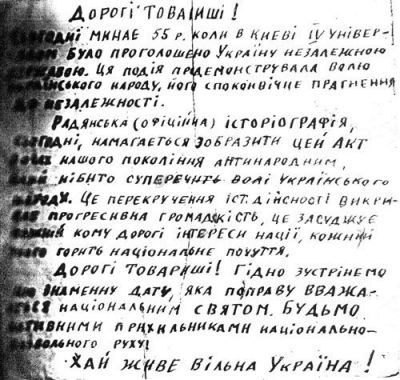
The text of the proclamation was as follows:
‘Dear comrades! Today marks 55 years since the day when the independence of the Ukrainian state was proclaimed in Kyiv by the IV Universal of the Central Council. This historic act demonstrated the will of the Ukrainian people and their eternal desire for independence. Yet today's official Soviet historiography tries to portray this event as anti-people in the eyes of our generation. The advanced public indignantly condemns this crude distortion of historical reality. It is condemned by everyone to whom the interests of the nation are dear.
Dear comrades! Let us meet this significant date, which is rightfully considered our national holiday, with dignity!
Long live free Ukraine!’
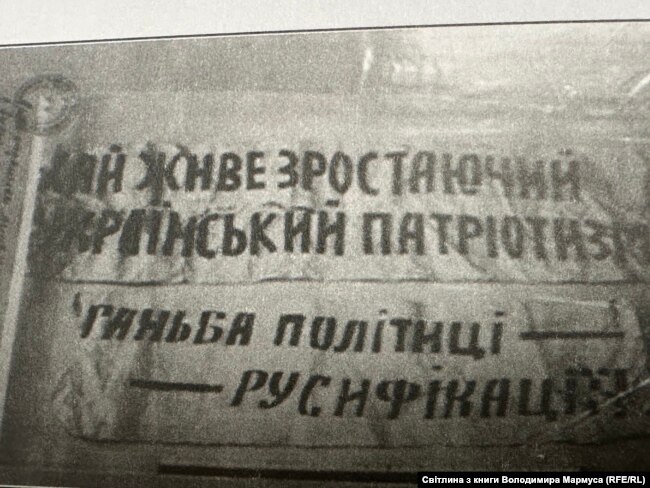
The boys also put up slogans:
‘Freedom to Ukrainian patriots!’,
‘Shame on the policy of Russification!’
‘Long live growing Ukrainian patriotism!’
‘Freedom of speech, press, and assembly!’
If information about the first actions of the “Rosokhach Group” did not reach the KGB (the local authorities in Rosokhach simply did not report what had happened “upward” for a long time), the daring act in Chortkiv could not go unnoticed. Shcherbytskyi was informed of these events in the Central Committee of the CPU.
‘After a while, I went to Chortkiv to see a relative…’ Petro Vynnychuk recalled. ‘I walked into a snack bar there where some criminals, as I understood it, were sitting at a table, as they spoke mostly Russian. They said: “The Chekists are giving us hell! I was beaten so badly recently that I could barely walk—they were asking if we knew who was putting up leaflets or flags.”’
On 19 February, they came for Stepan Sapelyak. Later, they arrested everyone.
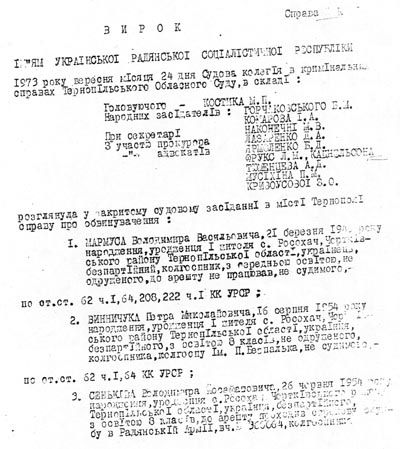
‘The trial took place in September,’ said Volodymyr Marmus. ‘They gave us various terms. For me—six years of imprisonment and five years of exile; my brother Mykola and Sapelyak received five and three; Senkiv and Vynnychuk four and three; Slobodyan and Kravets three and two; Petro Vitiv, considered a minor although he reached majority by the trial, and Mykola Lysyi were not prosecuted.’
…On 11 September 2022, near the village of Oskil in the Kharkiv region, 30-year-old paratrooper Vasyl Marmus—a musician, public activist, and son of the dissident Volodymyr Marmus—died defending the Motherland. Shortly before the start of the full-scale invasion, Vasyl wrote a song about the “Rosokhach Group”—