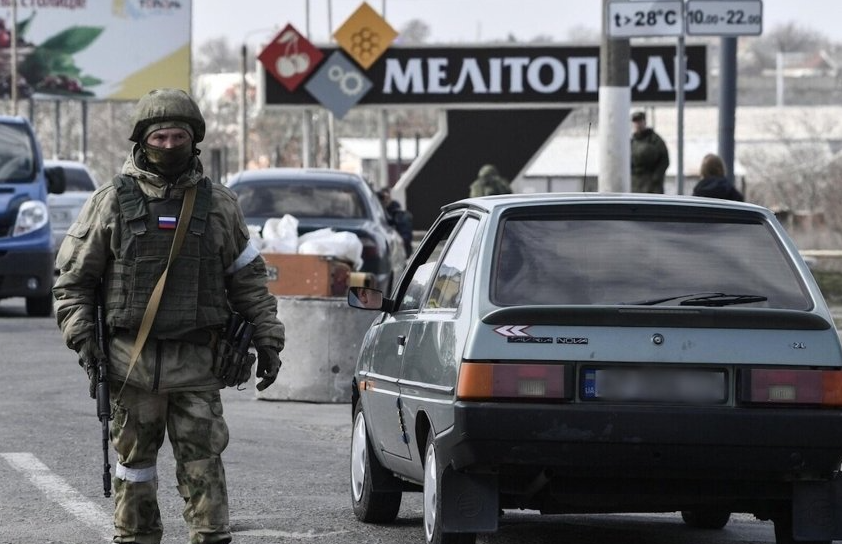
Even by the very low standards of Russia’s ‘justice system’, the 14-year sentence against Denys Shepotko stands out. The 24-year-old from occupied Melitopol was charged with ‘terrorism’ because of his alleged involvement in something described as the “banned terrorist nationalist ‘Azov’ association” in 2017. This was on Ukrainian territory where there was no such ban five years before Russia’s full-scale invasion of Ukraine and its later supreme court ruling declaring the Azov Regiment, which is part of Ukraine’s Armed Forces, ‘a terrorist organization’.
The supreme court ruling from 2 August 2022 was widely understood to be a pretext for reprisals against members of the Azov Regiment who had taken part in the defence of Mariupol. That has proven to be the case, with Russia’s Southern District Military Court using the later ruling retroactively to impose massive sentences against Ukrainian prisoners of war seized in April or May that year.
In the ‘trial’ of Denys Shepotko, the same Southern District Military Court proved willing to turn a blind eye to much more. Since Denys Shepotko is just 24, he would have been a minor in 2017 when he took part in totally legal demonstrations in three Ukrainian cities: Kyiv, Melitopol and Zaporizhzhia. Despite headlines, like that from the Russian state-controlled TASS, Shepotko could not, therefore, have been in the Azov Battalion, but may have been a member of the civilian ‘Azov movement’. What exactly the Russian supreme court ‘banned’ in 2022 remains unclear, but neither the original Azov Battalion, formed in 2014 as a volunteer battalion, but then incorporated, as the Azov Regiment, into Ukraine’s Armed Forces, nor the related civilian political movement were ever illegal in Ukraine. The charges against Shepotko, under Russian legislation concerning events over which Russia had no jurisdiction, are a legal absurdity.
In reporting the 14-year sentence on 31 October, the court’s press service stated that Shepotko had been charged under Article 205.5 § 2 of Russia’s criminal code (‘participation in the activities of a terrorist organization’) and Article 205.2 § 2 (public calls to carry out terrorist activities on the Internet). It is worth citing the ‘indictment’ as, even with care being taken to avoid mentioning the lack of any right to bring charges under Russian legislation, the impugned ‘offences’ are manifestly disproportionate to the sentence passed. It was, purportedly, established that Shepotkov had “in February 2017, while on the territory of the Zaporizhzhia oblast, joined the banned terrorist nationalist Azov association and subsequently carried out various tasks set by its leadership, taking part directly in political rallies in Zaporizhzhia, Kyiv and Melitopol.”
It was further claimed that, on 24 November 2024, Shepotko posted a video, with a message “calling people to carry out terrorist activities.” If the aim of mentioning that the video showed military action by both Ukraine’s Armed Forces and by the Nazis was to imply Ukrainian support for the latter, the current aggressor state clearly forgot the historical context. It seems far more likely that the video was calling on Ukrainians to fight the Russian invaders, as it once did the Nazis.
The sentence, which can still be appealed, was passed on 31 October by ‘judge’ Pavel Yurievich Gubarev, an individual who has been involved in handing down huge sentences against many Crimean Tatar and other Ukrainian political prisoners. Denys Shepotko was sentenced to 14 years maximum-security [‘harsh-regime’] imprisonment with the first two years in a prison, the worst of Russian penal institutions.