Russia is playing a brutal hide and seek with the families of Ukrainian men and women held prisoner somewhere in the vast expanse of the Russian Federation, or on occupied territory. Nor is the torture confined to those political prisoners or hostages whose imprisonment Russia has still not acknowledged. Even where show trials have been staged, and, for example, Ukrainian POWS sentenced to 25 or 30 years on surreal ‘terrorism charges for having defended their country, it is near impossible for their wives or parents to find out where they are imprisoned. Although a recent study by Mediazona suggests that even Russians have problems finding their relatives in Russia’s prison system, the situation is truly dire for Ukrainians.
There is no doubt that the secrecy is deliberate. With respect to civilian hostages, Russia is essentially adopting the role of kidnappers who want a ransom before they release their hostages. Until such time as Moscow has decided what ransom to demand, the Ukrainians are simply held incommunicado and without any official charges or status. For years now, the only information about these hostages as well as about many prisoners of war has come solely from other Ukrainian POWs finally released in prisoner exchanges. Moscow knows that the freed men or women will provide whatever information they can to alleviate the pain of other families, and therefore constantly moves hostages from one prison to another. Although some prisons are especially notorious for the savage torture to which Ukrainians are subjected, it is believed that 90-95% of all prisoners of war endure torture. The transfers are also dangerous, both because of the appalling conditions and, probably, treatment during the so-called ‘etap’, or journey between prisons, and because of the beatings, etc. to which prisoners are invariably subjected when brought to a new prison. 63-year-old Dniprorudne Mayor Yevhen Matvyeyev was effectively beaten to death when he arrived at the SIZO, or remand prison in Kizel (Perm region) where Ukrainian journalist Victoria Roshchyna also died after months of torture.
There are also a huge number of Ukrainian POWs and political prisoners against whom Russia has brought charges and staged show trials, yet even finding out where they are is gruellingly difficult. Mediazona’s Dmitry Shved has spoken with human rights activists about Russia’s “closed and non-transparent prison system” and writes about the ways in which this system holds even those Ukrainians whose imprisonment is not denied “in virtually total isolation from the outside world”.
Prison authorities refuse to provide information, with varying excuses given. Some cite the lack of diplomatic relations between Ukraine and Russia, without, of course, mentioning that the relations ended because of the full-scale invasion of Ukraine that has led to Russia holding thousands of Ukrainian prisoners of war and civilian hostages. Other pretexts cited are the need to protect personal data or the supposed impossibility of corresponding without authorisation on the Russian ‘state services’ website. The latter demand, arising from amendments to the relevant law in 2025, has made it impossible for Ukrainians whose relatives are held in Russian captivity to send ordinary requests for information as to their whereabouts.
You can still, apparently, write to prisons the old way, on their official email. That, however, can mean bypassing Ukrainian blocks on such Russian addresses and, more importantly, means writing individually to a huge number of such prisons dotted all around the Russian Federation. According to Yelena Bazanova, a lawyer helping to look for Ukrainian prisoners, there is no system to this, and Ukrainians can be held anywhere in Russia.
Russian and occupation ‘courts’ are also increasingly concealing the names of defendants on their websites. Although Mediazona writes of such concealment where ‘terrorism’ charges are concerned, the same secrecy is seen over those accused of ‘spying’, ‘treason’ or ‘sabotage’. In a very large number of cases recently, huge sentences have been passed against civilians from occupied territory without any of the Russian bodies complicit in this providing the victims’ names.
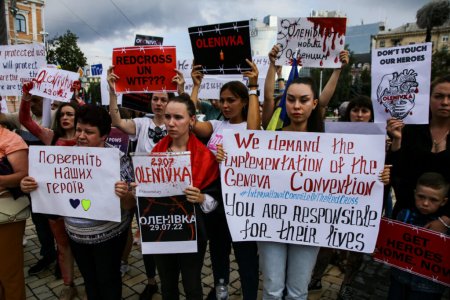
The issue is, nonetheless, especially acute for Ukrainian prisoners of war and their families precisely because Russia is abusing its already flawed ‘terrorism’ legislation as a weapon for their persecution. Massive sentences are being churned out by Russian military courts on the basis of several politically motivated rulings which declared units of Ukraine’s Armed Forces ‘terrorist organizations’. The Russian supreme court’s ruling on 2 August 2022 labelling the Azov Regiment ‘terrorist’ was widely condemned at the time as aimed at reprisals against POWs from Azov who had played such a vital role in the defence of Mariupol. This has proven to be the case, with a huge number of such POWs receiving sentences of 18, 20 years, or more on insane charges of ‘involvement in a terrorist organization’ (Article 205.4 of Russia’s criminal code) and of ‘training in terrorist activities’ (Article 205.3). Similar rulings have been used to bring identical charges and pass equally monstrous sentences against POWs from several other battalions within the Armed Forces.
On 10 February 2026, Mediazona reported that ‘judge’ Andrei Slepukhin from Russia’s Central District Military Court, during several mobile court hearings from 2-6 February, had passed an incredible nine such sentences against Ukrainian prisoners of war (Maksym Rud; Ivan Koziroda; Ihor Kravets; Ruslan Shevchenko; Vasyl Lomakhin; Maksym Lytvyn; Denys Kryhulsky; Maksym Liuty; and Bohdan Trofimiuk). The court on those occasions did publish both the names of the POWs and of their ‘lawyers’. Since the latter were all based in Saransk (Mordovia), Mediazona was able to establish that the hearings took place there. What the ‘lawyers’’ role was in these so-called ‘trials’ is quite unclear, and it is likely that they were appointed by the ‘investigators’ and there basically to sign documents. It would be difficult to see what other role they could have played since the ‘trial’ of each of these prisoners of war can have lasted no more than an hour or two. Although the length of each sentence was not revealed, each is likely to have been 18 years or worse in maximum-security Russian prison colonies.
There would be no way for the Ukrainian POWs’ families to guess that they were held in a Mordovian SIZO [remand prison], nor is it clear how long they were held there.
Bazanova says that she had earlier told POWs’ families that it was, in fact, a good thing that such ‘criminal proceedings’ had been laid since that meant that the men (or women in a few cases) had legal status. When there are no charges, Russia does not even have to admit to holding them, with this a particularly dangerous time given the torture and other illegal forms of duress to which the POWs are subjected. Now, however, even legal status does not mean that a POW’s family have any better chance of finding out where he is being held. The prison authorities will also fob off even lawyers, appointed by the family.
Russia has been imprisoning Crimean Tatar and other Ukrainian political prisoners in different prisons and prison colonies thousands of kilometres from their families since 2014. Since 2022, the number of victims has risen exponentially, with the regime clearly trying to spread them around the prison colonies. As human rights activist Mikhail Savva told Important Stories, this is to avoid them being concentrated in one place and creating “potential for resistance”. It is also, doubtless, aimed at blurring the scale of Russia’s violation of international law through such persecution of prisoners of war and illegal imprisonment without any charges of civilian hostages.