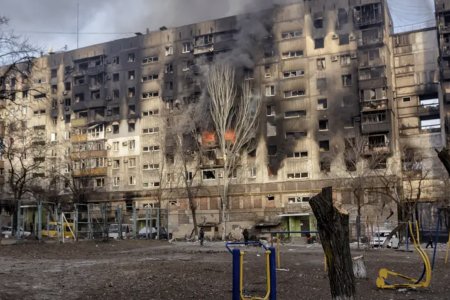
Russia’s so-called ‘Donetsk people’s republic’ and ‘Luhansk people’s republic’ are planning to launch ‘war tourism’ through what are claimed to be ‘places of military glory’. These will, undoubtedly, include cities like Mariupol which Russia first bombed and devastated, and then claimed to have ‘liberated’.
In announcing this new ‘tourist’ drive, the Russian-installed ‘Donetsk people’s republic deputy prime minister’ Kirill Makarov claimed that such ‘war tourism’ had considerable potential. This, he asserted, was because there are ‘places of military glory’ linked with what he called the ‘civil war’ in 2014 and with Russia’s full-scale invasion of Ukraine in 2022. There was never a civil war, only military aggression, initiated, funded and, largely, manned by Russia. This is only one of the many lies which will form the narrative around any such ‘tourist excursions’.
The Mariupol City Council was blistering in its assessment of these ‘plans’. The Russian invaders have done nothing to resolve the enormous problems they caused in Mariupol (and other areas under Russian occupation). There is a catastrophic lack of water in occupied parts of Donetsk oblast, with running water only provided for a few hours every second or third day. Boilers, the council says, are also constantly breaking down; the streets are full of stray dogs and heaps of rubbish. Tens of thousands of people have nowhere to live. As reported, many of the new apartment blocs that the invaders built on the ruins of those that they had bombed or shelled, are ‘sold’ to those who can afford to pay the mortgages, with this very clearly not the local residents.
Instead of addressing these urgent issues, the Council writes, “the occupiers have decided ‘to develop tourism’. The invaders plan to turn the city’s tragedy; its ruins; the mass graves into attractions and a platform for Russian propaganda. All with one purpose – to earn as much money as possible.”
The Council is surely right, with even the occupation spokespeople acknowledging the problems for ‘tourism’, with hotels, etc. destroyed in the military action, and many of the places too dangerous to visit.
The grandiose plans for ‘war tourism’ were accompanied by the news that over one billion roubles (around 11 million euros) is to be allocated for supposed development of the ‘DPR tourist industry’. Implementation of this is, purportedly, to begin in 2026 as part of a ‘national project’ entitled ‘Tourism and hospitality’
It seems likely that this money will either simply be syphoned off by corrupt Russian-installed leaders or will be used for propaganda. Although 11 million euros is a lot of money, it would not go far in rebuilding the hotels and other tourism infrastructure which the Russians destroyed. And that is even if you can find ‘war tourists’ who don’t object to a lack of running water, petrol shortages, etc.
Back in 2022, while people had no food or water, Russia drove huge screens around the besieged city to transmit propaganda. The plans for ‘war tourism’ seem in the same league.
Russia’s extensive propaganda drive in and about occupied Donbas (the so-called ‘Luhansk and Donetsk people’s republics’) dates back to 2014, with these likely to form the basis for any ‘war tourism’ when it is developed. Russia continues to push its fictitious narrative about ‘a civil war’ from 2014; about the fake ‘referendum on 11 May 2014 which even Russia stopped short of recognizing, and the totally unproven claims about ‘genocide of Russian-speakers’. Within hours of the tragic disturbances and fire in Odesa on 2 May 2014, the propaganda machine began pushing toxic and highly inflammatory lies about a ‘massacre’, with these still cultivated to this day. While destroying monuments to the Holodomor, to the Ukrainian poet Dmytro Stus and getting rid of all Ukrainian books from schools and libraries, Russia has erected statues to war criminals, like Russian mercenary Arsen Pavlov [‘Motorola]], as well as several Russian or Russian-supporting militants whose violent deaths were almost certainly commissioned by Moscow.