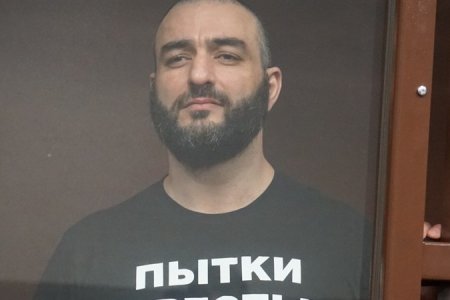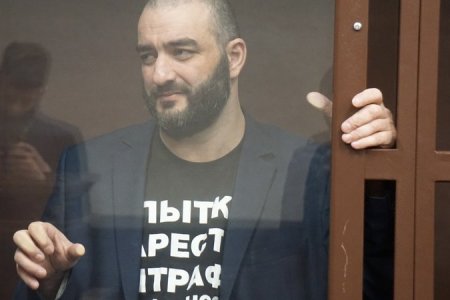
A CT scan, taken months after Tofik Abdulgaziev first showed alarming symptoms, has found that the Crimean Tatar political prisoner has a brain tumour. He is now registered to see a neurosurgeon for the latter to determine whether the tumour is malignant or not, however it is quite unclear when this will be, although speed is clearly paramount.
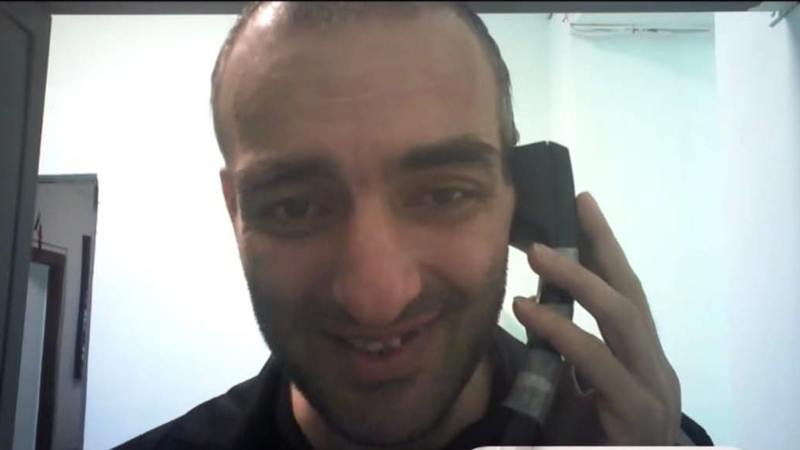
Tofik Abdulgaziev, whom Russia sentenced to 12 years for his civic activism as part of the Crimean Solidarity human rights movement, is currently held in a prison tuberculosis hospital in Chelyabinsk, thousands of kilometres from his family and home in Crimea. His wife, Aliye Kurtametova told Crimean Solidarity that Tofik had managed to phone her and tell her about the results of the CT scan which he learned about from the head of the medical unit, Olga Angold. Aliye is clearly extremely worried, and says that she had feared this since her husband first reported a sharp deterioration in his eyesight, with this beginning in October 2025. In November, he told his wife that he could not see the plate in front of him, and in order to call her, he had needed to ask for help in dialling the number. He explained that he has no peripheral vision and his central vision is also blurred and fuzzy.
Tofik Abdulgaziev (b. 19.07.1982) was in good health until 27 March 2019 when he became one of 25 civic activists and journalists targeted in Russia’s worst attack to date on the Crimean Tatar human rights movement. He has been imprisoned ever since, first in occupied Crimea, then in Russia.
As reported, the political prisoner has been in prison tuberculosis hospital No, 3 in Chelyabinsk since March 2024. He was moved, in July 2023, to the Verkhneuralsk Prison in Chelyabinsk oblast, 2,700 kilometres from his home and family in Crimea. It was after the gruelling journey that he began losing weight and complaining of acute joint pain. By February 2024, his lawyer Emil Kurbedinov reported that he was unable to move about and that he had difficulty even holding a spoon.
On 22 March 2024, he was admitted to a critical care ward in a grave state, and, by the time his family were allowed to see him, he had lost around 40 kilograms and was gaunt and frail.
In late April 2024, he was diagnosed with what was then identified simply as tuberculosis, but was clearly the very serious disseminated tuberculosis of the lungs, with this having spread to the chest lymph nodes. The doctors also found a number of other serious, some life-threatening conditions - double pneumonia; fluid in the lungs; medium severity anaemia; connective tissue dysplasia with damage to the mitral valve (valvular heart disease); chronic heart failure; chronic gastritis and kidney stones.
It was clear that Abdulgaziev should be released on health grounds, but the same, even then, was true of a number of other political prisoners who had died in captivity, including Dzhemil Gafarov, whose detention even Russian regulations prohibit, and Kostiantyn Shyrinh.
On at least one occasion, the prosecution organized its own supposed expert assessment which claimed that Abdulgaziev did not have illnesses that could prevent him from remaining in prison. That was when such shameful pretence was still required. Since the rearrests in recent months of the only two political prisoners whom Russian courts had, quite correctly, released - Lenur Khalilov, who has cancer, and Oleksandr Sizikov, who is blind and disabled, it is tragically clear that Russia will violate its own legislation, rather than allow the release of any Crimean Tatar or other Ukrainian political prisoners, however ill.

Tofik Abdulgaziev and Aliye have three children – Amar (b. 2005); Medina (b. 2010) and Yarmina (2015) and were also bringing up Aliye’s daughter, Sayire from her first marriage. Although it was clear by 2019 that all human rights activists were in danger, Tofik Abdulgaziev refused to be cowered and do nothing when others were facing persecution. He played an active role both in Crimean Solidarity, and in the linked Crimean Childhood organization, which particularly provides support to the children of political prisoners. Abdulgaziev actively visited political trials, organized parcels for political prisoners, was sound operator for recordings, and organized activities for children traumatized by the armed raids and arrests of their fathers.
He and his family were subjected to a first armed search on 4 May 2017. That was, presumably, the FSB’s warning of what would happen if he refused to leave the peninsula or end his civic activities. The next attack, on 27 March 2019, was much more serious. The arrests so obviously targeted men involved in highlighting repression and helping the victims of persecution that international condemnation was finally vocal. Human Rights Watch called the arrests “an unprecedented move to intensify pressure on a group largely critical of Russia’s occupation of the Crimean Peninsula” and stated unequivocally that attempts “to portray politically active Crimean Tatars as terrorists” is aimed at silencing them. There was similar criticism from the US State Department ; the EU ; Freedom House and Civil Rights Defenders, and the Memorial Human Rights Centre was swift to declare all the men political prisoners and denounce the attempt “to crush the Crimean Tatar human rights movement”.
All of the men were charged only with ‘involvement’ in the Hizb ut-Tahrir movement, a peaceful transnational Muslim organization which is legal in Ukraine and not known to have carried out acts of terrorism anywhere in the world. Russia has never provided any grounds for its highly secretive 2003 Supreme Court ruling that declared Hizb ut-Tahrir ‘terrorist’, yet this inexplicable ruling is now being used as justification for huge sentences on supposed ‘terrorism charges’. Five of the men faced the more serious charge of ‘organizing’ a Hizb ut-Tahrir group (Article 205.5 § 1 of Russia’s criminal code), while the others, including Abdulgaziev were accused of ‘taking part’ in such an unproven group. The aggressor state, which invaded and annexed Crimea also charged the 25 Ukrainian citizens with “planning a violent seizure of power and change in Russia’s constitutional order” (Article 278).
The prosecution claimed that the ‘proof’ to back these charges came from innocuous discussions about religion, politics, courage which were illicitly taped back in early 2016. Three years elapsed before the FSB carried out the arrests, making the ‘terrorism’ charges seem especially preposterous. Faulty transcripts of these conversations were sent to FSB-loyal ‘experts’ who are chosen for their willingness to ‘find’ whatever the FSB demands of them. The defence obtained independent expert assessments by people actually qualified in their field. Their analysis of the supposed expert assessments was damning, but ignored by the court.
As in all of these ‘trials’, the judges collaborated with prosecutor Yury Konstantinovich Nesterov in allowing anonymous or secret witnesses despite the lack of any evidence that these ‘witnesses’ would be in danger if they testified openly. There is considerable evidence that ‘anonymous witnesses’ are often people who have themselves been tortured and / or threatened with imprisonment if they do not collaborate with the FSB. It is invariably these alleged witnesses who claim to have heard the defendants admit to being members of Hizb ut-Tahrir , or similar. They almost always claim to remember particular ‘incriminating conversations’ while demonstrating total ‘amnesia’ about everything else. In the last report on occupied Crimea from UN Secretary General Antonio Guterres , there was particular criticism of Russian convictions based almost exclusively on anonymous testimony, and of the role played by Russian judges in upholding such practice and preventing the defence from exposing the flaws in this alleged ‘testimony’.
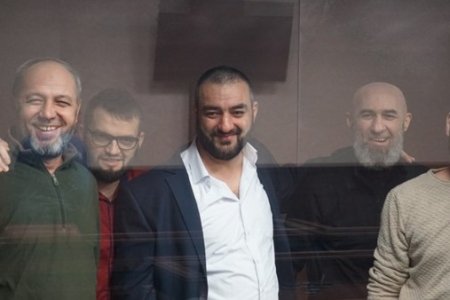
Russia split the 25 political prisoners into five groups, staging the same cloned ‘trial’ with each. Tofik Abdulgaziev was found ‘guilty’ on 12 May 2022, together with four other civic activists: Bilyal Adilov (b. 1970); Vladlen Abdulkadyrov (b. 1979): Izet Abdullayev (b. 1986),; and Medzhit Abdurakhmanov (b. 1975). Presiding judge Rizvan Zubairov, together with Maxim Nikitin and Roman Saprunov from the Southern District Military Court sentenced Adilov to 14 years; Abdulgaziev and the other men to 12 years. In all cases the first five years were to be in a prison, the worst of all Russia’s penal institutions. These shocking sentences against evidently innocent men were upheld on 17 May 2023 by ‘judge’ Anatoly Solin and two colleagues from the Military court of appeal in Vlasikha (Moscow region).