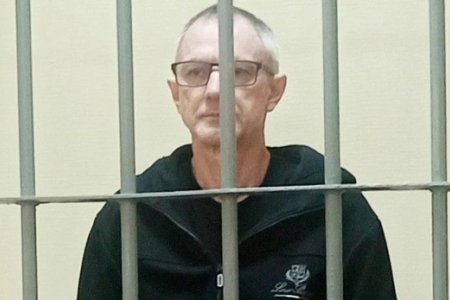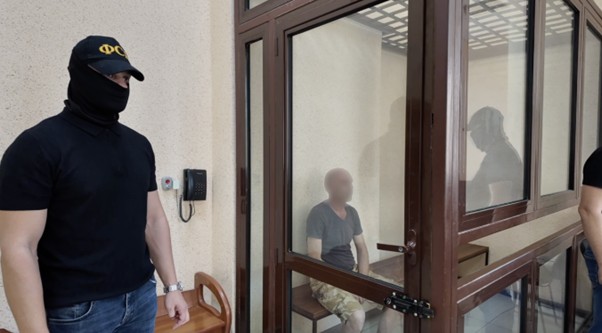
Russia’s occupation ‘Crimean high court’ has sentenced 44-year-old Taras Khudak to an unprecedentedly harsh 18 years’ maximum-security imprisonment on charges that seem otherwise copy-pasted from a huge number of similar ‘trials’. Khudak was accused of ‘state treason’, with the Ukrainian claimed to have “betrayed Russia” by passing on to Ukraine information about the position of Russian air-defence systems in occupied Feodosia.
The indictment and almost certainly symbolic nature of any ‘trial’ are standard, as is Russia’s cynical excuse for bringing ‘treason’ charges under Article 275 of Russia’s criminal code. The alleged ‘spying’ is claimed to have been ‘treason’ because Khudak has Russian citizenship without which the Russian invaders have made it impossible to live on occupied territory.
In reporting the sentence, Crimean Tribunal noted both its template nature and two specific features. Russian propagandists were not even concealing the fact that Khudak had been targeted because he is from Ivano-Frankivsk, in Western Ukraine, and because his brother served in Ukraine’s Armed Forces.
The other feature is undoubtedly important, although it has become anything but uncommon under Russian occupation. Taras Khudak is one of an ever-increasing number of Ukrainian citizens who have been abducted, held incommunicado, without any official charges being laid, for a very long time with Russia’s FSB denying any knowledge of their whereabouts.
Khudak, a businessman from Feodosia, was abducted in April 2025, yet it was only on 10 September 2025 that Russian media, citing the FSB, reported his supposed ‘arrest’. It was claimed that he had “passed to Ukraine photos, videos and electronic files containing the coordinates of military structures, sites of critical infrastructure and air-defence systems.”
There were reports also in December stating that the same, unnamed, person from Feodosia was to go ‘on trial’. As is virtually always the case, the next thing heard was that Khudak had been sentenced to 18 years maximum-security imprisonment. The sentence, Crimean Process reports, was passed by a former Ukrainian judge, turned traitor, Victor Sklyarov. All such ‘trials’ are behind closed doors, however the public or media are usually allowed in for the reading of the verdict / sentence. Here, however, Crimean Process points out, all information was concealed, making it impossible to know in advance about the passing of sentence on 4 February. Information was published post-fact.
The secrecy behind all of these ‘trials’ is also highly selective, with the notorious collaborator Aleksandr Talipov and his Crimean SMERSH vigilantes, Russian and occupation media, being provided with the ‘official’ version, as well as a video, almost certainly of a staged ‘arrest’, and of a videoed ‘confession’. While all such alleged confessions are almost certainly obtained under duress from people held incommunicado, without access to proper lawyers, it is noticeable that Khudak begins by describing his criticism on social media of Russia’s full-scale invasion of Ukraine in 2022. After that, the story is essentially that presented in the indictment, that he was contacted by a representative of Ukraine’s Security Service, and provided the videos, photos, etc. sought. While quite possible that all of this is complete nonsense, the suspicion does arise that Russia’s FSB deliberately set Khudak up, having noted his opposition to the full-scale invasion; his Ukrainian defender brother and even his Western Ukrainian roots. It seems conceivable that the video is supposed to arouse such suspicions, with the information campaign around Russia’s version of Khudak’s supposed ‘spying’ and the appalling sentence aimed at sending a chilling message to others in occupied Crimea of what they too could face if they do not keep their heads low.