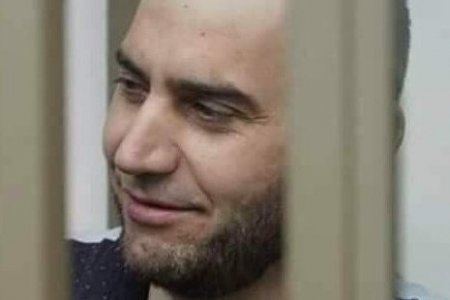
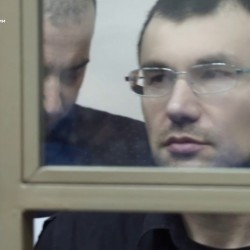
Exactly 10 years ago, in the early hours of 11 February 2016, armed Russian enforcement officers burst into a number of homes in the Yalta region, taking four men prisoner – well-known Crimean Tatar human rights activist Emir-Usein Kuku (b. 1976); Muslim Aliev (b. 1971) Inver Bekirov (b. 1963); and Vadim Siruk (b. 1989); Young children were woken up by masked men, quite unnecessarily breaking down doors, smashing windows and brandishing machine guns, as they forced their fathers to the ground and then took them away in handcuffs. Russia had brought violence, enforced disappearances and politically motivated repression with its invasion and occupation of Crimea, however the ‘operation’ on 11 February 2016 brought a new level of terror to occupied Crimea. This terror has since particularly targeted human rights activists, civic journalists and others with a pronounced civic position and left well over 200 children traumatized and growing up without their fathers or, since 2025, without either parent.
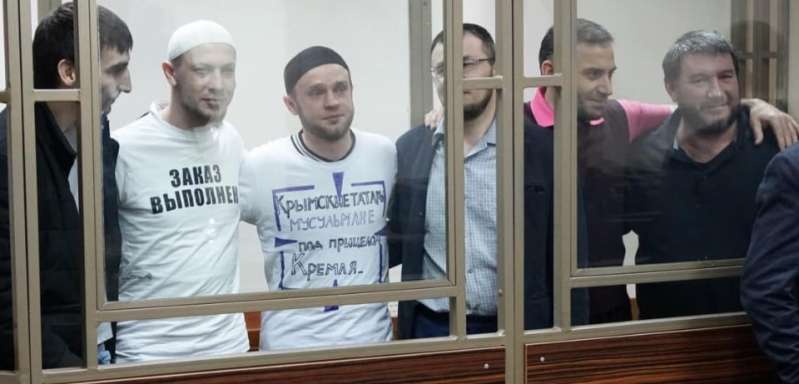
It was the events of that day, demonstrating the mounting repression against Crimean Tatars and a small number of other Crimean Muslims that led to the emergence of the Crimean Solidarity human rights movement and of Crimean Childhood, a related organization helping the children of political prisoners. Russia’s reprisals against Crimean Tatars and their representative organization, the Mejlis, had begun earlier, however it is doubtless no coincidence that so many Crimean Solidarity journalists and activists have first actively monitored and reported on armed arrests, like those on 11 February 2016, and the subsequent political trials, only to then be arrested themselves and sentenced to 10-20 years’ imprisonment.
The arrests on 11 February 2016, as well as those on 18 April that year of two very young Crimean Tatars - Refat Alimov (b. 1991) and Arsen Dzhepparov (b. 1991) were not Russia’s first use of flawed ‘terrorism’ charges. If the lack of international attention to Russia’s first arrests in January 2015 emboldened the invaders to assume similar indifference, they were, thankfully, mistaken. Russia’s persecution of Emir-Usein Kuku was all too evidently linked with his work monitoring human rights violations in the Yalta region for the Crimean Contact Group on Human Rights. More also began coming to light, thanks, in particular, to courageous lawyers (Emil Kurbedinov, others) and civic activists. Kuku had already twice faced persecution before (in April 2015, then in December that year) with the first occasion only turning into an FSB ‘search’, beating and interrogation after a likely abduction attempt went wrong. Muslim Aliev had, just as clearly, been targeted for his civic position and his religious ‘dissidence’, with it no coincidence that two other Crimean Tatars from the ‘Alushta’ Muslim community have since faced essentially identical charges and massive sentences. There are strong grounds for believing that Envir Bekirov faced worst charges and that his nephew, Refat Alimov, was arrested because Bekirov had refused to ‘cooperate’ by providing false testimony against other men. Arsen Dzhepparov’s wife recounted how the couple had known for some time that the FSB would come for Arsen because he had refused to provide such covert ‘services’ to the FSB. Vadym Siruk, an ethnic Ukrainian convert to Islam, may have been targeted as a warning to other converts, as well as for his clear civic position.
We also know from an interview given by Damir Minadirov, a friend of Kuku’s who was also targeted on 11 February, of the threats and torture used to try to force others to provide false testimony.
Flawed conveyor-belt ‘terrorism’ charges
The men were all accused of unproven ‘involvement’ in Hizb ut-Tahrir, a peaceful, if controversial, transnational Muslim organization which is legal in Ukraine. Not only was the Russian supreme court ruling in 2003 that declared Hizb ut-Tahrir ‘terrorist’ passed in suspicious secrecy, without any explanation, but it has also been superseded. A new law, passed three years later, gives clear criteria for declaring an organization ‘terrorist’, criteria which have never been met in the case of Hizb ut-Tahrir.
Muslim Aliev and Inver Bekirov were designated the role of ‘organizer’ of the so-called ‘Hizb ut-Tahrir cell’, under Article 205.5 § 1 of Russia’s criminal code, while the others were charged with ‘involvement’ under Article 205.5 § 2.
This was Russia’s second such ‘Hizb ut-Tahrir case’ in occupied Crimea, but the first in which the men were also accused of an even more surreal charge, namely ‘planning violent seizure of power’ (Article 278).
No evidence
In none of these ‘trials’ is there ever any proof even of actual involvement in Hizb ut-Tahrir, let alone of ‘terrorism’ or ‘plans to violently seize power’. The FSB and other enforcement officers who carry out armed searches never pretend to be looking for anything but ‘prohibited religious literature’. More often than not, they bring such books, and claim to have ‘found’ them, usually in places no devout Muslim would dream of placing religious books. There are usually illicitly taped conversations – about religion, political persecution, bringing up children, courage, etc. The FSB typically send transcripts, often with mistakes, to FSB-loyal ‘experts’ who can be relied upon to claim to perceive such ‘evidence’, sometimes in the use of a perfectly common word in Crimean Tatar.
The main prop in all such ‘trials’ is provided by supposed ‘testimony’ of ‘secret witnesses’ whose claims cannot be verified, and who tend to repeat the indictment virtually verbatim, and ‘not remember’ the answers to the simplest of questions. ‘Judges’ from the notorious Southern District Military Court in Rostov invariably allow such secrecy and also block questions from the defence aimed at demonstrating that the alleged ‘witness’ is lying. Russia’s use of anonymous ‘witnesses’ has been condemned by the UN Secretary General and was found to be in violation of defendants’ right to a fair trial in 2020, long before Russia’s withdrawal from the European Court of Human Rights in 2022.
Predetermined ‘guilty’ verdicts and sentences
On 12 November 2019, ‘judges’ Roman Viktorovich Saprunov; Dmitry Viktorovich Merkulov and Roman Vladimirovich Podolsky from the Southern District Military Court in Rostov handed down the six guilty verdicts required of them. These were, on 25 June 2020, upheld by Oleg Aleksandrovich Yegorov; Aleksander Aleksandrovich Mordovin and Anatoly Valentinovich Solin from the Vlasikha military court of appeal. Muslim Aliev and Inver Bekirov were sentenced to 19 years; Emir-Usein Kuku and Vadym Siruk – to 12 years; Refat Alimov to 8 years and Arsen Dzhepparov to seven years. Not one Ukrainian political prisoner has ever been released early, and both Refat and Arsen served their sentences to the last day, The sentences were for maximum-security (or ‘harsh-regime’) prison colonies, with prison administrations imposing even harsher conditions on Crimean Tatar and other Ukrainian political prisoners.
All six men had been recognized as political prisoners by Memorial long before the sentences were announced, and were also declared prisoners of conscience by Amnesty International.
Emir-Usein Kuku was 39 when he was seized 10 years ago. His son, Bekir, was nine, his daughter, Safiye, just 5. Muslim Aliev has four children, two of them with heart conditions, and had become an active member of the ‘Alushta’ Muslim community when his daughter became gravely ill. He was the only breadwinner and had been working at several jobs to pay for the medical treatment his children needed. His younger son, Seidali, was just seven when he saw masked and armed men come for his father and was profoundly traumatized. 53-year-old Enver Bekirov has three children, two of whom were still underage when he was taken away. Vadym Siruk’s wife, Anna Bogucheva gave birth to their second daughter soon after her husband’s arrest. Arsen Dzhepparov’’s daughter Evelina was still quite small when he was arrested. During the weeks when he and his wife Zarina knew that he faced imprisonment for his refusal to collaborate, Arsen had asked how he would ever be able to tell Evelina about conscience and honour if he had helped persecute innocent men who also had wives and children.
During his final address to the court, Vadym Siruk had spoken of the persecution that Russia had brought to his peaceful Crimea where all had lived side by side, without any suggestion of terrorism.
“The real terrorists are those who burst into the homes of people peacefully sleeping, who intimidate people who tell the truth; those who have turned a resort peninsula into a military base, bringing in thousands of items of military technology; and those who persecute and imprison people for their political and religious views.”
Please write to Emir-Usein Kuku; Muslim Aliev; Inver Bekirov and Vadym Siruk!
Letters are a lifeline to the men and send an important message to Moscow that its treatment of Ukrainian political prisoners is under scrutiny. Letters, unfortunately, need to be in Russian, handwritten, and on ‘safe’ subjects. If that is a problem, you could send the brief sample below (or try something like ChatGPT).
Sample letter
Привет,
Желаю Вам крепкого здоровья и надеюсь, Вы скоро вернетесь домой, к своим родным. Простите, что мало пишу – мне трудно писать по-русски, но мы все о Вас помним.
[Hi. I wish you good health and hope that you will soon be home, with your family. I’m sorry that this letter is short – it’s hard for me to write in Russian., but you are not forgotten. ]
Addresses (these can be in English or Russian, as below)
Addresses (these can be in English or Russian, as below)
Muslim Aliev
453256, Россия, Республика Башкортостан, г. Салават, станция Южный, ФКУ ИК-2
Алиеву, Муслиму Нуриевичу, 1971 г.р.
[In English: Russian Federation, 453256, Bashkortostan, Salavat, Stantsiya Yuzhny, Prison No. 2
Aliev, Muslim Nurievich, b. 1971 ]
Inver Bekirov
453256, Россия, Республика Башкортостан, г. Салават, станция Южный, ФКУ ИК-2
Бекирову, Инверу Небиевичу, 1963 г.р
[In English: Russian Federation, 453256, Bashkortostan, Salavat, Stantsiya Yuzhny, Prison No. 2
Bekirov, Inver Nebiyevich, b. 1963 ]
Emir-Usein Kuku
453256, Россия, Республика Башкортостан, г. Салават, ФКУ ИК-16
Куку, Эмиру-Усеину Кемаловичу, 1976 г.р.
[In English: Russian Federation, 453256, Bashkortostan, Salavat, Prison No. 16
Kuku, Emir-Usein Kemalovich, b. 1976 ]
Vadym Siruk
453256, Россия, Республика Башкортостан, г. Салават, станция Южный, ФКУ ИК-2
Сируку, Вадиму Андреевичу, 1989 г.р.
[In English: Russian Federation, 453256, Bashkortostan, Salavat, Stantsiya Yuzhny, Prison No. 2
Siruk, Vadim Andreevich, b. 1989 ]