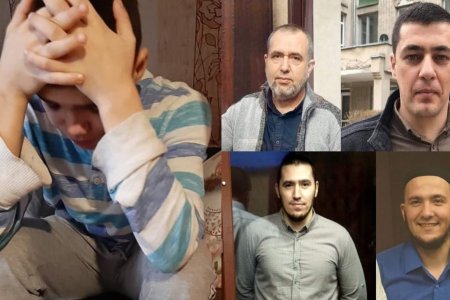
Amet Suleimanov has been waiting for life-saving heart surgery for 18 months with no sign of any movement, despite disturbing echocardiogram readings. It is increasingly clear that Russian prison authorities prefer to ignore the law and jeopardize the lives of Crimean Tatar and other Ukrainian political prisoners rather than risk annoying those in power who demanded their imprisonment.
Suleimanov’s wife, Lilya Liumanova was allowed a brief visit with her husband at the beginning of February. Despite having illnesses which, even according to Russian legislation should preclude imprisonment, he is held in the appalling conditions of the Vladimir Central prison.
As well as seeing her husband, Liumanova was able, finally, to receive the results of an echocardiogram which he was given in August 2025. Although this was well over six months ago, Suleimanov’s lawyer, Lilya Hemedzhy had not been given it, even after she was forced to lodge a complaint with the prosecutor’s office. The regional penal service claimed that they had sent the document by post, however scepticism seems warranted and, certainly, nothing was received.
In speaking with Crimean Solidarity about the results of the echocardiogram, Liumanova stressed that she is not a doctor, but it is, nonetheless, clear just from comparing the last two tests that the results have worsened, with the grounds for concern only confirmed by seeing her husband’s condition. This is clearly adversely affected by his permanently high blood pressure, and by the likely blood clot which caused severe bruising on his leg. As reported, after consulting with a doctor in Crimea, Liumanova twice sent medication, only to have it returned, with no explanation, just the words “not allowed”. It was finally accepted on a third attempt. Liumanova stresses that all such medication is aimed at strengthening his organism, with all the symptoms indications that his body is having to deal with something more global.
All of the Russians implicated in Suleimanov’s persecution, including, it would seem, medical personnel, are aware that Suleimanov suffers from chronic rheumatic heart disease, aortic insufficiency, coronary artery disease and third level mitral valve prolapse. He had needed a heart valve transplant even before his arrest in March 2020 and had been forced to suspend his journalist work for the Crimean Solidarity human rights initiative because of his worsening state of health.
Liumanova stresses that if her husband is not operated on soon, the load will all be transferred to a second heart valve which will also need to be replaced.
It became clear in October 2024 that Suleimanov had been removed from the waiting list for a heart valve replacement, and that this had taken place at the end of 2021, at the initiative of the occupation ‘Crimean health ministry’. Attempts since to get some movement on an operation so urgently needed receive fob-off replies. Liumanova is told that an application has been made to Moscow and that “they’re waiting”, with this translating into nothing is happening.
Suleimanov has suffered two hypertensive crisis since the recognized political prisoner was first taken into Russian captivity. Each such crisis, and the strain this places on vital organs, place his life in jeopardy. His eyesight has also deteriorated dramatically, with the doctors diagnosing eye angiopathy, a disease of the blood vessels in the retina, with this doubtless caused by his permanently high blood pressure which is not being addressed. The condition is compromising his balance and could lead to blindness.
Amet Suleimanov (b. 1980) was arrested on 11 March 2020, together with the two elder sons of a prominent Crimean Tatar historian – Seitumer Seitumerov (1988) and Osman Seitumerov (b. 1992), as well as their maternal uncle –Rustem Seitmemetov (b. 1973).
The FSB had clearly marked out their targets according to journalist or civic activist activities, and appear to have only understood, during Suleimanov’s arrest, that he would not survive detention. He was the first of Russia’s Crimean political prisoners to be ‘only’ placed under house arrest, with this continuing until after the appeal hearing against his 12-year sentence. Unfortunately, it seems likely that any such moves were aimed solely at avoiding the political prisoner’s death before his predetermined conviction. All players since then, including ‘judges’, prosecutors and penal service employees have all focused solely on covering their tracks, as seen with the ‘medical commission’ which, in March 2024, ignored the findings of specialists set out in the same report, and claimed that Suleimanov had no illnesses that precluded detention. More details about the commission and the member who told Suleimanov that he would be released 20 minutes before death here.
As well as multiple calls from the UN General Assembly, OSCE, the EU and other bodies to release all Ukrainian political prisoners, Russia has ignored an important interim decision issued by the United Nations Committee against Torture [CAT] on 22 February 2023. CAT called on Russia to abstain from implementing Suleimanov’s 12-year prison sentence since this would likely result in his death. It asked Russia to ensure that Suleimanov received a comprehensive medical examination in a specialized medical facility and that he underwent heart surgery and/or treatment in accordance with the results of the examination.
All of this has been openly flouted. On 26 June 2024, the Frunze district court in Vladimir rejected an appeal against a ruling from the same court in March 2024 which claimed there to be no grounds for releasing Suleimanov from custody. During the June hearing, the defence produced an expert assessment which confirmed that Suleimanov suffers from two illnesses which preclude imprisonment according to Russia’s own list. They also pointed to the contradictory nature of the ‘medical examination’ illegally carried out by the Penal Service after Suleimanov was moved to the prison in Vladimir. The ‘conclusion’ reached by the ‘doctors’ who signed this ‘expert assessment’, aimed at allowing Suleimanov to be held in prison, was in conflict with the data and conclusions reached by the specialists, including a cardiologist. Hemedzhy stressed that the international classification codes applied by these specialists fully coincide with those illnesses which even Russia acknowledges are incompatible with imprisonment. The court was not, therefore, put in a position where it had to decide which of two medical assessments it should believe, since the findings of the independent assessment, fully coincided with the data and conclusions of the narrow specialists ‘consulted’, but then ignored, for the Penal Service assessment.
The charges against Amet Suleimanov, Rustem Seitmembetov and Seitumer and Osman Seitumerov differed little from the claim of ‘counter-revolutionary terrorist propaganda’, used during Stalin’s Terror to execute the Seitumerov brothers’ great-grandfather. In occupied Crimea, Russia is using a deeply flawed Supreme Court ruling from 2003 to imprison men on ‘terrorism’ charges without even accusing them of a recognizable crime and is targeting journalists and civic activists from the Crimean Tatar human rights movement.
The men were essentially accused only of supposed ‘involvement’ in the peaceful transnational Hizb ut-Tahrir Muslim organization, which is legal in Ukraine and not known to have committed acts of terror anywhere in the world. No proof is even needed of actual involvement in Hizb ut-Tahrir, since the FSB invariably plant ‘prohibited literature’ which they then claim to have found during armed searches which they prevent lawyers from being present at. Illicitly taped and innocuous conversations about religion, Russian persecution, events in Crimea are passed to FSB-‘experts’ who claim that this or that word ‘proves’ involvement in Hizb ut-Tahrir. They also recruit ‘anonymous witnesses’ who invariably repeat the indictment, while proving suspiciously unable to provide any other details about the defendants whom they claim to have known well. All of this is seen and clearly understood by the ‘judges’ who prevent the defence from asking questions which demonstrate that such ‘witnesses’ are lying and that the ‘experts’ have no competence to express an opinion.
Seitumer Seitumerov was charged under the more serious Article 205.5 § 1 of Russia’s criminal code with ‘organizing a Hizb ut-Tahrir group’, while his brother, uncle and Suleimanov were charged with ‘involvement’ in this entirely unproven ‘group’, under Article 205.5 § 2. All of the men were also accused of ‘planning a violent uprising’ (Article 278) although even the FSB admitted that not one of them was suspected of actions or direct plans to commit any action aimed at ‘overthrowing the Russian constitutional order’
Despite the flawed charges, non-existent evidence and the fact that any custodial sentence would kill one of the men, prosecutor Yevgeny Nadolinsky demanded horrific sentences against all four men, including 13 years in the case of Suleimanov (whom he had previously tried to get remanded in custody). On 29 October 2021, three ‘judges’ from the Southern District Military Court in Rostov (Russia) - Igor Kostin (presiding judge); Roman Plisko and Yevgeny Zviagin – largely obliged, sentencing Seitumer Seitumerov to 17 years; Osman Seitumerov to 14 years; Rustem Seitmemetov to 13 years and Amet Suleimanov to 12 years. All of these sentences are for the worst of Russian penal institutions, with the first 3.5 years to be spent in a prison, where the conditions are most shocking.
These sentences were upheld on 9 February 2023, by ‘judge’ Aleksandr Aleksandrovich Mordovin from the Military Court of Appeal in Vlasikha (Moscow region).