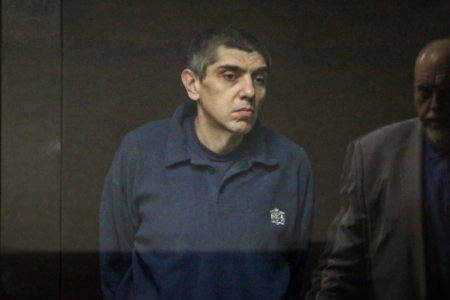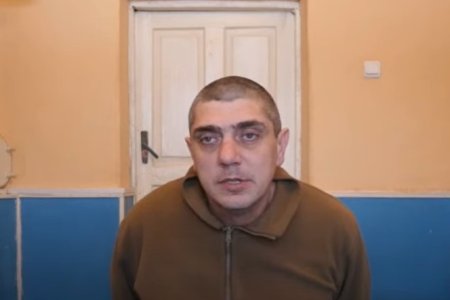
Russia has implicitly acknowledged that its full-scale invasion of Ukraine was a crime in its latest surreal prosecution of Anton Saikhiev, a Ukrainian prisoner of war persecuted for his role in the defence of Mariupol in 2022. On 25 February 2026, a court in Buryatia found Saikhiev guilty of ‘discrediting Russia’s army’ by stating that the latter attacked Ukraine. While Russia’s war of aggression undoubtedly discredits both the Russian regime and its military, the Ukrainian, imprisoned for defending his country, was prosecuted for telling the truth and fined 30 thousand roubles.
The sentence, first reported by Mediazona, was passed by ‘judge’ Natalia Alekseyevna Kuzubova of the Oktyabrsky district court in Ulan Ude. The Ukrainian POW was prosecuted under one of four articles of Russia’s administrative and criminal codes, rushed into law within ten days of Russia’s full-scale invasion of Ukraine and clearly aimed at crushing protest over the latter. Article 20.3.3 of Russia’s Code of administrative offences punishes for what are claimed to be actions or words “aimed at discrediting Russia’s armed forces”, with the scope of the charge soon extended to any fighters, including the convicted criminals recruited from prison to fight in the notorious Wagner unit, taking part in Russia’s war against Ukraine. In her ruling, Natalia Kuzubova essentially repeats the verbiage of the charge, claiming that Saikhiev had, “publicly, in the presence of prisoners, carried out actions aimed at discrediting the use of the armed forces of the RF to defend the interests of the Russian Federation and its citizens, to support international peace and security” [sic], with this, purportedly having ‘undermined confidence’ in what the ‘judge’ follows the official line in referring to as Russia’s ‘special military operation’ on Ukrainian territory.
Saikhiev was claimed to have done this by stating “that the Russian army attacked Ukraine, that it occupied Ukrainian territory and that the presence of the Russian army on Ukrainian territory is unlawful; that the Russian army killed civilian residents and bombed Ukrainian social sites”.
In short, Saikhiev was accused and convicted of stating entirely incontrovertible facts about Russia’s war against Ukraine. Russia’s use of flawed legislation to try to rewrite history predates Russia’s full-scale invasion of Ukraine, with both a Perm court and Russia’s supreme court upholding a surreal criminal prosecution against Vladimir Luzgin for reposting a text which correctly stated that the Soviet Union, in collaboration with Hitler, had invaded Poland in 1939. Since 3 March 2022, Article 20.3.3 and obedient ‘courts’ have been used to prosecute thousands of Russians and Ukrainians from occupied territory for telling the truth about Russian crimes in Ukraine, with the fact that Russia’s defence ministry denies all the correct charges deemed sufficient grounds.
The ruling named two prisoners who confirmed what Saikhiev had said, claiming that they had not been placed under any pressure. That was, quite likely, not the case, however Saikhiev himself is said to have not denied his words. Nor, of course, did he have any reason to do so, however Kuzubova was still prepared to find him ‘guilty’ and fine him 30 thousand roubles. Saikhiev is a prisoner of war, with defenders of Mariupol known to be treated with particular brutality and harshness, so it is by no means clear that he would be able to appeal within the requisite ten days. Although Kuzubova repeated the standard wording about payment of such fines, the practical impact of the ruling would probably only be if Saikhiev’s family were able to transfer money for him to use in the prison shop, since the prison authorities could use that money to pay the fine.
Anton Saikhiev (b. 14.07.1987) was among the defenders of Mariupol who were taken prisoner in May 2022. He was serving in the Twelfth Operational Brigade of Ukraine’s National Guard, with this including a separate ‘Azov’ special purpose unit. When declaring Saikhiev, together with three other Ukrainian POWs - Vasyl Bovkun, Oleksandr Maksymchuk and Artur Tkachenko political prisoners, the authoritative Memorial Support for Political Prisoners Project noted that, in Sakhiev’s case it was not clear whether he was a member of the Azov unit. This is of relevance given the fabricated pretext used to sentence the Ukrainian prisoner of war to 18 years’ maximum-security imprisonment on fake ‘terrorism’ charges.
All such ‘trials’ and sentences are based solely upon a ruling issued by Russia’s increasingly political supreme court on 2 August 2022. This outlawed the Azov Regiment, claiming it to be ‘a terrorist organization’. Although the original Azov Battalion had been formed as a voluntary formation in 2014, it became part of Ukraine’s Armed Forces in 2015, and all members of the Regiment are military servicemen. The ruling, therefore, was internationally condemned and widely understood as aimed at persecuting Ukrainian defenders of Mariupol, many of whom were serving in the Azov Regiment.
The ruling itself was kept hidden for three weeks and would have been concealed till now had Russia not come up with grotesque charges against Sergei Davidis, Head of Memorial and been forced to hand the ruling over to Memorial. The latter reported that the real reason for the secrecy was doubtless because of the ‘glaring weakness of the arguments given. If there is anything interesting in the ruling, it is purely that it yet again demonstrates the contempt for the law at its very basis”.
Defending one’s country cannot be ‘terrorism’, nor can a politically motivated ruling passed when the men were already in Russian captivity justify their prosecution, as the law is not retroactive. Other, equally insane, rulings have been issued to provide pretexts for Russia to stage equally absurd ‘terrorism trials’ against Ukrainian defenders serving in the Aidar Battalion, the Donetsk Battalion and the 48th Separate Assault Battalion, named after Noman Çelebicihan, all of which are parts of Ukraine’s Armed Forces.
As in most such prosecutions, Saikhiev was charged with ‘involvement in a terrorist organization’, under Article 205.5 § 2 of Russia’s criminal code, and with ‘training in terrorist activities’ under Article 205.3.
All of this is in flagrant violation of the Geneva Convention relative to the Treatment of Prisoners of War, and Saikhiev, like all other prisoners of war charged effectively with defending their country against an invader, should be released, not subjected to further cynical ‘trials’.