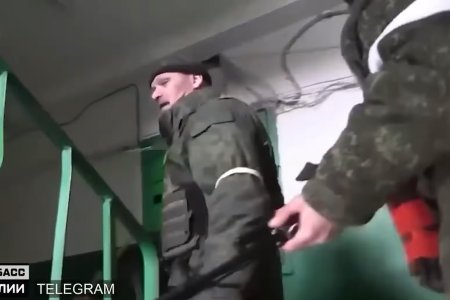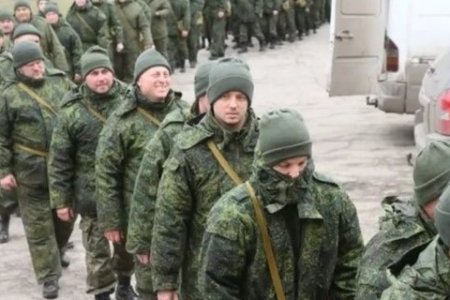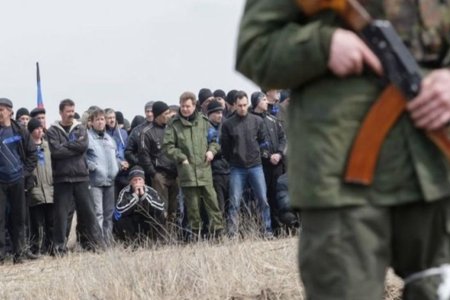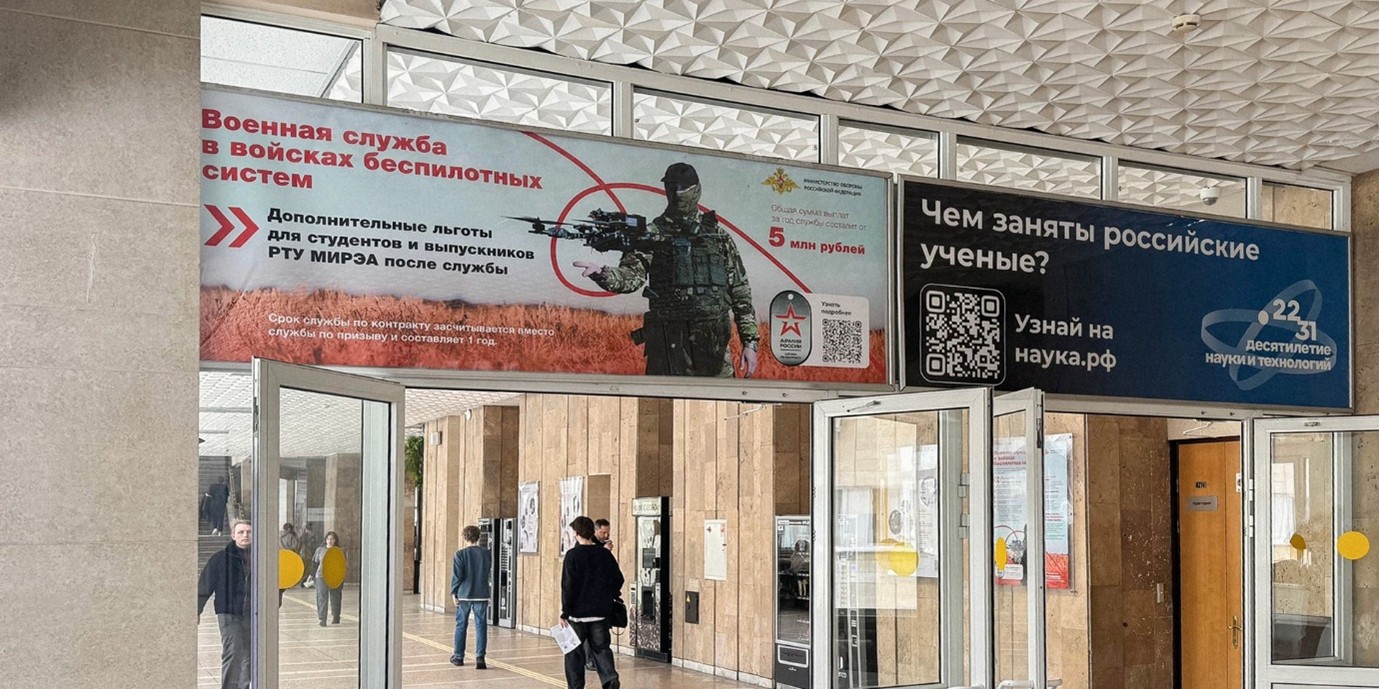
At least one higher educational institute in occupied Crimea is implicated in Russia’s latest drive to gain new cannon fodder for its war against Ukraine. The real number may, unfortunately, be higher, with institutes not always eager to broadcast the illegal methods used to terrorize or trick students into agreeing to sign contracts with Russia’s defence ministry.
Russia’s new ‘campaign’ began in December 2025 or, at least, entered a new, aggressive phase. Russia has, after all, been trying to convince young people since 2014 that they should want to fight and be willing to die for what the regime wants them to believe is their country. It was also clear back in 2014 -15 that conscripts in Russia were being forced into signing contracts to fight Russia’s undeclared war against Ukraine in Donbas. Russia could not legally send conscripts to fight a war on foreign territory that Russia was claiming to have nothing to do with. Instead, the command made conditions intolerable enough for the conscripts themselves to agree to go as ‘contract soldiers’.
Since December 2025, universities and other higher educational institutes have been actively pushing students to take what they claim is a year’s leave from their studies and sign contracts supposedly to serve in an elite drone unit. All of this is deception, as lawyers have pointed out that there is no such one-year guaranteed period, with the young people, if they sign a contract with the defence ministry, very unlikely to be released. The lure of acquired skills and relative safety as drone pilots is also a lie. There is no guarantee that the students will not, either immediately or soon after they have effectively become contract soldiers, be transferred to another unit where there is much more likelihood that they will be killed fighting.
In late February, EKHO reported that students were being ‘recruited’ in at least 70 educational institutions over 23 regions of the Russian Federation, as well as one in occupied Crimea (part of the Lebedev Russian state university of justice). Other publications, such as Important Stories, have reported broadly similar figures, with all stressing that the real figure is likely to be higher. Since the same trend and similar methods have been reported over such a wide geographical expanse, it is clear that the initiative came ‘from above’. While it is probably the defence ministry which is behind this “new way of [illicit] mobilization”, there is no way it could be carried out without the complicity of Russia’s ministry of science and higher education, not to mention the staff of specific institutes. There are also reports that institutes are working to ‘quotas’ of students agreeing to sign contracts.
While students cannot, officially, be forced into signing such contracts, there are always methods. Students whose results have been poor or who have fallen behind can be threatened with expulsion if they don’t sign contracts’. This is illegal, with there strict rules about students being allowed to retake exams that they have failed at least twice before expulsion. That, however, is dependent on students knowing their rights, and feeling confident enough of being able to defend them. In the case of students who have received loans or money from employees, the threat of being made to return the money would be a powerful weapon of coercion. There are ‘incentives’, as well as threats, with students who were otherwise paying for their studies being offered state-financed places, as well as various payments, etc. There is, of course, also the intensive propaganda which Russia has been pushing since 2014, with students, including in occupied parts of Ukraine, constantly told that this is about defending the motherland’, and wanting to “protect Russia” [sic].
There have been a number of publications about this illicit form of mobilization, with human rights activists and lawyers advising students on their rights. Such publicity is important, especially when it clearly spells out the illegality of the methods of coercion. Virtually all such independent media are, however, labelled ‘foreign agents’ or otherwise under persecution in Russia and on occupied territory, where the regime is also blocking access to independent messenger apps and even making access to the Internet difficult. These are also among the multiple ways in which the regime seeks to block independent information and make it easier to manipulate or coerce students into agreeing to go and fight, with every likelihood that they will not return alive.
The situation is shocking in Russia, but far worse in occupied parts of Ukraine where the aggressor state is violating international law and openly or covertly mobilizing Ukrainians to fight their compatriots as part of an invading army.
Russia began its criminal use of conscription in occupied Crimea soon after its invasion and even prior to its full-scale invasion, some 34 thousand Crimeans had been forced to serve in the Russian army. It has long committed a second war crime through its active propaganda of military service and militarization, particularly among children and young adults. All of this is in flagrant violation of the Fourth Geneva Convention which, in Article 51, states unambiguously that “the Occupying Power may not compel protected persons to serve in its armed or auxiliary forces. No pressure or propaganda which aims at securing voluntary enlistment is permitted”.
Russian leader Vladimir Putin’s supposedly limited mobilization in the second half of 2022 appeared to particularly target Crimean Tatars in occupied Crimea. In occupied Donbas, Ukrainian men had been forcibly sent to fight, regardless of their state of health, from February 2022, with this now a grave danger on all occupied territory.