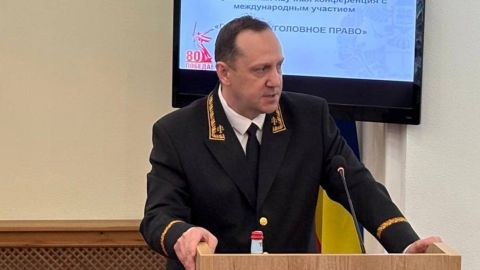
Sergei Viacheslavovich Obraztsov, a judge at Russia’s Southern District Military Court, has been convicted by a Ukrainian court of war crimes over his part in the 18-year sentence passed against Ukrainian prisoner of war Vladyslav Plakhotnik. The 18-year-old soldier was one of the first Ukrainian prisoners of war [POW] to have been ‘tried’ under Russia’s deeply flawed ‘terrorism’ legislation for defending Ukraine. There was simply no possibility that Obraztsov was not aware that he was putting prisoners of war, who have protected status, ‘on trial’ for serving their country, with this unequivocally prohibited by the Geneva Conventions, to which Russia is a party.
Massive sentences of up to life imprisonment against Ukrainian prisoners of war are now churned out by Russian ‘judges’ on a regular basis, so the ruling is of particular importance. Although Obraztsov is not in custody and was, therefore, tried in absentia’, the verdict is important, and not only because it clearly identifies such violations of international law as a war crime. The conviction can, hopefully, be used to get international warrants issued against Obraztsov, meaning that he would face arrest and possible extradition to Ukraine if apprehended while travelling abroad.
The trial before the Shevchenkivsky District Court in Kyiv was followed by Alina Kondratenko from the Media Initiative for Human Rights [MIHR] who reported the 10-year sentence on 18 March 2026. The prosecutor had asked for an 11-year sentence.
Russia began concocting ‘trials’ of Ukrainian prisoners of war in 2023, with men taken prisoner while defending their country very often accused of precisely those killings of civilians that the Russian invaders were committing on Ukrainian soil. These were ‘trials’ and sentences handed down, most often by kangaroo courts on occupied territory, with the only ‘evidence’ being videoed ‘confessions’ posted by Russia’s Investigative Committee or the so-called ‘courts’. It was clear and has been confirmed by those POWs later released in prisoner exchanges, that such ‘confessions’ are extracted through horrific forms of torture.
It was in June 2023 that Russia first set about using an especially cynical charge against POWs, with no attempt to fabricate other reasons for prosecution besides the fact of the men and women’s service in military units of Ukraine’s Armed Forces. Russia’s politically subservient Supreme Court had set the ground for some of the ‘trials’ on 2 August 2022, when it declared the Azov Regiment ‘a terrorist organization’. Although the original Azov Battalion was a volunteer formation, which arose in response to Russia’s military aggression in Donbas in 2014, it has been part of Ukraine’s Armed Forces since 2015. This is brazenly ignored by Russian courts, as is the fundamental principle that the law is not retroactive. The vast majority of Ukrainian POWs charged because of this flawed ruling, including the first show trial of 24 POWs which began in June 2023, were taken prisoner before it was handed down. Russia has since used similar rulings against other military units of Ukraine’s Armed Forces, including the Aidar Battalion; the 48th Separate Assault Battalion, named after Noman Çelebicihan; and the Donbas Battalion to sentence other Ukrainian POWs to huge terms of imprisonment on equally flawed charges.
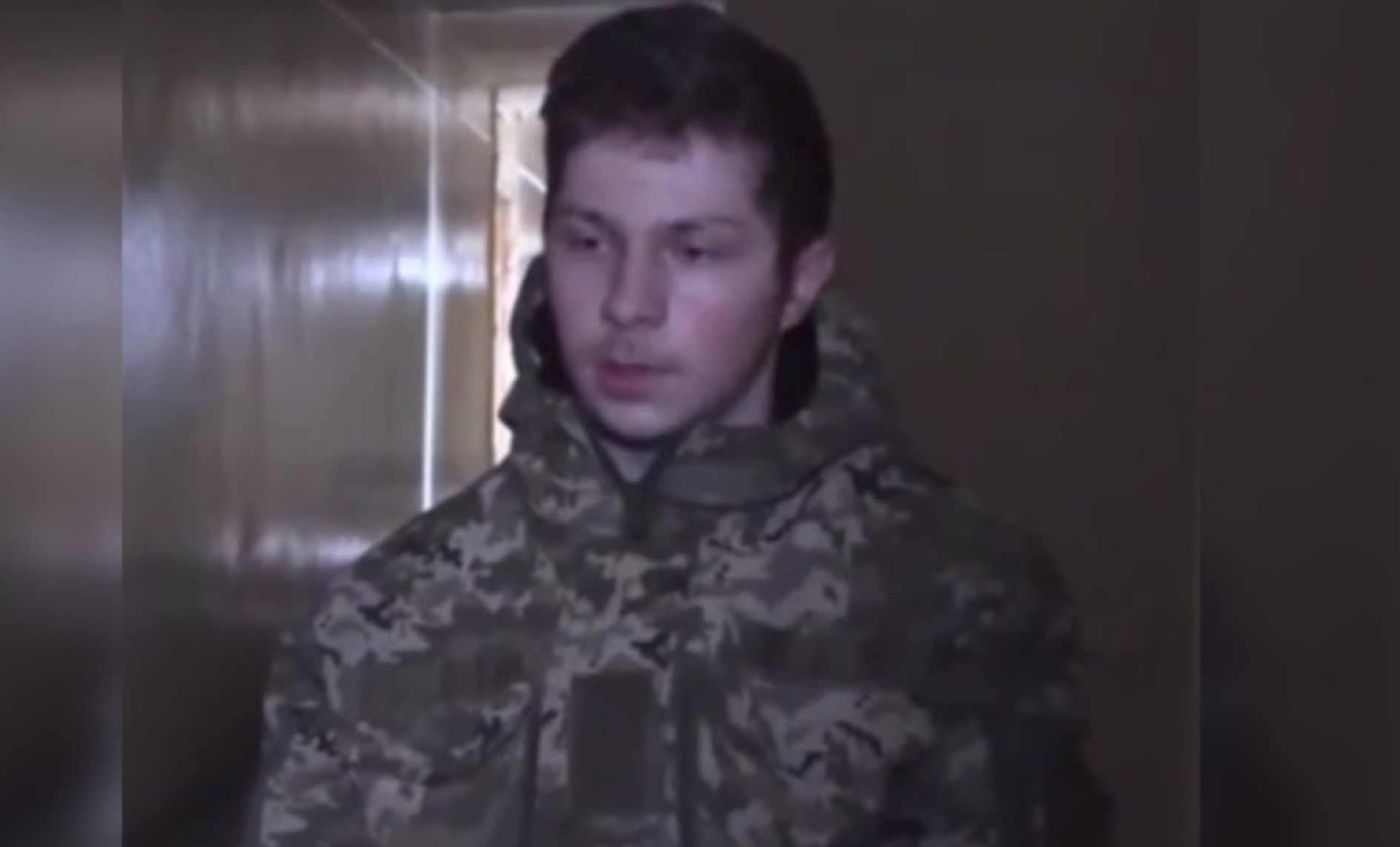
As reported, Vladyslav Plakhotnik was just 18 when sentenced by Obrazstov & Co. to 18 years’ maximum-security imprisonment for defending Ukraine as a member of the Azov Regiment. A Russian court of appeal later upheld the sentence. The young man had been taken prisoner at the end of 2023 and sentenced by Sergei Viacheslavovich Obraztsov on 3 May 2024 to 18 years’ maximum-security imprisonment, with the first three years in a prison, the harshest of Russia’s penal institutions. Plakhotnik was charged under Article 205.5 § 2 of Russia’s criminal code (‘taking part in the activities of a terrorist organization) and Article 205.3 (‘undergoing training in order to carry out terrorist activities’).with all of this based solely on the flawed supreme court ruling on 2 August 2022.
His Russian captors blindfolded Plakhotnik and forced him to take part in a vile propaganda video, on which they got him to falsely state that he had been ‘mobilized’. Vladyslav was, thankfully, released in a prisoner exchange on 4 July 2025. We now know that he was subjected to beatings, imitation executions and other torture during ‘interrogations’, and held in appalling, overcrowded conditions.
In his commentary, MIHR lawyer Andriy Yakovlev stressed that, since the Azov Regiment is a structural division of Ukraine’s Armed Forces, those serving in it are combatants according to international humanitarian law. Convicting combatants of having served in part of the Armed Forces is equivalent to criminalizing participation in military action.
Sergei Obraztsov was convicted of one specific crime over the persecution of a Ukrainian POW. He has, however, been involved in multiple trials of Crimean Tatar and other Ukrainian political prisoners and civilian hostages, most recently the shocking 22-year sentence against Crimean mother of two Nadiya Hrekova for an invented ‘terrorist attack on a Russian military officer
See also:
Russia passes massive sentences against 15 Ukrainian POWs for defending Ukraine against its invasion
Russia’s torture of Ukrainian civilians and POWs is a crime against humanity – UN investigators
Russian torture of Ukrainian civilians and POWs is clearly state-endorsed policy – UN Rapporteur