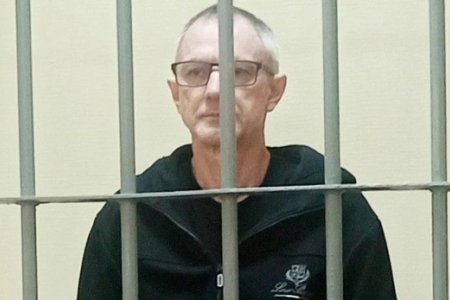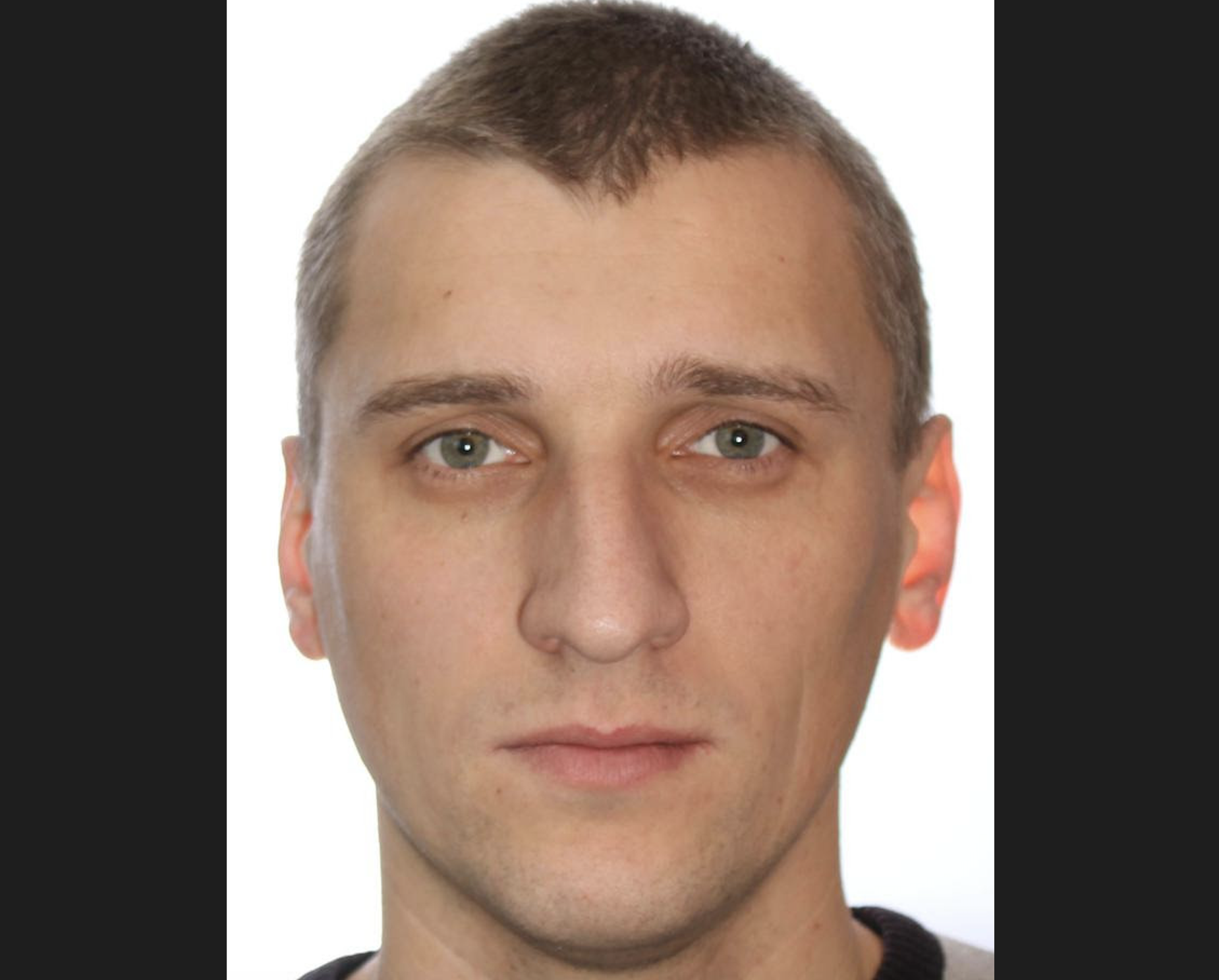
Russia’s Southern District Military Court has convicted Oleksandr Skrabunov (b. 24 October 1987) from Nova Kakhovka in occupied Kherson oblast of ‘treason’, ‘terrorism,’ and explosives charges over a number of attacks, one fatal, against officials and representatives of the occupying state. Even if 38-year-old Skrabunov had anything to do with the killing of ruling party ‘United Russia’ official Volodymyr Malov, the latter was an entirely legitimate target, with the other alleged acts also having nothing to do with ‘terrorism’. It is, in addition, quite possible that Skrabunov was seized so that the FSB could claim to have ‘solved’ the case.
Skrabunov was abducted on 3 February 2024 and has, therefore, been held in Russian captivity for well over two years, almost certainly incommunicado and without access to an independent lawyer. He appears to have been placed on Russia’s notorious ‘register of extremists and terrorists’ on 20 February 2024. Almost exactly a year later, the human rights initiative ‘If there were no war’ reported that he was in custody, accused of an attempted ‘act of terrorism’ and ‘an act of terrorism’ which killed somebody. That, however, was all that was known until the court and Russian state media reports of the sentence on 15 May 2026.
The charges against Oleksandr Skrabunov included the most cynical, if increasingly standard, ‘state treason’, under Article 275 of Russia’s criminal code. Russia has made it next to impossible to live on occupied territory without taking a Russian passport, with such forcibly imposed citizenship then used as excuse for charges carrying a massive sentence. He was also accused of several counts of ‘an act or attempted act of terrorism’, under Article 205 § 2 and §3, and of several explosives charges under Articles 222.1 § 3 and 223.1 § 2 of the same Russian criminal code. Russia is in violation of international law through prosecutions of Ukrainians from occupied territory and of fundamental human rights commitments in such selective and disproportionate use of very serious charges. Most of the multiple ‘act of terrorism’ charges appear to be based on claims that he used Molotov cocktails to set alight cars used by the Russian soldiers illegally occupying Ukrainian territory.
Skrabunov is claimed to have begun corresponding in 2023 “with unidentified officials of the Ukrainian Army’s Special Operations Forces” and to have agreed to work for them. The fact that they are ‘unidentified’ may well mean that the only evidence to back any of these claims came from supposed ‘testimony’, signatures to which would have been extracted from Skrabunov while he was under the total control of the FSB. Between 13 July and 29 August 2023, Skrabunov is alleged to have both given a vow of allegiance to Ukraine’s Armed Forces and to have organized Russian citizenship “in order to facilitate actions based against the Russian Federation’s security.”
He was accused of assembling the explosive device used to kill Volodymyr Malov, described as the ‘executive secretary of the Nova Kakhovka ‘United Russia’ party and of detonating it. Whether or not Skrabunov, who was only seized by the Russians in February 2024, was in any way involved, the attack did succeed in killing Malov.
Skrabunov is claimed to have had “a criminal plan to carry out an act of terrorism” on 10 September 2023, with the target being the Russian so-called ‘head of the civil defence service’ of the Nova Kakhovka occupation ‘military administration’. The attempt on the latter is supposed to have taken place on 30 November 2023 with the court asserting that it didn’t succeed through circumstances beyond Skrabunov’s control.
The sentence is monstrous: life imprisonment with the first five years in a prison, the harshest of Russian penal institutions, the remainder in special regime prison colony. A fine of 400 thousand roubles was also imposed.
In noting Russia’s violation of international law through its use of a Russian court, Crimean Process points out that the participation in the case of a Russian judge Kirill Krivtsov “places in doubt the independence and objectivity of the court as the case concerns military action in an armed conflict, in which the judge is a citizen of one of the sides and the defendant a citizen of the other.”
The human rights monitors comment that such bias is also confirmed by the amount of time spent in the consulting chamber, namely 19 hours, of which only four were part of the working day. This is, undoubtedly, correct, but it can be added that proof of Kirill Krivtsov’s bias is hardly needed given the number of appalling sentences he has either alone, or as part of a panel of ‘judges’, passed against Crimean Tatar and other Ukrainian political prisoners.
Crimean Process adds that “the Russian judicial system is ignoring the fact that there is an international armed conflict. Ukraine’s lawful and natural right to self-defence against military aggression from the Russian army is interpreted by the court as terrorist activities against the Russian state.”
Russia has been abusing its legislation on ‘terrorism’ and ‘extremism’ since 2014, and has, since 2022, rushed through politically motivated rulings to claim that men and women defending their own country as members of particular units of Ukraine’s Armed Forces were members of ‘terrorist organizations’. The same deliberate distortion is used with respect to Ukrainian civilians engaged in legitimate resistance against an illegal occupying paper.
Please write to Oleksandr Skrabunov!
The letters tell him, and Moscow, that he is not forgotten, but must be in Russian, handwritten and on ‘safe’ subjects (nothing about Russia’s war of aggression nor about the charges against him). ChatGPT and similar programs do an adequate job of translating into Russian, but try not to use idioms and colloquial expressions that can easily get mistranslated.
Address
344022, Российская Федерация, г. Ростов-на-Дону, ул. Максима Горького, д. 219, ФКУ СИЗО-1 ГУФСИН России по Ростовской области,
Скрабунов Александр Петрович, 1987 г. р.