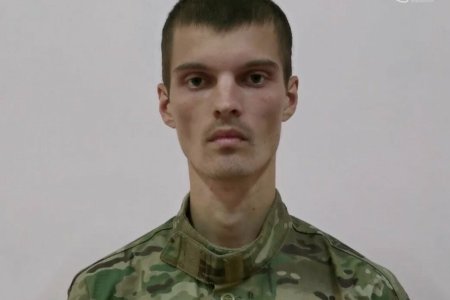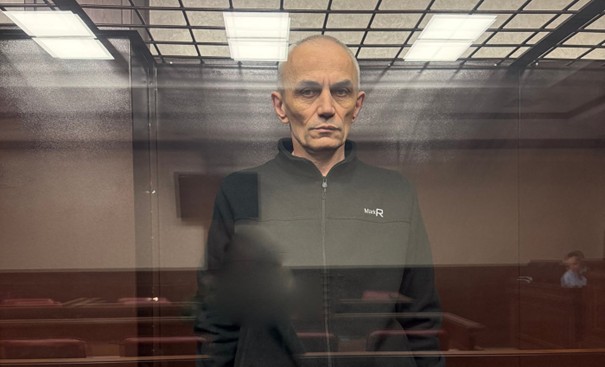
The cynicism around Russia’s ‘trial’ of Victor Kuzmenko is truly stunning, given that the Russians themselves acknowledged in 2023, after so-called ‘filtration measures’ lasting almost 18 months, that there were no grounds for his imprisonment and released him. The now 54-year-old military pensioner from Mariupol was seized again, six months later, when he tried to get to Europe in order to be reunited with his wife and children. The ‘terrorism’ charges laid against him would have been lawless, as well as preposterous, even had they not been based on a lie. All of this was, however, assiduously ignored by Russia’s Southern District Military Court which, on 21 May 2026, sentenced Kuzmenko to 18 years’ maximum-security imprisonment.
The charges against Victor Kuzmenko (b. 11 August 1971) were based solely on a politically motivated Russian supreme court ruling from 2 August 2022 which declared the Azov Regiment, part of Ukraine’s Armed Forces, ‘a terrorist organization’. The Azov Regiment had played an enormous role in the defence of Mariupol, and the ruling has, as feared, been used as a pretext for Russian persecution of prisoners of war. Russia is thus not only claiming that men and women defending their own country from an invader were engaged in ‘terrorism’. It is also flouting the fundamental legal principle that the law is not retroactive, with most of the prisoners of war ‘tried’ on these charges having long been in captivity before the ruling was passed.
Russia has also used this ruling, as well as analogous rulings against other units of Ukraine’s Armed Forces, to stage illegal trials against civilians abducted from occupied territory. In most cases, civilians were originally seized by the Russian invaders because they had briefly taken part in defending Ukraine back in the first years after Russia began its military aggression.
This would be the situation with Victor Kuzmenko were it not for an added nuance, namely that Kuzmenko, although a military pensioner, never took part in military action and was never a member of the Azov Regiment.
Mediazona reports that, during his trial at the Southern District Military Court in Rostov, Kuzmenko explained that he had served in a convoy unit of Military Unit 3057 from the middle of the 1990s until he retired from the service in 2020. No. 3057 had been renamed the 17th Separate Special Motorized Battalion and transferred to Ukraine’s Internal Troops in 1995. This battalion, renamed in late 2014 as the 18th Operational Regiment of the National Guard of Ukraine took part from 2014 in defending Mariupol. One of its divisions, from 2015, was the Azov Battalion (now Azov Regiment). A part is not the whole, and the convoying unit, which was basically engaged in convoying prisoners, had nothing to do with Azov. By the time the entire unit became known as Azov, in 2023, Kuzmenko had long retired from service.
Russia would be in violation of international law even had Kuzmenko been commander of the Azov Regiment. There is, nonetheless, every reason to believe him when he says that he had nothing to do with Azov given the 18 months of supposed ‘filtration methods’, which doubtless included torture, to which he was subjected from May 2022 to November 2023.
He explained to the court that he and his family had survived the siege and storming of Mariupol and had been forced to hide from the shelling. The Russians had clearly come for him immediately after fully gaining control in May 2022 and taken him away for so-called ‘filtration measures’, including at their notorious camp at Olenivka.
He was freed at the end of November 2023 on the basis of a decision by the so-called ‘Donetsk people’s republic prosecutor’ as not having been involved in what the occupiers called ‘crimes’.
Kuzmenko returned to the now occupied Mariupol where, in March 2024, he took Russian citizenship. Russia has made it nigh on impossible to live on occupied territory without taking a Russian passport, however, it seems likely that Kuzmenko was planning even then to try to cross into a European country from Russia and set off for the latter in April 2023.
He was seized on the border with Russia in Rostov oblast and imprisoned in Taganrog, including at the notorious SIZO No. 2 where Ukrainian prisoner of war and civilian hostages were savagely tortured, before being taken to Perm.
As in all Russia’s ‘Azov trials’ of Ukrainian prisoners of war or civilian hostages, Kuzmenko was charged with ‘taking part in the activities of a terrorist organization, under Article 205.5 § 2 of Russia’s criminal code, and with undergoing training in order to carry out terrorist activities’ (Article 205.3).
The supposed ‘evidence’ was provided in ‘testimony’ from another prisoner, who was claimed to have been an assistant personnel officer in one of the divisions of Military Unit No. 3057. This was full of claims about Azov having been created for “punitive activities impelled by the ideas of Ukrainian nationalism, radical Russophobia”, which Kuzmenko purportedly adhered to and which he had supposedly joined in 2015. The testimony alleged that he had found this out because, as part of his duties, he read Kuzmenko’s file.
In court, however, the same alleged personnel officer stated that he had seen Kuzmenko for the first time in Taganrog, had no idea about his political views, and had no access to any personal files. This, it should be said, took courage since he would have every reason to fear reprisals. He did stop short of refusing to confirm the earlier ‘testimony’ (which it is very likely that he signed, under duress, without reading.), but ended by saying: “We are prisoners of war and we’re claimed to be part of some kind of incomprehensible ‘terrorist society’.
In his final address, Kuzmenko spoke of having only wanted to join his family, and watch his daughter grow up. He said that he anticipated a guilty verdict, although only because there had been no sign in this trial of a fair and objective examination of the charges. He pointed to the evident unwillingness of the judge in the case to establish the facts, his refusal to question people who could easily be summoned, instead simply reading out their alleged ‘testimony’. The court had also refused to demand crucial material, such as the documents regarding his release from the Russian occupation ‘Donetsk people’s republic’, “although it is evident that in his material there is proof which confirms my innocence.”
The sentence demanded would be a life sentence for him, “a life sentence for an innocent man.
I don’t know what particularly forces the investigations and judges to pass such rulings – whether its fear of loosing their job, the wish to further their career or whether they simply couldn’t care less about another life. I hope that none of those present in this hall, besides me, will have to experience anything like this, while innocent. That is all.”
Victor Kuzmenko was, tragically, right with a monstrous 18-month sentence in a maximum-security prison colony, passed on 21 May, seemingly by ‘judge’ Oleg Alexandrovich Cherepov.