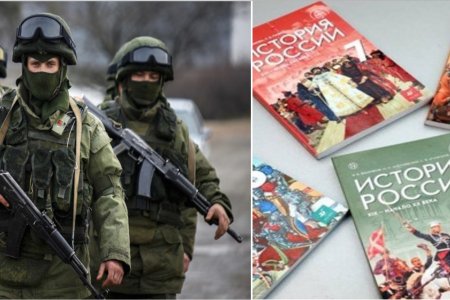
A 9th Grade social studies textbook for use in both Russia and occupied parts of Ukraine contains a map on which Kherson, Zaporizhzhia and Mala Tokmachka, as well as unoccupied parts of the Donetsk oblast, are all presented as if part of the Russian Federation. The emergence of such material was to be expected given the amendments to Russia’s constitution in October 2022 claiming that Donetsk, Luhansk, Kherson and Zaporizhzhia oblasts, in their entirety, as well as Crimea, are ‘Russian territory’. They do, however, highlight the grave mistake western politicians are making when they put pressure on Ukraine to “give up Donetsk oblast”, as though that would assuage Russia’s territorial appetite and end its aggression. Russia has made it abundantly clear that it will not stop there. Indeed, the textbook was under the editorship of Dmitry Medvedev, now the deputy head of Russia’s security council and one of the Russian officials most actively and aggressively inciting to genocide against Ukraine. He stated quite unambiguously in July 2024 that Russia would not stop until it destroyed Ukraine as a sovereign state and “returned the remaining territory to the fold of Russian lands.”
Verstva Media has examined a digital version of the textbook which is due to be used in schools from September 2026. The book begins with a map purporting to represent ‘the Russian Federation’ in 2025. This not only includes illegally occupied parts of Ukraine but also parts which were liberated (Sloviansk and Kramatorsk, liberated in 2014, and Kherson, in 2022, or have never been occupied, in particular Zaporizhzhia and Mala Tokmachka. Of the unoccupied cities, only Kherson is actually named on the map, however all four oblasts are visibly on Russia’s side of the ‘border’ which Moscow has redrawn. It is telling that, while Kherson, which Russia seized but could not keep, is named, Zaporizhzhia is not, with the map effectively treating Melitopol as the regional centre while still claiming the whole oblast as ‘Russian’, Kherson was liberated on 11 November 2022, just six weeks after a fake ‘referendum’ used as excuse for claiming overwhelming support on occupied territory for ‘joining Russia’. That embarrassment, as well as the euphoric welcome that Kherson residents gave the Ukrainian soldiers who freed the city, probably caused the particular savagery of Russia’s attacks since then on Kherson and its residents.
Obvious questions should arise, not least why Russia is regularly bombing cities that are purportedly part of the Russian Federation and using drones to hunt down residents. Presumably there is confidence that, even if the children have not yet learned to not ask inconvenient questions, their teachers and parents certainly have and will keep them in tow.
In the section claiming to be about the emergence of the ‘Russian state’, Russian leader Vladimir Putin’s 2016 shocking assertion that “Russia’s borders never end” is cited. Much is also made of Russia’s supposed role in a ‘multipolar world’ and its opposition to the West. Unlike the supposed ‘history’ textbooks which are also due to be used from September 2026, almost nothing is said directly about Russia’s war against Ukraine and its consequences, but there are constant repetitions of the lies Putin used to justify the full-scale invasion, including claims about “neo-Nazis in Ukraine”.
The book is full of other standard propaganda lies, including a whole section about supposed ‘traditional values’. While Russia purportedly “took on the mission of leader of the new world order”, the West is claimed to he foisting its worldview, namely single-sex marriages and the idea that a person’s biological nature can be changed.
With supreme cynicism, considering the lies at the basis of this latest ‘textbook’, its authors devote some verbiage to recognizing ‘fakes’. Among the safest sources of ‘information’, they claim, are the “official media” and “the websites of official state bodies”. Schoolkids are told that a lot of ‘fake news’ is aimed at arousing strong reactions, including anger, and that they should consider what aim the author had.
Within 10 days of Russia’s full-scale invasion of Ukraine, Putin had signed into law liability for four supposed ‘offences’, including criminal charges under Article 207.3 of Russia’s criminal code for supposedly ‘circulating knowingly false information’. Since then a huge number of Russians and Ukrainians from occupied territory have been sentenced to long terms of imprisonment for entirely truthful statements about Russia’s killing of Ukrainian children, bombing of civilian targes and horrific atrocities in Bucha and other Ukrainian cities under Russian occupation. The claim that this is ‘knowingly false’ is based solely on blanket denials from Russia’s defence ministry, with this regarded as the truth, however overwhelming the documentary, video, photographic evidence and witness testimony to the contrary.