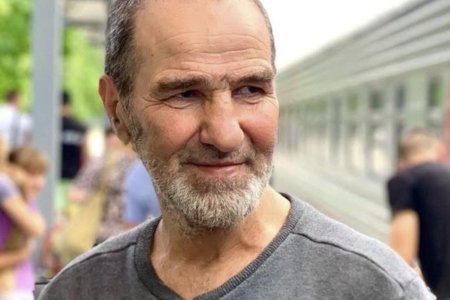
When demanding that Lenur Khalilov be returned to an Arkhangelsk prison colony in violation even of Russian regulations, prosecutor N.S. Ryazanov claimed that the 58-year-old political prisoner would receive “full medical care” in the harsh-regime prison colony. Six months later, Khalilov is receiving no treatment for liver cancer which has already spread to the lymph nodes, with the prison hospital staff offering only analgin painkillers.
Khalilov’s wife Umida Kudoibediyeva has told Crimean Solidarity that she had not been able to speak with her husband for around three weeks, with her application for a call ignored. When finally able to speak with him, he spoke of being total drained, without any strength, and sometimes unable to move around without a wheelchair. The staff at the regional prison hospital have talked of sending him to another hospital where he could be examined by oncologists, yet nothing has been done, and for the moment, all he receives in weak painkillers. Umida is, understandably, extremely worried. She notes that she learned in the middle of April that Khalilov had been allocated Grade III invalid status with the right to medication on preferential terms. In fact, even without that, Russia bears full responsibility for his well-being in Russian captivity.
It will also bear full liability for his death.
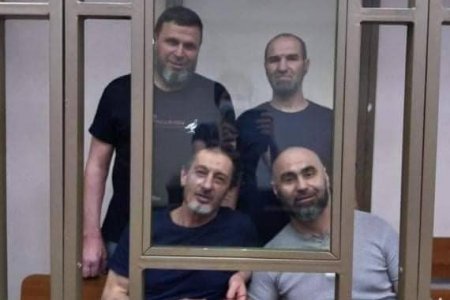
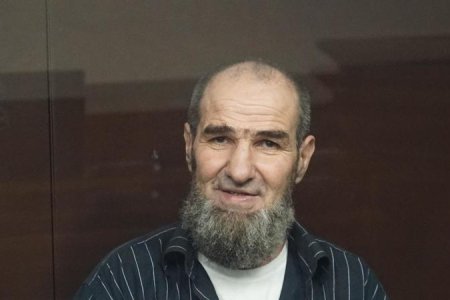
Lenur Khalilov (b. 8 December 1967) is one of four recognized Crimean Tatar political prisoners arrested on 10 June 2019. after armed ‘searches’ which made no pretence of looking for anything but ‘prohibited religious literature’. The massive 18-year maximum-security imprisonment sentence in his case was almost certain because he was the leader of the ‘Alushta’ religious community which the occupation regime was trying to crush, both because of its religious independence and in order to seize the 19th century Yukhary-Dzhami Mosque which the community has legally occupied since 1994. See: Savage sentences in Russia’s religious persecution and plunder in occupied Crimea
Russia has an appalling track record for imprisoning and, in some cases, causing the death of Crimean Tatar and other Ukrainian political prisoners who should never have been in custody. For that reason, his release in August 2025 seemed so extraordinary merely for being in full compliance with Russia’s own regulations.
Khalilov had only recently been brought to the prison colony in Arkhangelsk oblast and ended up in the prison hospital where he finally received a full medical examination. This identified a number of serious conditions, including cancer which is on Russia’s list of diseases which should preclude imprisonment. The diagnosis, provided by an oncologist, found that he was suffering, 10 months ago, from liver cancer which had already spread to the lymph nodes. intervention was therefore imperative and prescribed in order to prevent the cancer cells from spreading to other vital organs.
Given this diagnosis, Khalilov and his lawyer applied to the court for his release on the grounds of illness. On 20 August 2025, judge N.Y. Belaya from the Isakogorsk district court in Arkhangelsk, rightly ordered that he be released. He was freed a few days later and returned to a huge welcome back home in Crimea.
There were two such rulings in 2025, the other freeing Crimean political prisoner Oleksandr Sizikov, whose disability and total blindness did not stop the Southern District Military Court from sentencing him to 17 years.
One can only speculate whether local judges genuinely passed lawful rulings or whether the rulings were always intended to be overturned, sending a chilling message that Russia shows no mercy and will violate its own legislation for maximum reprisals against Ukrainian political prisoners.
As mentioned, an appeal was lodged by prosecutor N.S. Ryazanov against Khalilov’s release. On 14 October 2025, a ‘judge’ from the Arkhangelsk regional court obliged and ordered Khalilov’s rearrest. Details can be found here of the verbiage used in Ryazanov’s appeal, however two arguments stand out for their cynicism. He claimed that “the necessary medical care was provided in full measure” and that Khalilov, who is a recognised political prisoner and whose release has been demanded by the UN, OSCE and numerous other bodies, is a terrorist’ and that releasing him would not be just in relation to the public. ‘
The gravely ill political prisoner was taken into custody on 8 November 2025 and forced to endure the gruelling journey to the harsh-regime prison colony in Arkhangelsk oblast where he has, effectively, been sent to die.