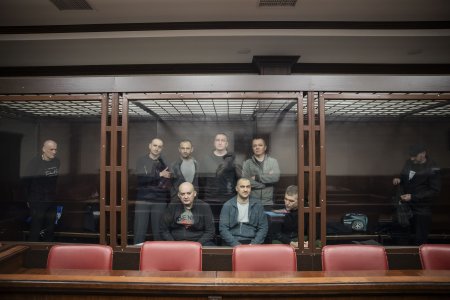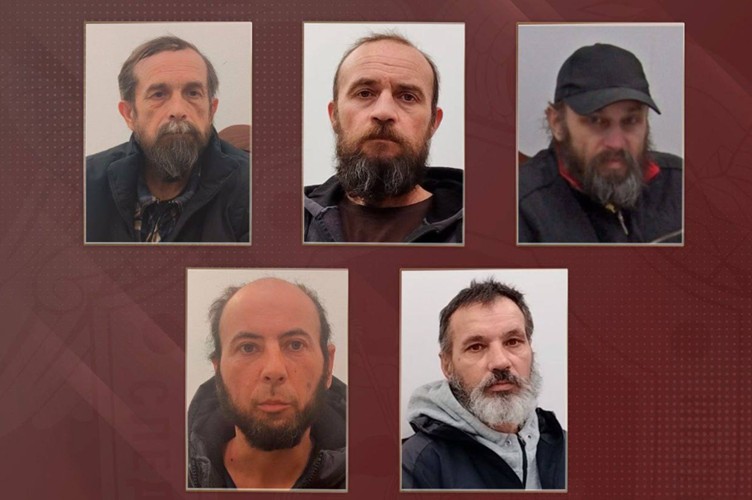
The Centre for Journalist Investigations ;CJI] has succeeded in identifying five Ukrainians abducted from occupied Kherson oblast and undoubtedly tortured into ‘confessing’ to the killing of Volodymyr Leontiev, a collaborator installed by the Russian invaders as ‘hear’ of occupied Nova Kakhovka. Russia is, once again, treating an attack on a perfectly legitimate target as ‘terrorism’ and using methods for seizing ‘suspects and fabricating charges’ that make it immaterial whether the latter were really involved or chance passers-by. In this case, it seems extremely likely that the five Ukrainian civilians: Oleh Andrushak, Pavlo Borodin, Viacheslav Voronko, Mykhailo Shpakovsky, Mykola Kolomiyets were seized because the FSB had to ‘arrest somebody’ after failing to catch the partisans who had killed the traitor and carried out other acts of resistance.
Volodymyr Leontiev collaborated from the first day of Russia’s full-scale invasion of Ukraine, with the invaders immediately installing him as ‘head’ of occupied Nova Kakhovka. His post changed later, but not his active role in all aspects of Russia’s invasion including their abductions of civilians. In March 2024, he was sentenced, in absentia, by a court in Odesa to 12 years for his role in the abduction of journalist Oleh Baturin; the Mayor of Tavriysk Mykola Risak and another official. A year later, a Kherson oblast court sentenced him, also in absentia, to 15 years on war crimes charges linked with his role in ordering the abduction of Mayor of Beryslav Oleksandr Shapovalov on 19 March 2022.
Leontiev died in hospital on 1 October 2025 after a drone attack that morning. According to Volodymyr Saldo, the Russian-appointed ‘governor’ of occupied parts of Kherson oblast, it was a Ukrainian ‘Baba Yaga’ drone (i.e. one of several possible Ukrainian heavy bomber drones).
It was almost six months later, on 19 March 2026, that Russian state-controlled media reported that “the terrorists who killed” Leontiev had been arrested in a joint ‘operation’ by the Russian occupation FSB and Investigative Committee. It was clearly implied that all five men had only now been arrested. In fact, four of the men were abducted and vanished without trace in October 2025, while Mykhailo Shpakovsky’s wife reports that all contact with her husband was lost on 19 November 2025.
Since the discrepancies concern not only when the men were ‘arrested’, but how Leontiev was killed, it is worth noting that two partisans, who had safely left occupied territory, stated clearly on 15 October 2025 that they had killed the traitor. Judging by their account, it is likely that they were behind other acts of resistance for which the FSB regularly claims to have ‘captured the culprits’. The two men ended by saying that they had, through their own example, showed that “it’s possible to fight the invaders. We will definitely return to Nova Kakhovka and raise the Ukrainian flag!”
By 19 March 2026, the story of how Leontiev was killed had changed radically. It was now claimed that all five ‘arrested’ men had acted on instructions from Ukrainian handlers. ““In order to support the Ukrainian side, one of the men established contact with representatives of Ukraine’s Security Services, and acting on their instructions, received components to make a homemade explosive device which were provided to him with the use of a drone”. This is the closest that the story now gets to the drone attack which Saldo reported at the time. In this new version, the men are accused of assembling a homemade explosive device and placing it near “the entrance to the administrative building and to have detonated it as Leontiev approached.
Two older women standing nearby were, supposedly, injured. At least one Russian propaganda source clearly thought this ‘not good enough’ and claimed that the two women had been killed.
In his CJI report, Oleh Baturin points to another discrepancy. All of the Russian reports claim that Leontiev was killed entering ‘an administrative building’. In fact, the attack occurred as the collaborator was heading, during working hours, to a fitness centre.
If the wish to not admit that Leontiev spent working hours doing workouts is just comical, there is nothing at all funny about the fact that Russia only admitted on 19 March 2026 to holding men held incommunicado since early October 2025 or the middle of November. It is almost certain that the men’s detention had not been registered in any way. Such periods of time where the FSB and Investigative Committee’s victims have no contact with the outside world, no independent lawyer and no formal procedural status are standardly used to fabricate charges and extract ‘confessions’, normally though torture.
There is every reason to assume that the ‘admissions of guilt’ which Svetlana Petrenko, from Russia’s Investigative Committee, claimed that all the men had made, were obtained through torture, threats against the men’s families or other totally inadmissible forms of duress.
On the video accompanying the Russian reports on 19 March 2026, a man whose face is blurred, says that he carried out the supposed ‘terrorist attack’ at the beginning of October “by planting an explosive device passed to me by officers of Ukraine’s Security Service. The aim was to intimidate the civilian population.”
Even without the absurdity of claiming that a targeted attack on a Russian-installed collaborator was an attempt “to intimidate the civilian population”, the ‘confession’ bears all the hallmarks of a text which the person was forced to learn by heart.
Baturin has spoken with the relatives of some of the men who only learned where they were from the photos, etc. circulated by the FSB and Investigative Committee on 19 March 2026. He has, he writes, “reached the conclusion that this is the latest FSB falsified case about a ‘terrorist group’”
The above enforced ‘confession’ was made by Viacheslav Voronko (b. 7 August 1981) who, like all of the men except Mykhailo Shpakovsky, is from Novotroitske in the Henichesk raion of Kherson oblast. He is the founder and director of a private business ‘Svaroch’ and specializes in engineering; geology; geodesics and technical consultation.
The Russians are claiming that he was the main figure in the supposed plot to kill Leontiev. He is supposed to have contacted Ukraine’s Security Service [SBU], to have organized receipt of components for the explosive device with these allegedly passed on by drone. It is not quite clear whether the mention here of a drone is supposed to make up for the entirely different method suggested by which Leontiev was actually killed. If so, it fails, with a planted bomb very different from a heavy bomber drone.
Pavlo Borodin (b. 18 October 1981) is also a businessman from Novotroitske and, according to his daughter, Hanna, had recently worked at ‘Svaroch’ and was on friendly terms with Viacheslav Voronko.
Both men disappeared on 2 October 2025, although, at least in Borodin’s case, the FSB long denied that he was in custody.
Mykola Kolomiyets (b. 24 March 1979) with virtually nothing else known about him.
Oleh Andrushak (b. 5 August 1970) was a typical target for the Russian invaders as he had, before the occupation, been head of a civic organization of veterans of ATO [the military operation in Donbas from 2014, which Russia was still trying to deny it was behind).
Mykhailo Shpakovsky (b. 20 December 1987) is originally from Liubymivka, but he and his wife were living in Nova Kakhovka. He had been a driver before the full-scale invasion, but was working at a garage cooperative called ‘Sokil’ when the Russians came for him on 19 November 2025. The family knew nothing about his whereabouts for a long time but his wife, Hanna, says that they have since learned that he was first held in occupied Henichesk and then taken to the increasingly notorious SIZO [remand prison] which the invaders set up at Chonhar.
It was with the Russian reports on 19 March 2026 that she learned what had happened to her husband. Hanna is adamant that her husband had nothing to do with the killing of Leontiev and notes that they have no links with anybody in Novotroitske and she does not recognize any of the other men on the photos posted on Russian media.
All of this is chillingly similar to at least two other earlier abductions and show trials.
See:
‘The Kherson Nine’: Oleh Bohdanov; Serhiy Heidt; Serhiy Kabakov; Yuriy Kayov; Serhiy Kovalsy; Denys Lialka; Serhiy Ofitserov; Konstiantyn Reznik and Yuriy Tavozhniansky
Savagely tortured ‘Kherson Nine’ sentenced to 155 years in grotesque Russian show trial
Andriy Holubiev, Ihor Horlov; Yury Petrov, Volodymyr Zuyev and Oleksandr Zhukov
Russian torturers can get a ‘confession’ to JFK’s assassination and the court will swallow it