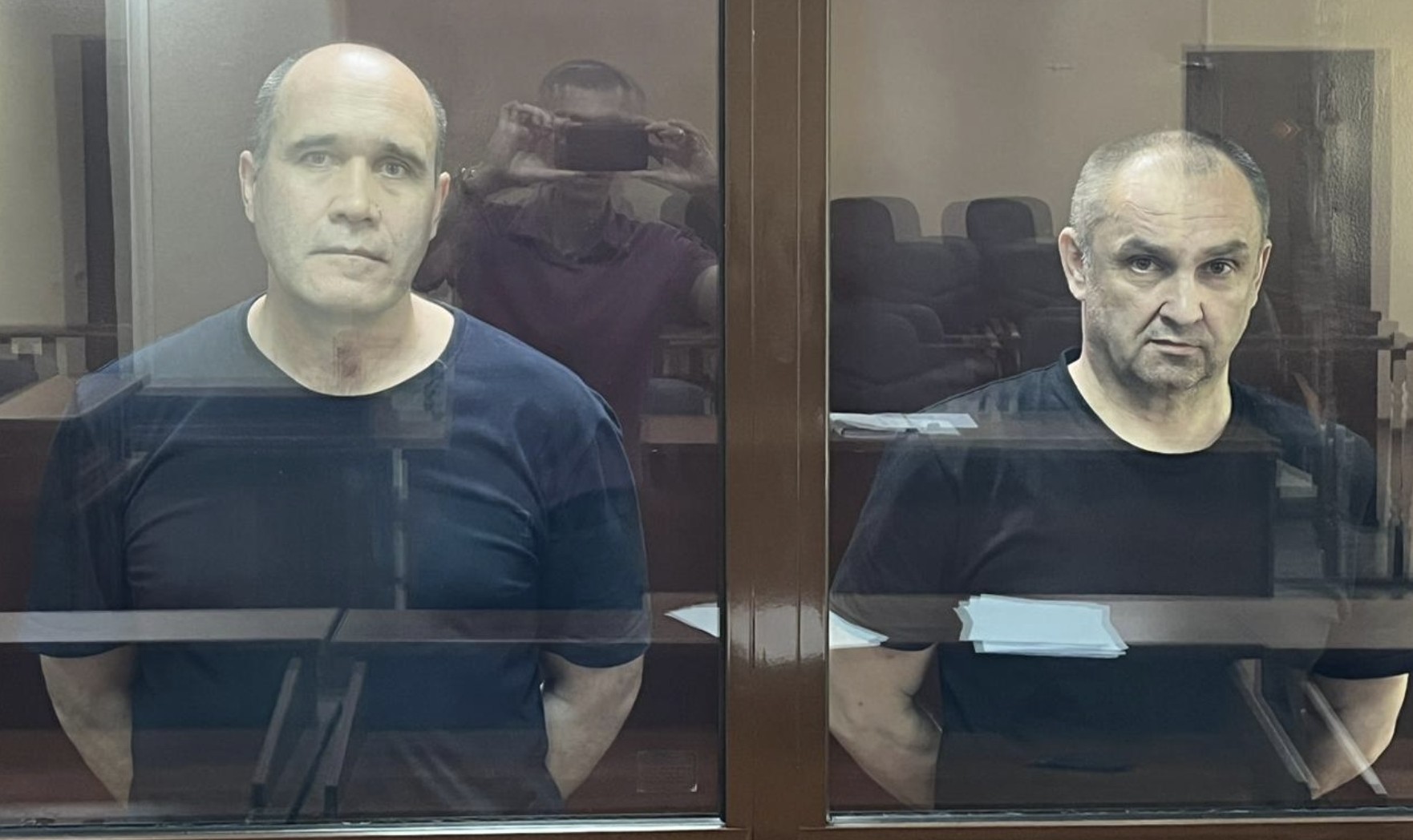
Over four years after Vasyl Dmytriuk and Ivan Tereshchenko were taken prisoner from the Azovstal Steel Works, they and many other defenders of Mariupol remain imprisoned with Russia refusing to include them in prisoner exchanges. Although Russia is increasingly using flawed court rulings as pretext for claiming that Ukrainians defending their country were members of a ‘terrorist organization.’, Dmytriuk and Tereshchenko were sentenced by an occupation ‘court’ to 17 years on no less surreal charges of ‘hijacking a vessel’ and ‘abduction’.
Tetiana Katrychenko from the Media Initiative for Human Rights has learned more about Vasyl Dmytriuk from his elderly father and brother, including the fact that he was serving in the Ukrainian Border Guard Service’s Sea Guard when Russia invaded Crimea in 2014. He and the other crew of the ‘Liubomyr’ refused to betray their oath of allegiance to Ukraine, and withdrew, first to Berdiansk and then to Mariupol. The brutal treatment that many defenders of Mariupol received in Russian captivity is very likely because Sea Guard servicemen, marines and others had, like Vasyl Dmytriuk, been unwilling to become traitors.
As reported, the charges used in June 2024 against Dmytriuk and Tereshchenko pertained to their service in the Sea Guard in March 2018. Dmytriuk had remained in Mariupol, serving first on the Liubomyr, then later, as commander, of the Sea Guard vessel ‘Oniks’. Judging by the testimony he gave during the ‘trial’ in 2024, Dmytriuk was not yet commander when, on 25 March 2018, ‘Oniks’ stopped the ‘Nord’ fishing boat from Kerch in occupied Crimea, travelling under a Russian flag in the Sea of Azov. Dmytriuk headed the group inspecting the boat and its documents. It was the latter, passed on by the captain of ‘Nord’, Vladimir Gorbenko, which led to the boat being detained. The passports and vessel documents had all been issued by the Crimean occupation authorities and were, therefore, of no legal standing according to Ukraine’s legislation. Ukraine had, back in July 2014, closed Crimean ports to any international ships, and ‘Nord’ was in violation of this, by carrying out fishing in Ukrainian waters under a Russian flag.
‘Nord’ was seized, with Ukraine’s prosecutor initiating criminal proceedings over the boat’s departure from a port in Russian-occupied Kerch. Gorbenko and another member of the crew were accused of having infringed Ukraine’s border regulations. All of this was in full accordance with both Ukrainian and international law. Yet there was an escalation in the situation with Russia seizing the captain of another vessel, and later, in November 2025, firing shots at Ukrainian naval boats and abducting 24 seamen. Although Dmytriuk and Tereshchenko were carrying out their duties as officers of Ukraine’s Sea Guard, Russia even placed them on the international wanted list in January and April 2019, respectively.
The Russian ‘investigators’ came up with accusations against four Ukrainians, including Maksym Benedesiuk, the then commander of Oniks and Taras Markov, senior lieutenant of Ukraine’s Armed Forces. Only two men were, however, put on ‘trial’, namely, Dmytriuk and Tereshchenko who had fallen into Russian captivity. Although the men were evidently prisoners of war and should have been treated in accordance with the Third Geneva Convention, Russia instead brought insane charges against them over the events of 25 March 2018. The two were charged under Article 126 § 2 of Russia’s criminal code (abduction of a person) and Article 211 § 3 (hijacking of a water-bound vessel). Dmytriuk was even “formally detained” under those charges on 26 July 2023, some 14 months after he was actually taken prisoner. The occupation ‘court’ in Crimea even cited the fact that the charges pertained to events before the men became POWs as supposedly making their prosecution alright. It did nothing of the kind, especially given that the men had, in March 2018, merely been carrying out the normal duties of the Ukraine’s Sea Guard.
The supposed ‘trial’ took place at the occupation ‘Crimean high court’, before ‘judge’ Sergei Nikolaevich Pogrebniak. who has taken part in many trials and sentences against Ukrainian political prisoners. On 10 June 2024, he sentenced both Dmytriuk and Tereshchenko to twelve and a half years on the charge of hijacking of a water-bound vessel, and to ten and a half years for supposed ‘abduction’. These two sentences were slightly merged, resulting in 17 years’ maximum-security imprisonment, with the first three years in a prison, the harshest of all Russian penal institutions. During the ‘trial’, Gorbenko and others from ‘Nord’ had ‘victim’ status. It seems they claimed that guns had been pointed at them and that they had been threatened, claims that Dmytriuk totally denied.
International lawyer Andriy Yakovliev pointed out to MIHR that attempts to justify the POWs’ ‘trial’ by citing events from 2018 do not withstand any scrutiny. He points out that the conflict between Russia and Ukraine, according to the European Court of Human Rights and resolutions from the UN’s General Assembly began with Russia’s invasion and occupation of Crimea. The actions of the Ukrainian Sea Guard officers on 25 March 2018 fall under combatant’s immunity according to Article 43 of the First Additional Protocol to the Geneva Conventions.
Yakovliev speaks of two components, one involving violation of the fundamental right to a fair trial and the use of torture and other forms of coercion to extract ‘confessions’. The other pertains to the charges and the fact that international law does not recognize Russia’s seizure of Crimea, nor its use of its own legislation on occupied territory. With this the case, the charges are evidently absurd, with the impugned events taking place in Ukrainian territory waters, not on Russian territory.
“Russia does not have the right to try a Ukrainian military serviceman for actions which do not constitute either an international, or a general crime. Therefore the sentence against Dmytriuk does not provide any legal grounds for his imprisonment, it merely changes the formal name of the grounds for this imprisonment. We are dealing with the deprival of liberty and with depriving a prisoner of war the right to a fair and normal trial – and that is already a war crime.”
Vasyl Dmytriuk is imprisoned in a prison in Verkhnyouralsk, Chelyabinsk oblast, over two thousand kilometres from Ukraine. Ivan Tereshchenko is a little bit closer, in Saratov oblast. There is almost no contact between Vasyl and his father, with any news from Vasyl coming via his lawyer.
Pogrebniak saw no need to conceal the political nature of this case, quite the contrary. It was claimed, for example, that the two men’s “political hostility towards Russia” over the annexation of Crimea was an aggravating circumstance, as was Dmytriuk’s rejection of the claim that ‘Crimea is Russian’.