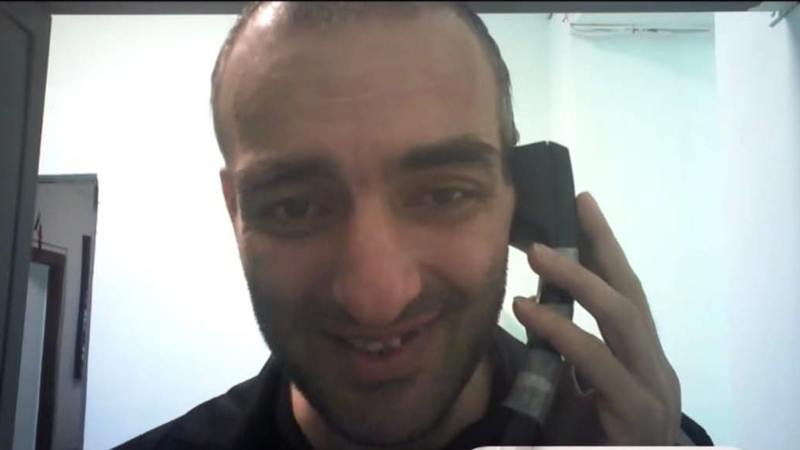
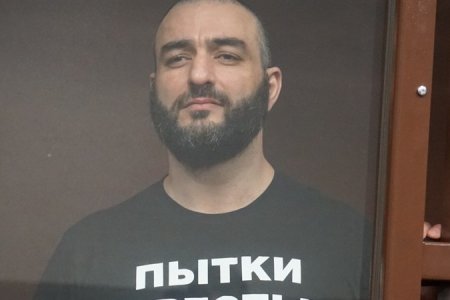
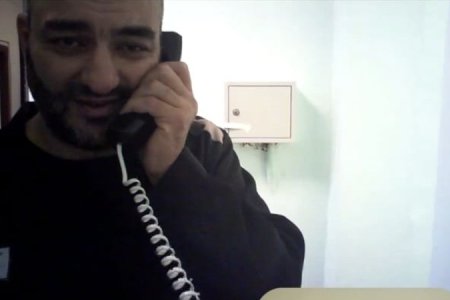
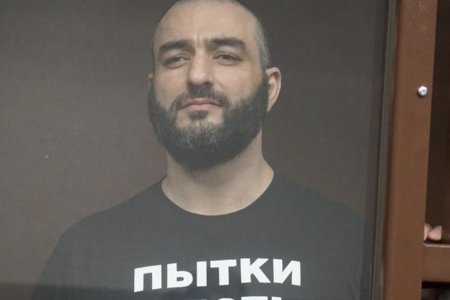
Just over six months ago, doctors in Russia confirmed that Tofik Abdulagziev has a malignant brain tumour, a diagnosis that should, unequivocally, have led to the Crimean Tatar political prisoner’s release. It was, instead, to be the last time that Russian medics remembered their professional oath. Since then, both doctors and judges have chosen to take part, either by omission or through direct steps, in Russia’s persecution of a Crimean Solidarity activist for his refusal to remain silent about Russian repression.
Tofik’s wife, Aliye Kurtametova, reported on 24 June that the hearing scheduled for that day into the application for Tofik’s release had, yet again, been postponed, with this, like on all previous occasions, for over a month. Such delays are a cruel farce, given that the hearings are over compelling grounds for releasing Abdulgaziev because of his critical condition. There should, in fact, be nothing at all controversial about the hearing since Abdulgaziev’s diagnosis is on the list of diseases which preclude detention. It should have been enough back in late December or early January to have shown the doctors’ report for the court to have issued the order to release Abdulgaziev.
Except that Tofik Abdulgaziev is a political prisoner, with that changing everything, and not only for Russia’s FSB, Investigative Committee and the prosecutors who are most implicated in political repression. ‘Judges’, even at regional level provide the rulings demanded of them, with medics also proving ready to fabricate medical documents in order to justify the effective torture to a gravely ill political prisoner. Or, where the evidence is too clear, willing to do nothing and opt for cruel delay tactics. “If you are gathering due to some very serious illnesses, due to which a person is suffering and is, perhaps, bordering between life and death, it is surely not sensible to drag out this process? It is a question of humanity and of a person’s legitimate right to life.”
The excuse this time for postponing the hearing was that the medical assessment needed to back (or reject) the application was, purportedly, not ready. This is after six months when the diagnosis was unequivocal. Aliye writes that, if before any flickering hope of justice had remained, this has vanished and she is almost certain that the court is deliberately dragging out the process. Her husband’s huge brain tumour, especially in the appalling conditions of a Russian prison, is not going anywhere and Tofik suffers acute headaches and nausea, loses consciousness and experiences numbing in his limbs. Aliye stresses that the medics who say that they can do nothing when her husband loses consciousness are not to blame – specialists are needed, not prison medics.
Tofik Abdulgaziev turned 45 on 19 June, having spent the past seven years in Russian captivity. He was one of 25 Crimean Tatar civic journalists and activists, most of them involved in the Crimean Solidarity human rights movement, who were seized on or soon after 27 March 2019 and sentenced to huge terms of imprisonment on profoundly flawed ‘terrorism’ charges. The arrests received international condemnation, with it clear that Russia was using such methods to try to crush the Crimean Tatar human rights movement.
You need to be physically strong to fight cancer and Abdulgaziev’s state of health had been gravely compromised by the years of imprisonment, either in occupied Crimea, or in Russia. He was moved, in July 2023, to the Verkhneuralsk Prison in Chelyabinsk oblast, 2,700 kilometres from his home and family in Crimea. It was after the gruelling journey that he began losing weight and complaining of acute joint pain. By February 2024, his lawyer Emil Kurbedinov reported that he was unable to move about and that he had difficulty even holding a spoon. In late April 2024, he was diagnosed with what was then identified simply as tuberculosis, but was clearly a very form, namely disseminated tuberculosis of the lungs, with this having spread to the chest lymph nodes. The doctors also found a number of other serious, some life-threatening conditions - double pneumonia; fluid in the lungs; medium severity anaemia; connective tissue dysplasia with damage to the mitral valve (valvular heart disease); chronic heart failure; chronic gastritis and kidney stones. There was, in short, every reason even then to release him on health grounds.
It was after this that Russia organized the first of two fake medical assessments, neither of which could have been carried out without the direct collusion of trained medics. In the middle of 2024, the prosecution organized its own supposed expert assessment which claimed that Abdulgaziev did not have illnesses that could prevent him from remaining in prison, with this used to justify a formal refusal to comply with Russia’s own legislation and free him.
The second was even more brutally cynical. The hearing on his release had originally been scheduled to take place in January 2026 at a district court in Chelyabinsk. It had, however, been postponed for a month, until 27 February. After hearing nothing from her husband, Aliye managed to contact the lawyer representing him and discovered that Abdulgaziev had been removed from the court at the beginning of the hearing, with it claimed that he had behaved badly towards the panel of judges.
It transpired that, the day before the hearing, Abdulgaziev had been taken to a gathering of prison doctors, attended also by individuals from Russia’s FSB. The court had asked the prison hospital to provide an assessment of Tofik Abdulgaziev’s state of health. Before even pretending to carry out an examination, Olga Anvarovna Angold, chief medical officer of Prison tuberculosis hospital No, 3 in Chelyabinsk, demanded that Abdulgaziev sign the document she thrust in front of him. Since the brain tumour has caused a dramatic deterioration in Abdulgaziev’s eyesight, which Angold would have known, he asked that the document be read out to him. Angold refused, saying “sign and then you’ll find out”. He initially refused to sign any document without knowing what it said, however the prison staff began pressurizing him and Angold became far ruder and more aggressive than when he had seen her earlier. He was in an extremely weak state, suffering from appalling headaches, and, after holding out for some time, he finally “decided to end the circus” and signed the document.
He discovered in court the following day that the document claimed that Abdulgaziev was entirely healthy and that he had no objection or complaints if he was moved back from the prison hospital to a normal cell. Olga Anvarovna Angold and her ‘doctor’ colleagues who, in December 2025, took a CT scan and tests, and found that Tofik Abdulgaziev was suffering from a malignant brain tumour, were now willing, under pressure from the FSB, to write him a ‘clean bill of health’.
Then, on 17 April 2026, Russia’s Investigative Committee announced new criminal charges against Abdulgaziev under Article 297 § 2 of Russia’s criminal code (‘contempt of court’). This was supposedly because Abdulgaziev had expressed his opinion in strong terms when he discovered the brutal deception applied by Angold & Co. against him.
See also:
Monstrous sentences in Russia’s war against Crimean Tatar civic activists and their children