The United Nations Committee on the Elimination of Racial Discrimination has found that Russia violated several articles of the International Convention on the Elimination of All Forms of Racial Discrimination through its persecution of three Crimean Tatar lawyers. The ruling, on 26 June 2026, is important for a number of reasons, despite the miniscule chance that Russia will comply with it. The latter’s contempt for its own international commitments was only confirmed by the fact that the Committee’s ruling coincided with the Russian justice ministry’s further act of repression in labelling as 'foreign agents' Crimean Solidarity and several prominent Crimean Tatar lawyers, civic journalists and activists linked with this vital human rights movement.
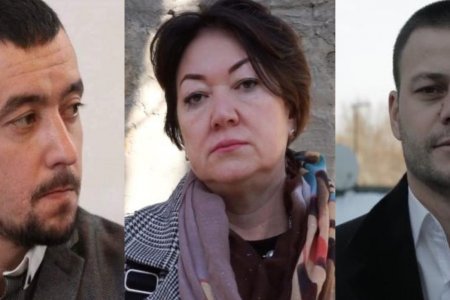
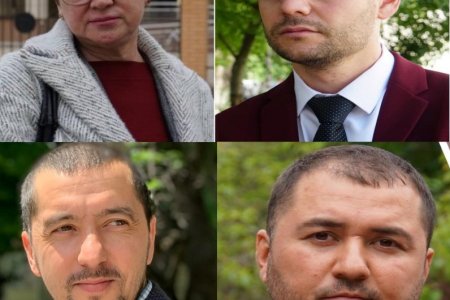
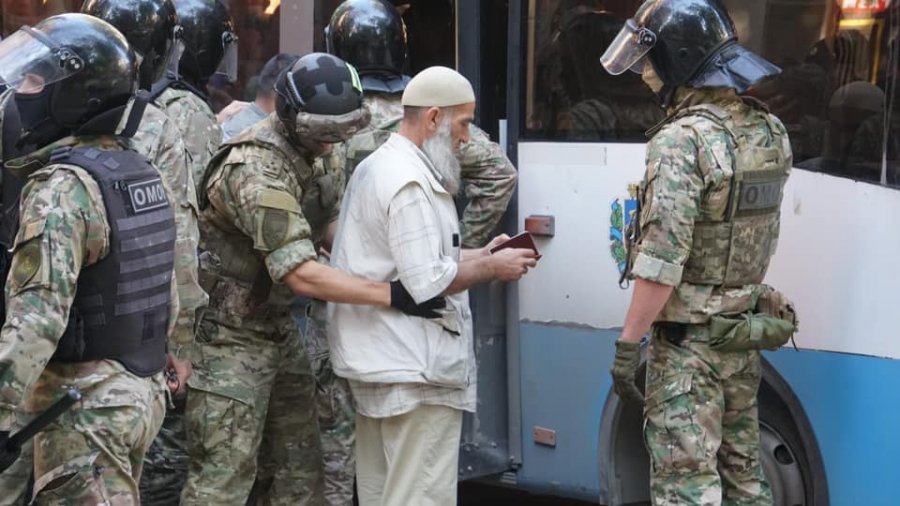
The Committee combined three separate applications brought by three Crimean Tatar lawyers. Although their names were not given in the ruling, all three cases of persecution in 2021 and 2022 were earlier reported here. The first victim, identified in the report as Y, a prominent Crimean Tatar lawyer defending political prisoners and other victims of repression. He arrived on 25 October 2021 to provide legal assistance to some of over 20 Crimean Tatars who had been detained outside the occupation ‘Crimean garrison military court’ where they had gathered in solidarity with three political prisoners - Rustem Emiruseinov, Arsen Abkhairov and Eskender Abdulganiev - whose appeal was being heard.
Y was then detained and both fined and imprisoned for 12 days. Later, on 26 May 2022, Y was again detained, this time for supposedly ‘discrediting the Russian armed forces’. His colleague, Z was later that day detained when he arrived to represent Y. He was imprisoned for eight days. On 27 May, their colleague, X was detained when she came to represent Z who had been held for over 24 hours in custody (before the occupation ‘court’ ruling imprisoning him). She was imprisoned for five days.
The three lawyers’ complaints were submitted to the Committee by Serhiy Zayets and the European Human Rights Advocacy Centre [EHRAC]. In their complaints, they asserted that Russia was in violation of the Convention as they had been subjected to different treatment on the grounds of their ethnicity and their association with other Crimean Tatars (as lawyers representing other Crimean Tatars).
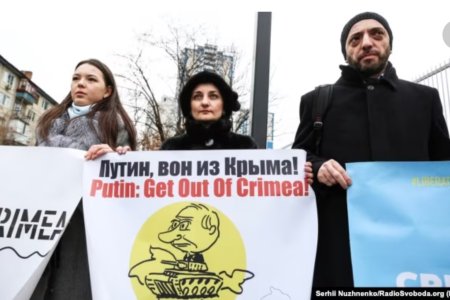
They complained that their prosecution was “part of an ongoing pattern of state harassment intended to repress and silence Crimean Tatar lawyers who defend other Crimean Tatars. The suppression by the State Party of Crimean Tatars as an ethnic minority, who has been opposed to the 2014 occupation, has been perpetrated in pursuit of the State Party’s policy to “Russify” Crimea and is inherently discriminatory.”
Violation of the right to equality before the courts
The Committee pointed out that Article 5(a) of the Convention guarantees the right of everyone, without distinction as to race or ethnic origin, to equality before the tribunals and all other organs administering justice in the State Party. The three lawyers’ had consistently raised what the Committee calls “arguable claims” that the administrative prosecutions “were discriminatory and formed part of a broader pattern of discriminatory treatment affecting Crimean Tatars, including lawyers providing legal assistance to members of that community”. Although such claims were backed by corroborative information . These claims were supported not only by the specific facts as submitted by the authors, but also by contextual and corroborative information, “including evidence of disproportionate targeting of Crimean Tatars in the enforcement of public order and assembly laws”, there was no attempt by domestic (occupation) ‘courts’ to properly investigate such allegations,
“The Committee recalls that the right to equality before the courts requires that allegations of racial discrimination be genuinely and effectively examined. In the absence of any substantive judicial assessment of the authors’ discrimination claims, the Committee considers that the authors were not afforded equal treatment before the tribunals within the meaning of article 5 (a) of the Convention. “
Violation of the right of everyone to security of person and protection by the State
The Committee noted that the lawyers had been subjected to regular detentions which they maintained were because of their professional activities. The Committee pointed both to corroborative material and reports from international and regional human rights bodies, and to the elements of harassment in the persecution of the lawyers and the fact that the detentions were imposed months after the alleged events.
“In the absence of any indication that the State Party took measures to prevent or remedy such discriminatory interference with their security of person, the Committee concludes that the authors’ rights under article 5(b) of the Convention were not effectively protected. “
Violation of the right to freedom of opinion and expression Article 5s)
The Committee noted that the measures against the lawyers had been in connection with their expressions of opinion, their public statements, etc. which were, in turn, linked with their professional activities. While the Committee notes only that they provide legal assistance to detained members of the Crimean Tatar community, the lawyers in question and their colleagues spend all their time representing political prisoners, as well as others detained for peaceful demonstrations of solidarity, etc.
“In the absence of the detailed explanations by the State Party that the interference with the authors’ expressive activities pursued a legitimate aim in a non-discriminatory and proportionate manner, the Committee considers that the authors’ enjoyment of their right to freedom of opinion and expression was impaired in a manner that disproportionately affected them as members of a protected ethnic group, contrary to article 5 (d) (viii) of the Convention. “
“As with restrictions imposed on the rights to freedom of opinion and expression, the Committee considers that the interference with the authors’ right to peaceful assembly must be assessed in its broader context. In this regard, it recalls its concluding observations on the State Party, in which it expressed concern about the disproportionate restriction of peaceful assemblies affecting members of certain ethnic minorities and called upon the State Party to ensure that legislation on public assemblies is not applied in a discriminatory manner. In the absence of any indication that the interference with the assemblies involving X and Z was necessary and proportionate in a non-discriminatory manner, the Committee considers that their right to peaceful assembly was impaired, contrary to article 5 (d) (ix) of the Convention. “
Violation of Article 6 – the right to effective protection and remedies
“The Committee notes that the authors’ allegations of racial discrimination were consistently rejected by the domestic courts without substantive examination, thereby depriving them of any meaningful avenue to obtain redress. In the absence of any convincing information as to the existence of effective judicial or administrative remedy capable of addressing the authors’ discrimination claims or providing adequate redress, the Committee considers that the State Party has failed to comply with its obligations under article 6 of the Convention.”
Russia is ordered to make reparation for the violations of its obligations under the Convention and of the rights of the lawyers. Russia should also take further measures to ensure that existing legislation is applied in an effective manner and with due regard to the requirements of the Convention. “The State Party is also requested to give wide publicity to the Committee’s Views, including by disseminating them in its official language or languages, as well as in the language of the authors.”
The use of expressions like “the Commission wishes” is part of the problem with this and other rulings. The Commission has no mechanisms to force Russia to comply and it is probably safe to assume it will not.
The ruling remains important as are all legal assessments and qualified reports on Russia’s violations of its international commitments. It is particularly cheering given a disappointing and contentious judgement from the International Court of Justice on 31 January 2024. The court then saw all of the same corroborative evidence, yet a majority of judges (albeit with prominent dissenting voices) asserted that Ukraine had not proven that Russia’s ban, expulsion of Crimean Tatar leaders and persecution were racially, and not politically, motivated. In reporting the Committee’s ruling on 26 June, Serhiy Zayets wrote that “practice shows that civic initiatives can sometimes be more effective than those of the state”, Certainly on this occasion, the Committee scrutinized the example of Russia’s persecution of three Crimean Tatar lawyers and presented compelling reasoning for their crucial finding of mulitple Russian violations of the UN Convention.