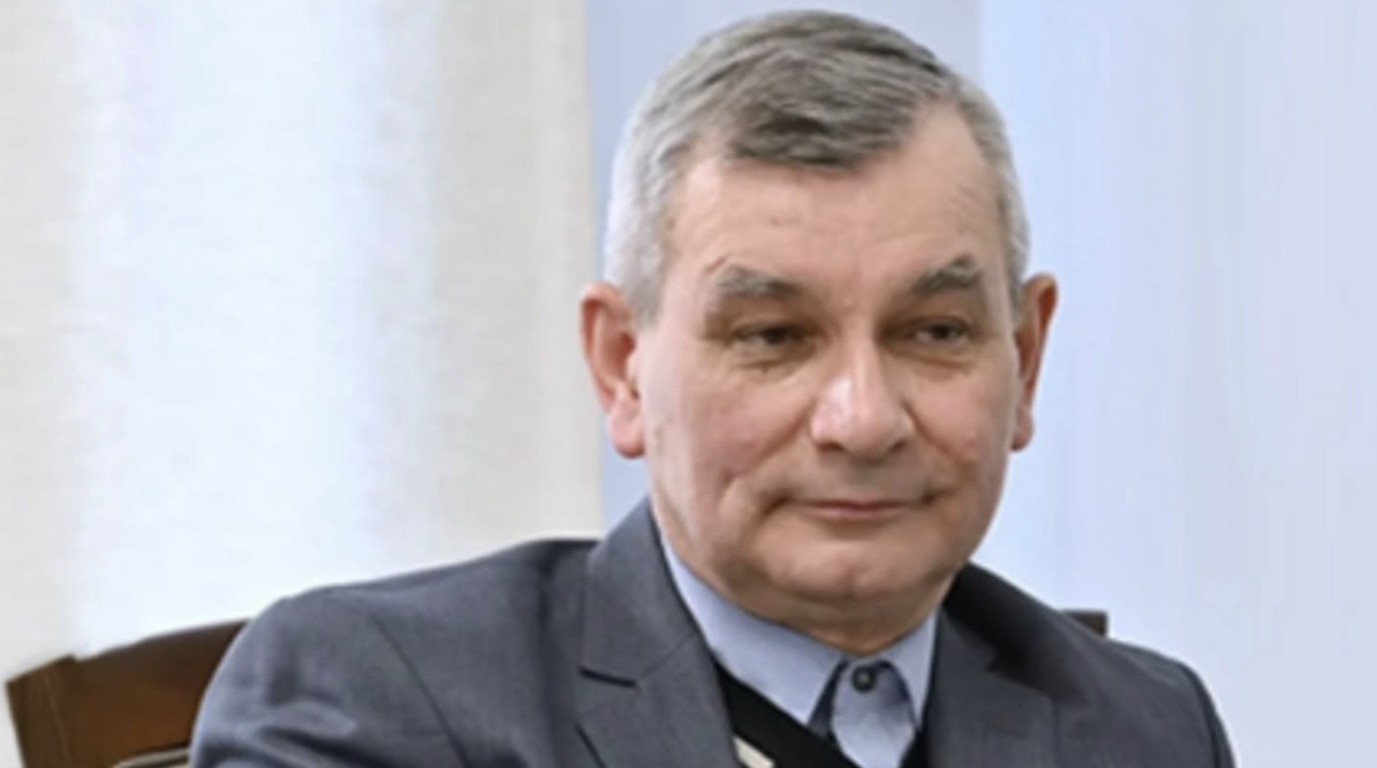
An occupation ‘court’ in the Luhansk oblast city of Sorokyne (earlier Krasnodon) has rejected Volodymyr Rytikov’s challenge of the occupation regime’s decision to deport him from his home. Russia is trying to justify its actions by claiming that the 66-year-old Ukrainian Pastor from the Council of Churches Evangelical Baptists “posed a security threat” to the invaders’ country.
Since the Russian invaders assert that occupied Luhansk oblast “has joined the Russian Federation”, Volodymyr Rytikov had been forced, in his own native Ukraine, to live on the basis of a ‘residence permit’. He had then stated in writing that he wished to retain his Ukrainian citizenship and refused to take Russian citizenship and swear an ‘oath of allegiance of a Russian citizen’
The residence permit was withdrawn by the occupation ‘migration service’ at the FSB’s demand, with the Pastor challenging the decision to ‘expel’ him from his own country at the occupation ‘Krasnodon district court’. It was reported on 13 August 2026 that this entirely illegitimate ‘court’ had refused to revoke the earlier decision. The Russian propaganda source notes that Rytikov stated in ‘court’ that he has been a minister since 1990 and is the Pastor of a church of the International Council of Evangelical Baptist Churches. “However the organization is not registered as a legal entity, and the man does not have any permits for such activity”.
Russian demands of any religious community are significantly more onerous than any requirements in Ukraine. They are also the demands of an illegally occupying state. Even those religious communities which were, in principle, willing to register as legal entities, many would not do so as they were registering as ‘Russian’ religious communities.
The issue is also fundamental in this case for another reason as Ihor Bandura from the Ukrainian Baptist Union explained. “Pastor Vladimir Rytikov and his congregation belong to the Council of Churches of Evangelical Christians-Baptists – the group that has always considered any state registration of churches to be a matter of principle and even a sin, as it implies submission of the church to the state. This is the key historical and theological difference from the other Baptist unions, which accept registration,”
The lack of such illegally foisted registration is one of the weapons that Russia is using to drive out or crush virtually any religious community aside from those linked with the Russian Orthodox Church.
Another, as seen in this case, is Russian citizenship. Russian leader Vladimir Putin first issued a decree on 27 April 2023, demanding that Ukrainians living on Ukrainian territory under Russian occupation either take on Russian citizenship or state that they do not wish to do so. Those who refused the aggressor state’s citizenship would, from 1 July 2024, be considered ‘foreigners’. From then, should Russia choose to consider them a ‘threat to national security’, it would deport them. More details about what the occupiers could deem a ‘threat to national security’ can be found here, but the fact that this has been cited as pretext for expelling a Ukrainian pastor, serving his church since 1990, already speaks volumes.
Rytikov is reported to have stated in writing both his unwillingness to take Russian citizenship and to swear the demanded ‘oath of a Russian citizenship’. The latter oath was first demanded in another of Putin’s decrees in 22 November 2023, but began being used as a weapon in 2025, with those who had not signed such an oath facing removal of Russian citizenship. For Ukrainians, the outcome was essentially the same, namely being deported from their own country.
Rytikov himself has faced repeated administrative prosecution and fines for so-called ‘unlawful missionary activity’ (Article 5.26 of Russia’s ‘code of administrative offences’). In January 2026, armed enforced officers burst into a worship service he was leading. He has also been subjected to telephone and Internet surveillance. The moves to drive him out of Luhansk oblast, where the 66-year-old was born and has lived all his life, came to a head on 21 March 2026, when he was ordered to leave within two weeks.
All Ukrainian Orthodox communities; Baptist and other Protestant Churches, Greek-Catholic or Roman Catholic Churches and the Jehovah’s Witnesses have faced systematic persecution under any Ukrainian territory that came under Russian occupation. Baptist and other Protestant communities were very strong in both Luhansk and Donetsk oblasts, with the persecution dating back there to 2014. Forum 18 reported widespread restrictions of freedom of religion in the Russian proxy ‘Luhansk people’s republic’ on the eve of Russia’s full-scale invasion of Ukraine. By August 2022, Yaroshlav Pyzh, President of the Ukrainian Baptist Theological Seminary reported that around 400 Baptist churches had been lost on areas under occupation.