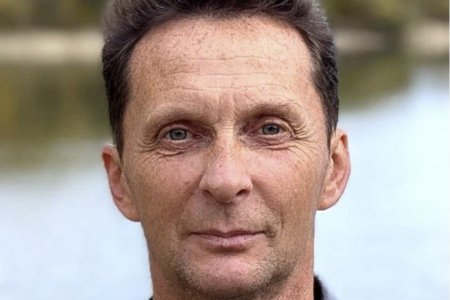
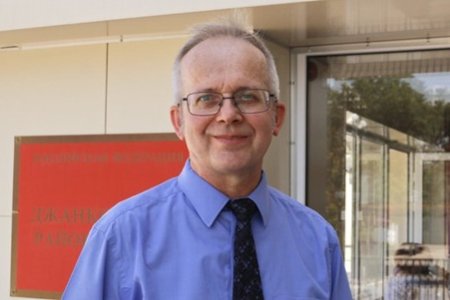
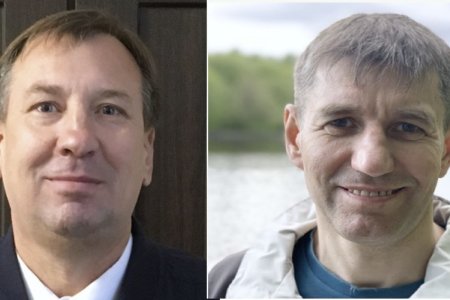
28-year-old Ilia Chertov from Zaprudne in occupied Crimea was seized at Sochi’s Adler airport on 10 August 2026. Although there is nothing to suggest that the Crimean Jehovah’s Witness, whose father is also facing persecution, had been informed of charges against him, Russian media, doubtless parroting Russia’s Investigative Committee, claimed that the latter had “broken up the activities of yet another organizer of an Alushta extremist cell”. The clear implication was that they had done so as he “was trying to flee the country’.
The Russian reports were all published on 20 August but gave no indication that he had in fact been detained a full ten days earlier. They were equally silent about the absurd administrative charge used to get the young man jailed for three days while charges were organized and ‘searches’ carried out, with these allegedly uncovering ‘prohibited literature’. Since Russia has even banned the Jehovah’s Witnesses booklet ‘What does the Bible teach us?’, it is quite possible that the search did find religious material which Russia, in contrast to Ukraine and most other countries, has banned. Even this is not guaranteed, however, as it has become standard, at least for the FSB, that they bring the supposedly ‘prohibited literature’ with them, and then claim to have found it.
According to the Jehovah’s Witnesses’ site, it was after the administrative arrest that Ilia Chertov was taken back to occupied Simferopol where he was formally charged with “organizing the activities of an extremist organization’ under Article 282.2 § 1 of Russia’s criminal code. His telephone was taken from him when first detained in Sochi, with no protocol of this drawn up. He was initially handed the order for his administrative arrest, but then that was also taken away. He was given nothing to eat for a day and a half after being detained.
The charges under Article 282.2 § 1 were initiated on 18 August by ‘senior Investigative Committee investigator Andrei A. Kirov, with Ilia Chertov formally charged on 20 August and placed under house arrest the following day. The same charge has been used to sentence a number of believers from occupied Crimea to 6 or 6.5 years’ imprisonment.
It is telling that even the official ‘Investigative Committee’ reports, circulated to Russian and occupation media, make no attempt to do any more than citing the Russian supreme court ruling from 20 April 2017 that outlawed a world faith as ‘an extremist organization’. This, the reports said, had supposedly “been established” by the Investigative Committee, with the ‘proof’ against Ilia Chertov lying in the fact that this internationally condemned ruling had not stopped the young believer from practising his faith.
Andrei Kirov is also behind identical charges laid against Ilia’s father, Volodymyr Chertov in August 2025. As reported, armed searches were carried out of eleven homes on 27 August 2025, with Volodymyr Chertov, then 52, initially taken into custody. He was subsequently charged with ‘organizing the activities of an extremist organization’, and released, but banned from carrying out certain activities. Andrei Kirov, who had initiated the criminal prosecution, and Adel Abzalilov were also involved in some of these searches, during which personal documents were removed, including ownership papers for homes and cars, and cash effectively stolen. Volodymyr Chertov and his family were subjected to a second search on 11 March 2026, with Volodymyr threatened with being held in a remand prison if he didn’t agree to ‘cooperate’. He became unwell and needed to be hospitalized.
Volodymyr Chertov (b. 15 October 1972) is originally from Donetsk and is a professional gardener. He has been a Jehovah’s Witness since the early 1990s, with his wife Nelli also a believer. The couple raised Nelly’s two sons from an earlier marriage, their own son, presumably Ilia, and adopted daughter.
It was learned in July 2026 that Volodymyr Chertov had also been charged with ‘financing extremist activities, specifically the provision and collection of funds knowingly aimed at ensuring the activities of an extremist organization.’, under Article 282.3 § 1. It is, unfortunately, possible, or even likely that Ilia Chertov will also face this escalation of the charges, since such ‘financing’ could mean as little as collecting money to pay for photocopying material or similar.
Two other believers from Zaprudne, identified only by age – one 49, the other 50, have also been accused of organizing the activities of an extremist organization. The two are claimed to be part of “the higher body of management of the district cell’, although the Jehovah’s Witnesses do not have such bodies.