Warnings have been sounding since early 2026 of a major humanitarian catastrophe in Russian-occupied Oleshky (Kherson oblast) with the situation in September having only worsened. There have been no deliveries at all of food or medicines since 26 May 2026, with the remaining population of the city in grave danger of starvation. As reported, this is no natural situation, and residents have long suspected that evacuation routes are being blocked in order to use them as human shields.
Russia has created such an information blockade on all occupied territory that it can be difficult to obtain or verify information. A few days ago, Anastasia Melnychenko used her Facebook page to post an important summary of available information. The following combines her information with that already reported here, and the most recent reports from Tetiana Hasanenko, Head of the Oleshky Military Administration.
The current humanitarian blockade of Oleshky is, Melnychenko stresses, manmade. It had long been clear that the Russian occupiers had no interest in rebuilding Oleshky, with the city, which is on the left bank of the Dnipro, primarily used as a base from which they are subjecting Kherson to constant shelling. Melnychenko also notes that the Drone Warfare project, as well as some western journalists, report that the Russians are using Oleshky as a training ground for drone operators.
The Oleshky Military Administration estimates that there are around two thousand residents still living in the city. These are mainly older people, or those with limited mobility, however there are believed to be 47 children. In the Oleshky Hromada, which also includes surrounding villages and rural settlements, there are up to six thousand residents, including over 180 children.
Any regular deliveries were reported to have stopped by December 2025, with Hasanenko reporting at the end of February 2026 that there had only been one delivery of foodstuffs since the middle of January. Other attempts to get food and other vital supplies into the city had resulted in deaths, because vehicles either came under drone attack or shelling, or hit mines. Hasanenko confirmed in an interview to Suspilne on 11 September that the last time food and medicines were brought in despite the danger, and people evacuated was 26 May 2026.
According to the information Melnychenko has gleaned, the last food shop in Oleshky closed almost nine months ago, in January 2026, and there have been no deliveries by volunteers or commercial outfits since 26 May 2026. On 2 June, two people were killed and another two gravely injured trying to get deliveries to the city. It seems there was an attempt on 1 September, however the vehicles were forced to stop and turn back because of mines, etc.
Without any new supplies, people are mainly surviving on preserves, or what they can grow or pick on plots of land or catch. The constant likelihood of drone attacks, however, has made it dangerous to work outside, even if people have dachas or plots of land. Many, in any case, do not, are elderly or in ill health. It is also September, with winter not far off, and other problems, such as the lack of electricity and gas, are rapidly becoming critical.
Melnychenko writes that the situation is exacerbated still further by cases of effective looting by Russians who take homemade preserves and other food items from people’s cellars. In March a local resident was killed by Russians when he tried to prevent them from getting into his cellar. Hasanenko also knows of cases where armed Russians first robbed people and then left them 5,000 roubles. That was more like jeering at people, she says, as they couldn’t buy anything with the roubles.
The Head of the Oleshky Military Administration remains convinced that the Russians are using the residents as human shields and consciously preventing them from leaving. This seems clear from the fact that people are not just obstructed from reaching government-controlled territory. The Russians could, at least, take them to occupied Skadovsk or Crimea. “Not just leave them to die”.
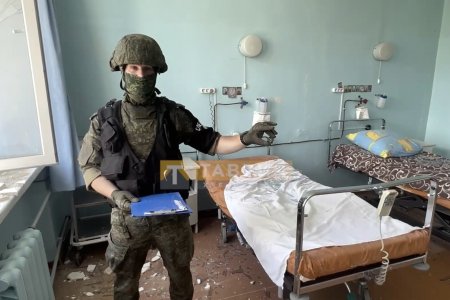
The problems are not solely with the lack of food deliveries. No medicines are arriving and there is only one clinic remaining in the city, and that is forced to work without electricity, without basic diagnostic equipment, material for sewing up injuries, antibiotics or painkillers. The same dangers with evacuation apply here too, with there little or no chance of transporting a person needing urgent medical treatment to another city, even those under Russian occupation.
Melnychenko writes that people are dying of heart attacks and strokes because of the lack of any qualified medical facilities, as well as of sepsis and, during the winter of hypothermia.
Hasanenko mentions that it is also difficult to verify information about deaths and understand whether a person was killed or died, and the morgue has been destroyed. Because of the constant drone attacks, people are afraid to even retrieve bodies which can lie unburied. Nor is this the physical danger the only thing residents have to fear. Hasanenko notes that they could get into trouble with the Russian occupiers if the person was killed in shelling or attacks. The Russians demand that the bodies get taken to occupied Kalanchak where they will get recorded as supposed “evidence of the Ukrainian Armed Forces’ crimes.”
There are also problems if a fire breaks out as there is no water to extinguish the flames, with people simply forced to move and find other unoccupied premises.
Although Russia finally acknowledged that there was a critical situation in June, it has done nothing to evacuate people. Volodymyr Saldo, the collaborator whom Russia has installed as so-called ‘governor’ of occupied Kherson oblast has tried to justify this inaction by claiming they fear “provocation from the Ukrainian Armed Forces.”
There was talk on the Russian side of an evacuation, Hasanenko says, but it has not come to anything, and the Ukrainian authorities cannot do anything without the agreement of the occupying state. Ukrainian volunteers and / or the Ukrainian authorities actively facilitate evacuate of civilians from any area where they face grave danger. If such evacuation has still not taken place from Oleshky, the reason lies with Russia.
In May 2025, the UN’s Independent International Commission of Inquiry on Ukraine issued a special report on Russia’s use of drone attacks on civilians which concluded that Russia’s widespread use of drones to drop explosives and kill civilians in Kherson oblast, as well as in double-tap strikes, where ambulance workers were targeted after they rushed to the scene of such attacks could be viewed as violations of international law as deliberate state policy and as crimes against humanity. The Commission also noted the Russian military’s coordination of their drone attacks with Russian Telegram channels likely pointed to “coordinated state policy, on the part of the Russian authorities, to force the population of Kherson Province to leave the area. The Commission therefore concludes that Russian armed forces may have committed the crime against humanity of forcible transfer of population.”
Having seized control of Oleshky, the Russians are probably loath to directly drive Ukrainian residents out but are gravely violating their obligations under international law by so endangering the local population. Nor are local residents in any way deceived by attempts to blame Ukraine for the horrific situation. Back in March, the Media Initiative for Human Rights was told by one resident that the Russians were claiming that it was Ukrainian drones that are killing people. The person continued: “but we’re not complete fools and understand perfectly well that it is the occupiers who are terrorising us”.