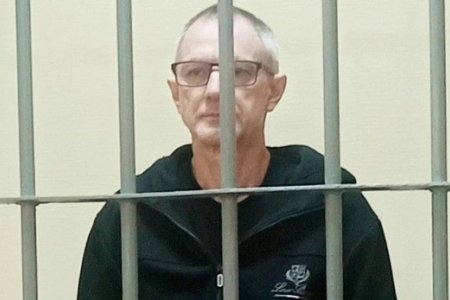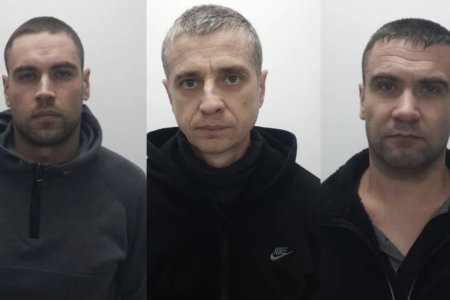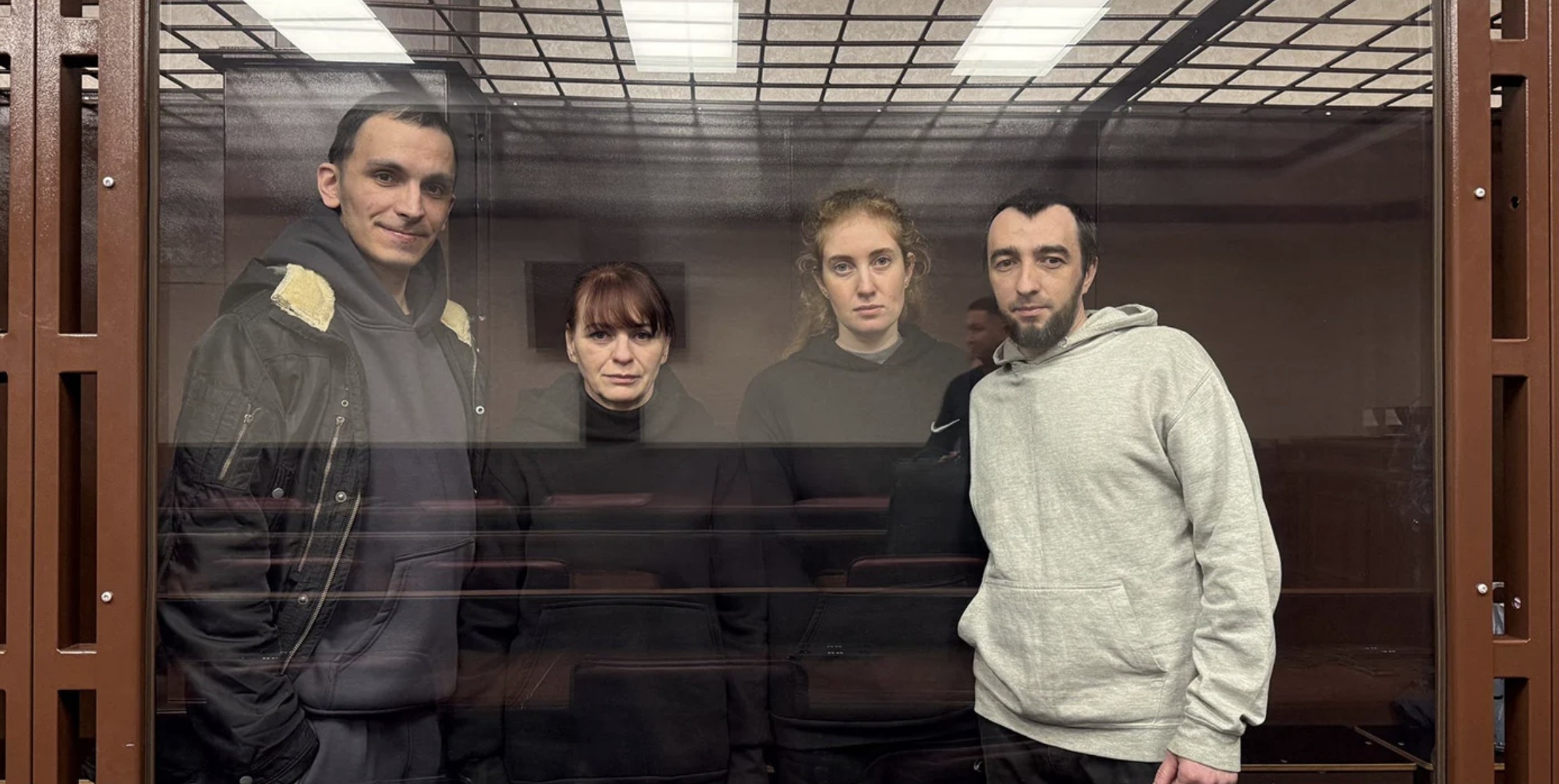
Russia’s Southern District Military Court has passed 13 and 14-year sentences against four Ukrainians abducted from occupied Kherson oblast in May 2024. The court, as always, ignored detailed testimony from all of the defendants about the electric current torture and beatings to which they were subjected, and of rape in the case of one of the two women.
Natalia Kozhemiatska (b. 7.02.1979); Kostiantyn Semeniuk (b. 16.04.1997); Anastasia Bernatska (28.03.1999) and Pavlo Peleshuk (b. 9.03.1993) are all from Nova Kakhovka which came under Russian occupation at the beginning of Russia’s full-scale invasion of Ukraine. Although in Russian captivity since May 2024, they were held incommunicado, ‘in basements’, for at least the first six months before the Russians officially ‘arrested’ them. This too was ignored by the court although there would be no reason for not charging people immediately, and allowing them lawyers, if there were any evidence against them, not just ‘confessions’ extracted through torture while the four were held without any legal status.
The four were accused of involvement in the organization of an attempt on the life of Maksym Kary, a collaborator installed by the Russians as ‘head of the Nova Kakhovka civic defence. There had been an attempt to blow up this individual’s car with him in it on 10 May 2024. Kary had noticed something suspicious and was unharmed although an FSB bomb disposal officer died trying to defuse the device.
This was claimed by the aggressor state to constitute ‘abetting terrorism’ under Article 205.1 § 3 of Russia’s criminal code. Russia is persistently flouting the prohibition on any occupying state from applying its legislation on occupied territory, and doing so in a particularly cynical manner. Kary, as a collaborator working for the Russian invaders, was a perfectly legitimate target, with the attempt on his life having nothing in common with terrorism.
The prosecution claimed that the four men and women from Nova Kakhovka had followed Kary’s movements, with this, purportedly, on orders from the administrator of a chat group which was claimed to have links with Ukraine’s Military Intelligence. This was all that they were accused of, with it likely, Natalia Kozhemiatska’s sister believed, that her sister was charged because of a photo that the Russians found of Kary’s gutted car. It is not clear why the others were targeted, but the fact that they were held incommunicado, without charges, for six months rather suggests that evidence was scant, with this quite possibly why they were only accused of largely unprovable ‘surveillance’.
The sentences, passed on 12 November 2026 by Denis Vitalievich Vovchenko, were still savage. Natalia Kozhemiatska and Kostiantyn Semeniuk were both sentenced to 14 years’ imprisonment; Anastasia Bernatska – to 13 years and 4 months; and Pavlo Peleshuk – 13 years. The women’s sentences are to be in a medium-security prison colony, the harshest for women prisoners. Both Semeniuk and Peleshuk, however, were sentenced to five years in a prison, the harshest of Russian penal institutions, with the remainder of their respective sentences in a maximum-security prison colony.
Mediazona reports that Natalia Kozhemiatska told the court that she had been tortured with the use of electric currents, beaten around the head and raped. The others also spoke of torture, with Pavlo Peleshuk stating that he had invented ‘testimony’’ to get them to stop beating him with a rubber baton and torturing him with electric currents.
Despite the methods of terror on occupied territory, there continue to be many acts of resistance to Russian occupation, including attacks on Russian-installed representatives of the occupation regime. The Russian FSB invariably claim to have ‘arrested the culprits’, with charges laid of ‘terrorism’ or even ‘intentional terrorism’. While it is possible that in same cases those abducted, tortured and then sentenced to long terms of imprisonment were genuinely involved in partisan resistance, in others the abductions seem quite arbitrary.
Virtually nothing is known about Anastasia Bernatska; Kostiantyn Semeniuk and Pavlo Peleshuk, except one key fact, namely that no charges were laid before they had been held incommunicado, and, they allege, savagely tortured and beaten. More, however, is known about Natalia Kozhemiatska, how she came to be in Russian captivity and the criminal treatment to which she was subjected.
As reported, in June 2025, Natalia’s sister, Tetiana spoke about her sister’s ordeal to the ZMINA Human Rights Centre. She explained that Natalia, together with her husband and father, had remained in Nova Kakhovka after the Russian invasion, while Tetiana moved with her family in April 2022 to government-controlled territory.
With most places closed after the Russian invasion, Natalia was forced to take up work at a cigarette kiosk in the city. She worked with another woman, but she was designated the senior of the two and was responsible for locking up the kiosk in the evening and taking all the goods home with her.
On 17 May 2024, Tetiana learned from Natalia’s husband that she had been seized by armed Russians as she was walking to the kiosk to lock up for the night.
The Russians brought Natalia home a day later, in the evening of 18 May. She looked terrified and spoke of having been tortured with the use of electric currents (attached to sensitive parts of the body, with the pain excruciating). She arranged with her mother that the latter would come over the next day. This had, however, all been a trick. The Russians returned at around 10 in the evening and ordered her to dress warmly as she was “going with them for a long time”.
Natalia disappeared, with her family unable to find out anything for a long time. Tetiana immediately informed the Ukrainian police and other relevant authorities of Natalia’s abduction / disappearance, while Natalia’s mother reported her missing to the occupation ‘police’ on 31 May 2024. The official response to the latter was that Natalia had not been detained. In private conversations with her mother, however, the occupation police did admit that Natalia had been taken away by the FSB. Nor was there any real pretence, as the Russians returned in June 2024 and carried out a search of Natalia’s apartment, taking her passport and personal items. Over the following months, the family were aware that Natalia was held by the Russians, but not why.
The Russians’ abduction almost certainly turned into an ‘arrest’ around 10 November 2024, when Natalia’s mother received a call from a person who claimed to be Natalia’s lawyer and asked her mother to sign a contract with him to provide legal assistance during the pre-investigative stage. It was only after that document was signed that the family learned that Natalia was imprisoned in occupied Novotroitske and that they could pass on parcels with food items, etc. They discovered also that the charges were linked with the attempt on Maksym Kary. At some stage before June 2025, the Russians seem to have also accused at least Natalia Kozhematska of involvement in the death of a Russian FSB major, M.I. Sverdlyakov. That, however, seems to have been dropped from the final indictment.
Natalia’s mother was able to see her on 25 November 2024 in Novotroitske, and learned that during that first day after she was abducted, she had been savagely raped. Her mother was extremely concerned at how shocking Natalia looked and how thin she had become.