![© Depositphotos [жінка, полон] © Depositphotos © Depositphotos](https://khpg.org/files/img/1608824080.jpg)
According to the director of the Kharkiv Human Rights Group, Evhen Zakharov, at least 30 female military personnel and about three hundred civilian Ukrainian women are currently in Russian captivity. Lawyers of the Kharkiv Human Rights Protection Group provide legal assistance in 127 cases involving women, both prisoners (72 of whom are in the KHPG database) and those who have already returned home. Almost all who survived captivity testify to poor conditions of detention, beatings, and torture. In addition, our lawyers are working on 108 cases related to conflict-related sexual violence (CRSV), involving both women and men.
The findings of a large number of violations of humanitarian law in Russian captivity are also confirmed by international organizations. The UN Monitoring Mission conducted confidential interviews with 725 released Ukrainian prisoners of war after the exchanges. Among them were 689 men and 36 women. 697 of them (that’s 96%!) spoke about torture or ill-treatment while in Russian captivity. 321 out of 380 (84%) released civilians, with whom the Office of the UN High Commissioner for Human Rights conducted confidential interviews, also testified about torture and ill-treatment. At least 445 Ukrainian prisoners of war (418 men and 27 women) and 168 detained civilians (121 men, 46 women, and 1 boy) were subjected to conflict-related sexual violence (CRSV).
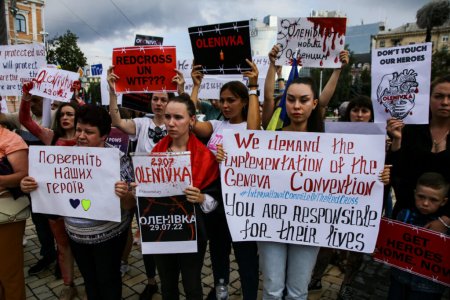
The Russians are holding Ukrainian female prisoners in various places of detention, both in the occupied territory and in the Russian Federation. Since 2014, they have been taken, among others, to the Donetsk SIZO and “Izolyatsia” [solitary confinement]. In the first years of the full-scale invasion, many female prisoners of war passed through the women’s colony in Mariupol, Olenivka. Civilian residents of the occupied territories ended up in numerous unofficial places of detention—torture, from where they were either released or taken further, for example, to the Belgorod SIZO and further, deep into Russia. In addition, at various times, KHPG clients were or are still in pre-trial detention centers in Taganrog and Valuyki, and in correctional colonies in Kursk, Malaya Lokna (Kursk region), Borisoglebsk (Voronezh region), etc.
— Cases involving prisoners come in groups to us, — says Tamila Bespala. — You take on the case of a servicewoman who returned from captivity and was tortured there. You start looking for witnesses to the crime, and in the process, it turns out that the women who were in captivity with her were also tortured. Interestingly, almost all of our servicewoman clients who were captured and later released continue their service, often not at zero point anymore, but in safer conditions. We usually communicate with them online, because they are somewhere on duty or even in the field.
— Do the conditions in which women are held in captivity differ from how men are held?
— The conditions in which women are held are almost the same as in places where men are held. The only thing is that in some places—I’m not saying everywhere—they still give out hygiene products. But not everywhere. A shower, if it’s once a week, is a treat. In normal life, to feel clean, a woman washes twice a day, and in the summer, she sometimes wants to shower even more often. And here—no matter how hot, how stuffy, or how cold—wait a week. It’s hard to understand why such conditions are created.
Women are beaten less than men. But they are still beaten. When they are taken out for walks, batons are already routine. Some women don’t even mention this in a conversation with a lawyer, because they stop perceiving it as a beating, as violence; it becomes so much a part of everyday life for them in captivity. I got the impression that female guards sometimes treat prisoners even more cruelly than male guards. In general, those who return from captivity tell very different stories: some say that they were even given something vitamin-rich (an apple once a month or an onion).
In contrast, others say that all their food was “empty.” In addition, different people perceive the same conditions differently. People do not always understand that what happened to them is a crime. They compare themselves with other victims who had it completely bad. “That happened to my cellmate, but everything is fine with me!” It is easier for some not to talk, but then you communicate with the person, and they open up, and you hear such things… In general, people often do not have a very high level of legal awareness. And in captivity, the sense of one’s own boundaries is often erased, and a person begins to perceive three slaps on the back in a day not as a crime, but as something ordinary.
— And what about medical care?
— They can measure blood pressure. And give some unknown pills. Moreover, no one knows what kind of pills those are, as prisoners are not told what exactly they are being treated with. That’s all the medical help. I often hear such stories: they enter a cell, break one pill in half, and give it to two female prisoners — “This is for your stomach, and this is for your head.” I heard this very often from many clients.
— Is there access to a gynecologist?
— If we are talking about colonies or pre-trial detention centers, then a gynecologist must examine the prisoners during the first stage, the so-called “reception” (in unofficial “torture chambers”, of course, this is not the case). But I cannot say that the woman will receive treatment if something is discovered. When there is a problem, it is not solved. It is worth noting that many women have a cessation of their menstrual cycle due to stress, poor living conditions, and malnutrition. The illnesses in captivity are similar for everyone—pain, fungal diseases, and, where there is sexual violence, there are bigger problems...
— How often do women returning from captivity report torture and CRSV?
— Many women may find it difficult to talk about their experiences, but they can tell what happened to others. Not everyone understands that the threat of sexual violence, forcing them to undress in front of guards, is also CRSV. There are also stories of women being forced to have sexual intercourse with guards to somehow improve their living conditions, for cigarettes, or even just for food. And this also says a lot about the terrible conditions of detention.
— Which of the places where women prisoners are held are the worst?
— Definitely — unofficial. The most terrible things happen there, both for women and men. I’m not saying that being in an official place of detention gives you confidence that you will survive, that you will not be tortured, no, they also beat and even kill there, but a smaller percentage. In addition, what I hear about the Donetsk “Izolyatsia” is beyond any scope. What kind of people with a sick imagination work there! We have clients who have been through “Izolyatsia”. Sexual violence in this place is just something ordinary.
— How do you work with women who return from captivity after experiencing torture or CRSV?
— We create all the conditions for a person to feel comfortable talking, taking into account all the standards. In general, psychologists should first work with people returning from captivity —a professional, trained, and humane psychologist. There should be an incredible selection here. The presence of a psychologist not only helps the victims but also simplifies the work of lawyers, law enforcement officers, and documenters.
— What should the training of such specialists be?
— This is not only about knowing the principles of the Istanbul Protocol and having the appropriate certificates. Constant training and practice are necessary. Humanity and motivation play a big role. We encounter different things. Some of our clients may have problems in their relationships with their husbands after captivity, while others may have severe depression and even the threat of suicide. The problems are different, so different specialists and approaches are needed. We have a psychiatrist on staff who steps in when the case is very difficult.
— A person has returned from captivity, and it is known that she survived torture and the CRSV. You even managed to identify the suspects. What next?
— The pre-trial investigation is beginning in the court. There are already verdicts. In cases where I participate as a lawyer, there have already been five verdicts. True, all in absentia. By the way, a major case about the Kupiansk torture chamber recently came to court. Among the 42 victims are women. Among other things, it is about the CRSV. I will represent most of the victims. But out of 18 accused, only two are in Ukrainian captivity. The materials have already been collected. The trial will be closed there.
— But trials drag on for a long time… A person has to repeat, over and over, what they would prefer to forget.
— Yes, indeed, not every person is ready to go through all the trials to the end. Quite often, clients refuse to participate in trials. Sometimes you can immediately see that a person will talk to you now, feel a little better, and then leave; they will not want to continue. Sometimes, the case has already been considered, the court hearing date is known, and the person refuses to attend. And it also happens that as a result of the trauma experienced, someone starts abusing alcohol or drugs… Then it is too late for trials. All this again speaks of how necessary it is for women who have gone through captivity, torture, psychological rehabilitation, and sometimes the help of a psychiatrist. We have such specialists, and we always work in tandem. They go together with lawyers for interrogations.
— How is it for you, as a woman, to work on such cases — about captive women, about the CRSV?
— It is better now, although I can still burst into tears. If we need to smoke with a client, we smoke. If she wants to cry—we cry... I’ve heard such things that it seems nothing surprises me anymore. But still, a new case comes, and you don’t understand how people can do such things. Personally, I find it difficult to work on cases involving children, because I’m a mother myself. There are cases where minors in captivity were sexually abused. It was especially difficult for me at the beginning of the full-scale invasion. Then it seemed that my psyche wouldn’t stand it: you couldn’t sleep or eat. Now it’s easier. The most difficult case was about a four-year-old child who was tortured during the occupation of the Kherson region.
— What struck you most while working on cases involving captive women?
— There was a case of a woman of considerable age, over 70 years old. She was held in a torture chamber for four months for helping the partisans. She did indeed give them food. She was regularly raped in the torture chamber. And even despite all this, she did not hand anyone over to the occupiers. And it also amazes me when you ask a woman, “How did you endure it? What gave you strength?” And I often hear the answer: “Children!”