Introduction
The capacity for critical and analytical thinking is not only an individual intellectual asset but also a public resource on which the way conflicts are resolved largely depends. A society whose members understand the complexity of problems and the diversity of views has an effective set of mechanisms for reconciling interests: public debate, compromise and legal procedure. A narrowing of intellectual horizons, by contrast, generates demand for simple solutions to complex problems: the search for an external or internal enemy, the forcible elimination of differences, and the handing of responsibility to a ‘strong hand’.
This connection is confirmed by research across various disciplines. Analysis of international crises shows that a decline in political leaders’ ability to take different points of view into account preceded the escalation of crises into armed conflict [1]. The educational level of the population is consistently associated with the stability of democratic institutions [2]. Consequently, the stunting of intellectual development leads to the degradation of the culture of public debate and creates the preconditions for war, coups, the entrenchment of tyranny and the persecution of dissenters.
Intellectual development, in turn, is impossible without freedom of opinion and its expression. At the universal level, this right is enshrined in Article 19 of the Universal Declaration of Human Rights and Article 19 of the International Covenant on Civil and Political Rights, which separately guarantees the absolute freedom to hold opinions. In its General Comment No. 34, the UN Human Rights Committee stresses that this freedom is an indispensable condition for the full development of the person and the foundation stone of every free and democratic society. For Ukraine and Europe, the decisive provision is Article 10 of the 1950 Convention for the Protection of Human Rights and Fundamental Freedoms. As early as Handyside v. the United Kingdom (1976), the European Court of Human Rights emphasised that freedom of expression constitutes one of the essential foundations of a democratic society and one of the basic conditions for its progress and for the development of every individual. The Court subsequently applied these principles to the digital environment, in particular with regard to the blocking of websites (Ahmet Yıldırım v. Turkey, 2012) and mass surveillance (Big Brother Watch and Others v. the United Kingdom, 2021). The Charter of Fundamental Rights of the EU, which became legally binding when the Treaty of Lisbon entered into force on 1 December 2009, additionally requires respect for the freedom and pluralism of the media in Article 11, and guarantees the freedom of the arts and scientific research in Article 13. Control over information flows therefore affects not merely one particular aspect of freedom of speech, but the very foundation of independent thought.
The problem
In recent decades, threats to this right have become global and systemic. According to Freedom House, global internet freedom has declined for fifteen consecutive years, with the most consistent deterioration recorded in the indicator measuring the manipulation of online sources by governments and other powerful actors. According to the 2026 V-Dem report, freedom of expression has suffered more than any other component of democracy, declining in 44 countries in 2025.
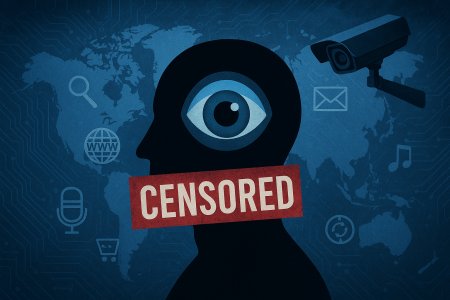
Contemporary threats operate in two mutually reinforcing forms. The first is the restriction of access to information: censorship, blocking, internet shutdowns and persecution for one’s statements. The second is the distortion of information: organised disinformation campaigns, which researchers at the Oxford Internet Institute have documented in 81 countries, algorithmic ranking of content [3] and personalised influence based on harvested data [4]. Restriction deprives a person of access to information, while manipulation substitutes its content and thereby infringes the freedom of opinion protected by Article 19(1) of the ICCPR.
Those carrying out restriction and manipulation are not only states but also transnational digital platforms, whose responsibility under international human rights law remains insufficiently defined.
The latest methods of manipulating consciousness
We have written previously about the mechanisms for restricting access to information. Let us now consider the latest methods of manipulating mass consciousness. Today, analysts identify several such trends.
1. Psychological profiling and microtargeting
Digital footprints (likes, search queries, purchase history, geolocation) make it possible to determine, with a high degree of accuracy, a person’s personality traits, political views, sexual orientation and other sensitive characteristics, even if that person has never disclosed them [5]. On the basis of such profiles, audiences are divided into narrow segments, and each segment receives messages tailored to its psychological characteristics. Experiments have shown that advertising adapted to a personality profile is markedly more effective than standard advertising [6].
2. Algorithmic ranking and curation of information
Search engines and social media feeds determine which information comes to a user’s attention and in what order. Experiments have shown that changing the order of search results can shift the preferences of undecided voters, with most participants failing to notice the manipulation [3]. A study based on Twitter data found that the algorithmic feed amplifies the political content of different parties unequally [7], while a Facebook experiment demonstrated that it is possible to influence the emotional state of hundreds of thousands of users through the selection of posts in their feeds [8].
The problem is that decisions about the visibility of information are made by opaque private systems that are not accountable to society and are optimised to capture attention rather than to ensure the quality of information.
3. Exploitation of emotions and virality
The architecture of social media rewards content that provokes strong emotions. Each moral-emotional word in a message increases the likelihood of its being shared [9]. False news, unfortunately, spreads on social media faster, further and more widely than true news, primarily because it provokes surprise and disgust [10]. Manipulators deliberately exploit this feature: messages that evoke fear, anger and a sense of threat suppress analytical thinking and prompt hasty reactions. As a result, public debate becomes polarised, and complex problems are reduced to emotionally charged ‘us versus them’ oppositions.
4. Bots, trolls and coordinated inauthentic behaviour
Automated accounts (bots) and organised groups of users (‘troll farms’) create the illusion of mass support or mass rejection; in other words, they manufacture artificial public opinion. Bots are particularly active in the early stages of the spread of unreliable content and help it to go ‘viral’ [11]. The Oxford Internet Institute has documented organised social media manipulation campaigns in 81 countries, with such campaigns increasingly being carried out by private companies on commission (the ‘Industrialized Disinformation’ report). State campaigns are not always aimed at direct persuasion. An analysis of Chinese government posts, which are produced in their hundreds of millions each year, showed that their main purpose is to distract attention from sensitive topics rather than to engage in debate [12]. This exploits the social proof effect: people tend to regard as correct whatever, in their impression, the majority shares.
5. Information overload (censorship through noise)
In conditions of information abundance, censorship is supplemented by a new strategy: rather than banning unwanted information, it is ‘drowned’ in a flood of other content, raising the cost of finding reliable information [13]. Researchers at the RAND Corporation describe the Russian propaganda model as a ‘firehose of falsehood’: high volume, multiple channels, speed, repetition and indifference to consistency and truthfulness. The aim of this strategy is not so much to persuade people of a particular version of events as to create the sense that the truth cannot be established. This breeds cynicism, apathy and a refusal to try to make sense of things; in other words, it undermines the very foundation of critical thinking.
6. Deepfakes and synthetic media
Artificial intelligence technologies make it possible to create realistic fake videos, audio recordings and images of real people. Such material has been used in election campaigns and armed conflicts. One example is the fake video of the President of Ukraine announcing a capitulation, disseminated in March 2022 via a hacked television channel website. The danger that deepfakes pose to privacy, democracy and national security has been analysed in detail in the legal literature [14]. No less important is the reverse effect, which has come to be known as the ‘liar’s dividend’: the very existence of deepfakes makes it possible to dismiss genuine compromising material as fake [14]. Ultimately, trust in any audiovisual evidence is undermined, which weakens both journalism and the administration of justice.
7. Generative AI and personalised persuasion
Large language models reduce the cost of producing persuasive texts almost to zero. Experiments have shown that AI-generated propaganda texts are almost as persuasive as those written by humans [15]. In debates with humans, GPT-4, when given basic information about its interlocutor, persuaded its opponent more often than a human did [16]. Dialogues with AI are capable of durably changing even deeply rooted beliefs [17]. Consequently, those who control AI algorithms acquire a potential instrument of manipulation: personalised dialogue on the scale of millions of users differs qualitatively from the mass propaganda of the past. It is no coincidence that the EU Artificial Intelligence Act (Article 5) prohibits AI systems that deploy subliminal or purposefully manipulative techniques that materially distort human behaviour.
8. Digital surveillance and self-censorship
Mass surveillance operates not only through direct repression but also through a ‘chilling effect’: people who know they are being watched change their behaviour. Following E. Snowden’s revelations in 2013, the number of views of Wikipedia articles on ‘sensitive’ topics fell noticeably [18]. Awareness of government monitoring also reduces willingness to express opinions that diverge from those of the majority [19]. Surveillance thus affects thinking indirectly: people stop seeking certain information and discussing certain topics, thereby narrowing their own intellectual space. Combined with facial recognition technologies and big data analytics, this creates the conditions for internal censorship without any explicit prohibitions.
Beneficiaries and victims of digital manipulation
Digital manipulation is not harmless: it redistributes power, resources and influence in favour of a narrow circle, while the costs are borne by society as a whole. For legal analysis, it is therefore important to answer the question cui bono: who benefits?
Beneficiaries
1. Politicians seeking to retain or seize power. Modern authoritarian regimes rely less and less on mass violence and increasingly retain power by managing information: creating the appearance of competence and popular support and discrediting alternatives [20]. Digital technologies make this strategy cheap and scalable. Its key elements are the compromising of opponents (leaks, fabricated material, deepfakes, harassment campaigns) and the portrayal of a political rival not as an opponent but as an enemy and a traitor, which researchers regard as one of the principal signs of the breakdown of democracy [21]. Techniques of compromising people are not available to authoritarian regimes alone. The international journalistic investigation Pegasus Project revealed that Pegasus spyware had been used against journalists, human rights defenders and opposition figures in many countries, including EU member states (see also the report of UN Special Rapporteur D. Kaye on surveillance and human rights).
Another strategy involves artificially stirring up hostility within society, since a divided society is incapable of collective action, and hatred of an ‘internal enemy’ justifies the concentration of power and the curtailment of freedoms. A well-documented example is the activity of the Russian ‘Internet Research Agency’, which simultaneously created communities in opposing political camps in the United States, inflaming conflicts along racial, migration-related and religious lines (report of the US Senate Select Committee on Intelligence; [22]). The most tragic example is Myanmar, where hate campaigns on Facebook against the Rohingya people, some of them organised by the military, preceded mass violence (report of the UN Independent International Fact-Finding Mission). According to the findings of Amnesty International, the platform’s algorithms actively amplified such content.
2. Digital platforms. The bulk of the largest platforms’ revenue comes from advertising, and therefore from selling users’ attention and predictions of their behaviour [23; 4]. Hence their interest in content that holds attention for longer. Such content turns out above all to be content that provokes hostility: posts about political opponents receive considerably more reactions and shares than posts about neutral but important events [24]. Division within society thus becomes not only a political tool but also a commercially profitable product.
3. The manipulation industry. A market has emerged for services that influence public opinion: private PR and marketing firms, data brokers, ‘troll farms’ and spyware developers. The Oxford Internet Institute found that commercial firms had conducted political manipulation campaigns on behalf of governments and parties in 48 countries (2020 report). This industry has an interest in keeping regulation weak and works for any client able to pay.
Victims
1. The human person. The principal harm is the loss of cognitive autonomy. A person is transformed from a decision-making subject into a source of behavioural data and an object of prediction and control [4]. Even before the digital age, N. Postman warned that the threat to free thought might come not from prohibitions but from a stream of entertainment that crowds out serious reflection [25]. The digital environment intensifies this tendency: fragmented, clip-like consumption of information, impulsive reactions and nudges towards purchases shape the behaviour of a consumer rather than that of a citizen. The impact of social media on mental health, especially that of adolescents, is widely debated, although the scale of this impact remains a matter of dispute in the academic literature [26; 27].
2. The opposition, journalists, human rights defenders and dissenters are subjected to surveillance, compromising campaigns, harassment and persecution. The harm is not only to them personally: society loses alternative sources of information and voices capable of criticising those in power.
3. Minorities and vulnerable groups. It is primarily against them that hate campaigns are directed, and they are the first to be cast as ‘the enemy’.
4. Society and democratic institutions. The polarisation of society destroys trust between citizens and in institutions: elections, the courts, the media and science. People lose their reliance on a shared body of facts, without which rational debate and the peaceful resolution of conflicts are impossible. This closes the circle described in the introduction: the suppression of critical thinking creates demand for simple and forceful solutions.
Lessons of history
The manipulation of mass consciousness is not an invention of the digital age. The totalitarian regimes of the twentieth century showed where a monopoly on information leads: first, the state appropriates the right to determine what is true; then it constructs an ‘image of the enemy’; and later it moves on to mass violence [28].
As early as 1918, the Bolshevik authorities proclaimed the ‘Red Terror’, while propaganda turned entire social groups (the ‘bourgeoisie’, the ‘kulaks’, ‘enemies of the people’) into objects of hatred who could be destroyed without trial. Stalin’s regime perfected this model: total censorship, state-controlled press and radio, show trials and a cult of denunciation. Propaganda concealed the Holodomor of 1932–1933 in Ukraine, and during the Great Terror of 1937–1938 more than 680,000 people were shot, having been presented to society as spies and traitors [29].
Nazi Germany established the Ministry of Public Enlightenment and Propaganda, headed by J. Goebbels, as early as March 1933. The regime distributed cheap radio sets on a mass scale, burned ‘harmful’ books and systematically dehumanised Jews in the press, in cinema and in school textbooks (Holocaust Encyclopedia, USHMM). Research shows that Nazi radio broadcasting intensified antisemitic acts in areas with long-standing antisemitic sentiment [30], and that people who went to school under the Nazis were, even decades later, more likely to hold antisemitic views [31]. Dehumanisation was the preparatory stage of the Holocaust, during which some six million Jews were murdered. The same mechanism operated later: in Rwanda in 1994, a radio station that called for violence against the Tutsi markedly increased participation in the genocide in the areas within its broadcast range [32].
The scale of manipulation: then and now
To manipulate the masses, totalitarian regimes needed an enormous apparatus: censors, printing works, state radio stations and networks of informers. Their propaganda was the same for everyone, one-directional and overt. People generally knew they were dealing with propaganda and learned to ‘read between the lines’, while samizdat and foreign radio left gaps through which alternative information could pass.
Digital technologies remove most of these constraints. Messages are personalised for each individual rather than for the masses. Influence becomes invisible because it is built into search results, news feeds or dialogue with AI. Feedback makes it possible to measure reactions instantly and adjust messages accordingly; costs fall almost to zero, and national borders cease to be an obstacle. Surveillance capabilities that neither the NKVD nor the Gestapo possessed are now supplied by users themselves, who voluntarily leave digital footprints. Moreover, manipulation can be carried out not only by states but also by private companies and hired contractors.
At the same time, technology in itself does not give rise to terror: the crimes of the twentieth century became possible through a combination of propaganda, a political will to commit violence and the absence of independent institutions. The main lesson of history is that mass violence has invariably begun with a monopoly on ‘truth’ and the dehumanisation of others. That is precisely why protecting freedom of thought and its expression in the digital environment is not an abstract legal norm, but a safeguard against the repetition of past catastrophes.
Conclusion
There is a profound asymmetry between the beneficiaries and the victims. The benefits are concentrated in the hands of a few (ruling elites, corporations and contractors), while the costs are spread among millions of people who are often not even aware that they have become objects of manipulation. It is this asymmetry, together with the invisibility of non-material harm, that explains why protection against digital manipulation requires a legal response, not merely a technical or educational one.
References
- Suedfeld P., Tetlock P. E. Integrative complexity of communications in international crises // Journal of Conflict Resolution. 1977. Vol. 21, No. 1. P. 169–184.
- Glaeser E. L., Ponzetto G. A. M., Shleifer A. Why does democracy need education? // Journal of Economic Growth. 2007. Vol. 12, No. 2. P. 77–99.
- Epstein R., Robertson R. E. The search engine manipulation effect (SEME) and its possible impact on the outcomes of elections // PNAS. 2015. Vol. 112, No. 33. P. E4512–E4521.
- Zuboff S. The Age of Surveillance Capitalism. New York: PublicAffairs, 2019.
- Kosinski M., Stillwell D., Graepel T. Private traits and attributes are predictable from digital records of human behavior // PNAS. 2013. Vol. 110, No. 15. P. 5802–5805.
- Matz S. C., Kosinski M., Nave G., Stillwell D. J. Psychological targeting as an effective approach to digital mass persuasion // PNAS. 2017. Vol. 114, No. 48. P. 12714–12719.
- Huszár F. et al. Algorithmic amplification of politics on Twitter // PNAS. 2022. Vol. 119, No. 1. e2025334119.
- Kramer A. D. I., Guillory J. E., Hancock J. T. Experimental evidence of massive-scale emotional contagion through social networks // PNAS. 2014. Vol. 111, No. 24. P. 8788–8790.
- Brady W. J. et al. Emotion shapes the diffusion of moralized content in social networks // PNAS. 2017. Vol. 114, No. 28. P. 7313–7318.
- Vosoughi S., Roy D., Aral S. The spread of true and false news online // Science. 2018. Vol. 359, No. 6380. P. 1146–1151.
- Shao C. et al. The spread of low-credibility content by social bots // Nature Communications. 2018. Vol. 9. Article 4787.
- King G., Pan J., Roberts M. E. How the Chinese government fabricates social media posts for strategic distraction, not engaged argument // American Political Science Review. 2017. Vol. 111, No. 3. P. 484–501.
- Roberts M. E. Censored: Distraction and Diversion Inside China's Great Firewall. Princeton: Princeton University Press, 2018.
- Chesney R., Citron D. Deep fakes: A looming challenge for privacy, democracy, and national security // California Law Review. 2019. Vol. 107, No. 6. P. 1753–1820.
- Goldstein J. A. et al. How persuasive is AI-generated propaganda? // PNAS Nexus. 2024. Vol. 3, No. 2. pgae034.
- Salvi F., Horta Ribeiro M., Gallotti R., West R. On the conversational persuasiveness of GPT-4 // Nature Human Behaviour. 2025.
- Costello T. H., Pennycook G., Rand D. G. Durably reducing conspiracy beliefs through dialogues with AI // Science. 2024. Vol. 385, No. 6714. eadq1814.
- Penney J. W. Chilling effects: Online surveillance and Wikipedia use // Berkeley Technology Law Journal. 2016. Vol. 31, No. 1. P. 117–182.
- Stoycheff E. Under surveillance: Examining Facebook's spiral of silence effects in the wake of NSA internet monitoring // Journalism & Mass Communication Quarterly. 2016. Vol. 93, No. 2. P. 296–311.
- Guriev S., Treisman D. Spin Dictators: The Changing Face of Tyranny in the 21st Century. Princeton: Princeton University Press, 2022.
- Levitsky S., Ziblatt D. How Democracies Die. New York: Crown, 2018.
- DiResta R. et al. The Tactics & Tropes of the Internet Research Agency. New Knowledge, 2018.
- Wu T. The Attention Merchants: The Epic Scramble to Get Inside Our Heads. New York: Knopf, 2016.
- Rathje S., Van Bavel J. J., van der Linden S. Out-group animosity drives engagement on social media // PNAS. 2021. Vol. 118, No. 26. e2024292118.
- Postman N. Amusing Ourselves to Death: Public Discourse in the Age of Show Business. New York: Viking, 1985.
- Haidt J. The Anxious Generation. New York: Penguin Press, 2024.
- Orben A., Przybylski A. K. The association between adolescent well-being and digital technology use // Nature Human Behaviour. 2019. Vol. 3. P. 173–182.
- Arendt H. The Origins of Totalitarianism. New York: Harcourt, Brace and Co., 1951.
- Snyder T. Bloodlands: Europe Between Hitler and Stalin. New York: Basic Books, 2010.
- Adena M., Enikolopov R., Petrova M., Santarosa V., Zhuravskaya E. Radio and the rise of the Nazis in prewar Germany // The Quarterly Journal of Economics. 2015. Vol. 130, No. 4. P. 1885–1939.
- Voigtländer N., Voth H.-J. Nazi indoctrination and anti-Semitic beliefs in Germany // PNAS. 2015. Vol. 112, No. 26. P. 7931–7936.
- Yanagizawa-Drott D. Propaganda and conflict: Evidence from the Rwandan genocide // The Quarterly Journal of Economics. 2014. Vol. 129, No. 4. P. 1947–1994.