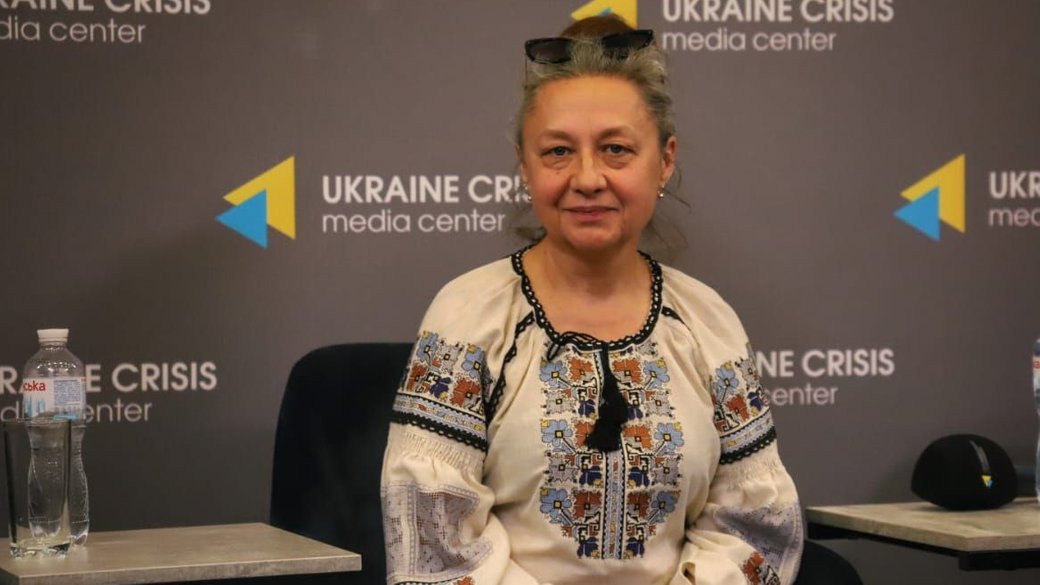
Natalia Shilo is originally from Horlivka; she was born and raised there in Donetsk Oblast. Her father is from here, and her grandmother was born here long ago in 1912. Natalia was trained as a teacher and was confident she would work with children here in Horlivka for the rest of her life.
"By the way, I was a physics and mathematics teacher at the city’s only Russian-language school. I taught in Russian, and no one oppressed or insulted us. I did not recognize Yanukovych as the President when he was elected in 2004. The children said, ’Yanukovych is ours.’ And I replied, ’I respect your choice, but he is not my President.’ Back then, in 2004, they were still young. Now it turns out that half of the students in my class have relocated to the government-controlled area of Ukraine; they are patriots... By the end of 2013, something appeared to fracture. I couldn’t understand what was going on, why people suddenly started to lose their common sense. My daughter was studying in Kharkiv, and in the spring of 2014, she called me and told me about the events at the Kharkiv Euromaidan, including how Serhiy Zhadan was beaten. I listened and cried — it couldn’t be true that people had suddenly gone insane!"
War
Military vehicles started entering Horlivka in May 2014. Natalia quickly realized they were Russians despite the soldiers not wearing any identifying marks. She says it was easy to understand because of their language. Having many relatives in Russia, Natalia understands how people talk in various Russian regions.
Each day, life in Horlivka became more intense as the city was shelled from all sides, and people started fleeing elsewhere. Natalia moved in with her mother, believing that the basement of her private house would be a safer place. Food delivery to the city stopped, and there was no water. Famine has begun. Mobile communications vanished. Even Natalia’s daughter in Kharkiv couldn’t imagine the conditions her mother and grandmother were trying to survive in Horlivka.
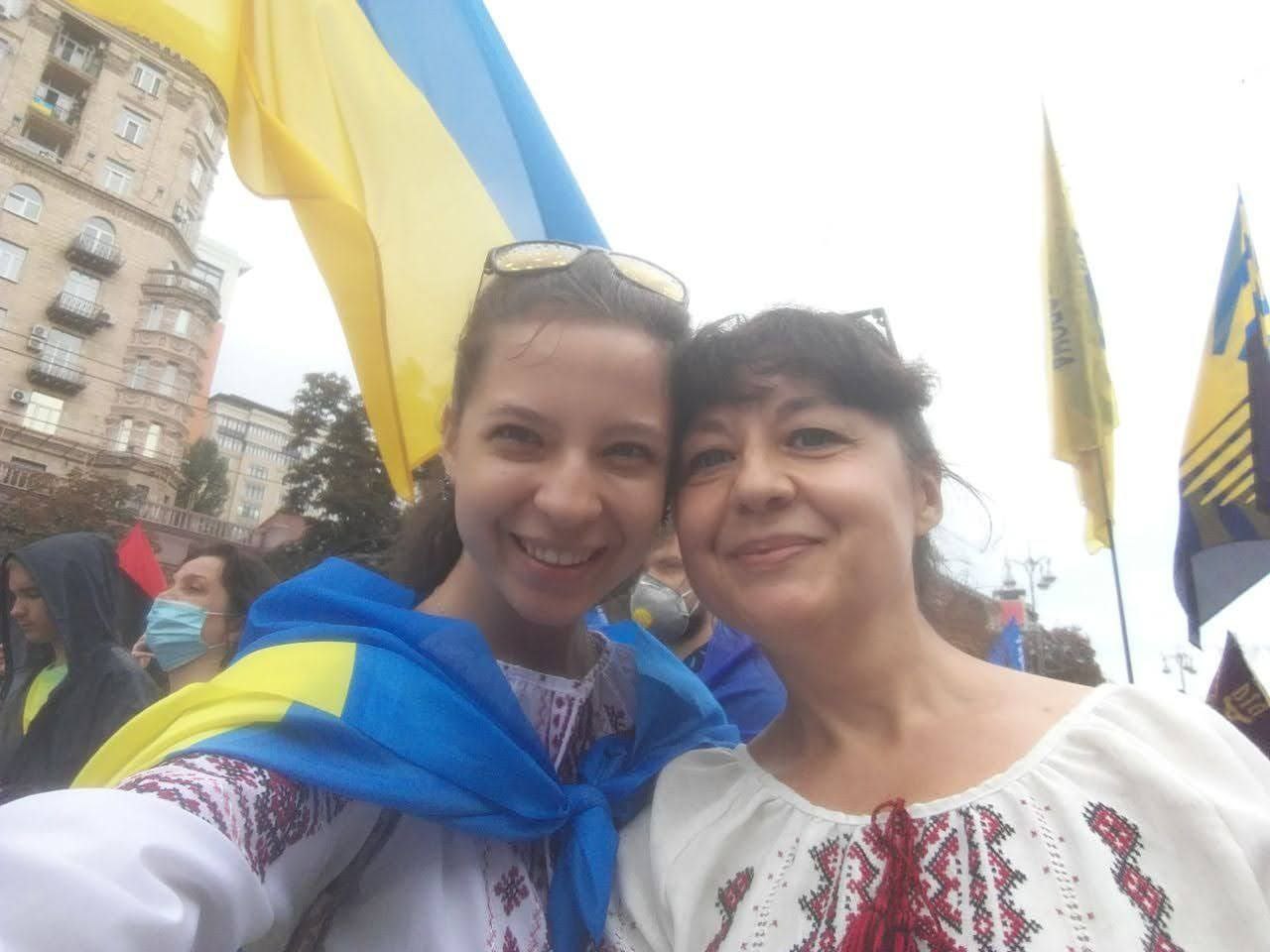
“Our school year began on October 1. My colleague and I had to go to work every day under shelling. Why? Because the deputy headmaster said, ’What if the children come to school?’ Only the deputy headmaster and the two of us were at the school; everyone else had left. We attempted to find a mobile network signal, even climbing onto the roof to get at least some reception. I managed to call the Ministry of Education and Science and said, ’I’m a teacher from Horlivka. There’s nobody here, no authorities, and the schools aren’t open. What should I do?’ They told me they were evacuating the institutes but not the schools because schools were under the authority of the local government. “Find someone from the local government!” But we already had neither police nor local deputies...”
Occasionally, a female psychologist volunteering to help people under occupation started calling Natalia from the territory controlled by the Ukrainian government. She was the one who helped Natalia find a job at one of the gymnasiums in Kharkiv.
“On December 19, I departed from Horlivka to Kharkiv. My mother remained behind. She said she would take care of my apartment, her house, and our country house. There were so many looters at that time! In Kharkiv, I worked at a gymnasium, participated in the “Teacher of the Year” competition, and was among the top three physics teachers in the city and the oblast. And later, I moved to Kyiv.”
“The MGB is coming for you”
...2021. At the start of summer, I was going to visit my mother in Horlivka — she was scheduled for surgery. I prepared myself and got a COVID certificate. I entered the “DPR” through the checkpoint in Uspenka. At the checkpoint, they told me, ’Please head to the waiting room; the MGB (the so-called “Ministry of State Security” in the “DPR” — ed.) is coming for you.’
It turned out that the militants had been waiting for Natalia Shilo for a long time. The fact is that since 2014, she has been running a page on Twitter (now X — ed.) where she described events in Donbas from a pro-Ukrainian perspective.
"They told me they had been ’chasing me for a long time,’ and now, seven years later, they had ’caught up’ with me. But I don’t believe I was that interesting to them. As one of their ’operatives’ later let slip, they ’also need an exchange fund.’"
At the checkpoint, the woman felt ill, her blood pressure rose, and an ambulance was called for her.
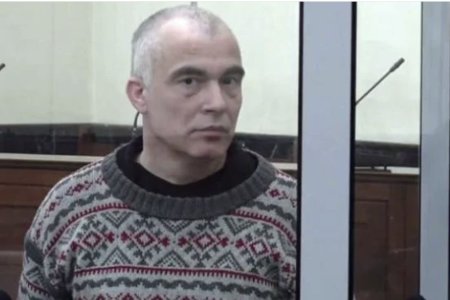
"The doctors gave me an injection, and then people from the MGB arrived and took me to Donetsk...” recalls Natalia Shilo. “Initially, they kept me in the MGB building, then moved me to the hospital, did a fluorography, and transferred me to a temporary detention center, where I stayed for about a month."
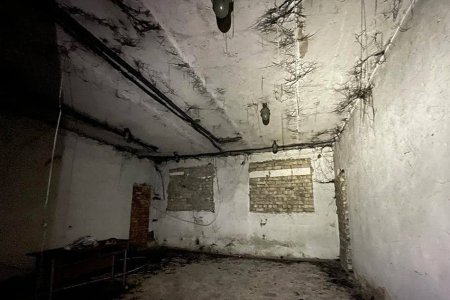
The conditions at the detention center were awful. Natalia was confined alone in a cell and was poorly fed; sometimes, guards even forgot to give her rations. There was only cold water. Guards confiscated all her belongings, including a change of underwear, leaving her without any hygiene products or soap. She had to undress to wash her clothes, even though there was 24-hour video surveillance in the cell. It was impossible to hide from it, even on the toilet — everything was exposed.
"They took my watch, and I didn’t see the sun, so I couldn’t tell what time it was. They wouldn’t let me sleep. There was always artificial light... They didn’t turn it off. As an MGB operative once told me, ’Our job is to make your existence unbearable’..."
“Investigation”
Every day, people from the MGB came to pick up Natalia and took her away for hours of interrogation.
"They transported us in paddy wagons, in handcuffs, with bags over our heads. I asked (the escort — ed.): ’Do you truly think I’m that much of a threat? You’re twice my size, and you have a machine gun! And you’re putting a bag over my head!...’ He responded, ’That’s how it should be.’ They grab you by the neck, bend you over, and you walk with a bag over your head, hunched at a 90-degree angle, stumbling because you can’t see anything..."
The “investigators” tried to force Natalia to confess that she had worked with the Ukrainian special services and had come to the “DPR” to spy. They said that a mythical “curator” from the SBU had supposedly already tried to call her phone, which had long been in the hands of the “investigators."
"There was no curator; I didn’t work for anyone! I just have a very keen sense of justice. I posted publicly on Twitter that there were Russians in Horlivka. I wrote that this wasn’t a civil war at all! My blog had six thousand followers..."
The free “lawyer” appointed by the so-called “republic” to Natalia immediately warned that she would not help her. Natalia’s daughter was able to hire a paid lawyer. He explained that he couldn’t get Natalia out of prison, but at least he would keep her in touch with her mother by passing notes and belongings.
Natalia says, “They didn’t beat me during the interrogations. They intimidated me, yelled at me, kept the lights on in the cell around the clock, didn’t let me sleep, and didn’t let me eat. I took a lie detector test when I could barely walk because I hadn’t slept for several days. Everything felt like a dream. They threatened to kill me by blowing in sealing foam, to take me somewhere where no one would ever find me, to shoot me, and to rape me. And they were all young men, while I’m almost a grandmother! They threatened to bring my mother and daughter in for questioning... One of them yelled at me in such a way... He was about to hit me. I thought, if they’re going to kill me, they will do it. But why should I die on my knees? So I looked up at him and asked, ’Excuse me, when did we start using first names?’ He was simply taken aback. I switched on ’teacher mode,’ and teachers are feared. And from that point forward, they only addressed me formally. I even fixed their mistakes in the interrogation protocols! Sometimes they didn’t even realize that I now ask them questions instead of them asking me. I utilized all my pedagogical knowledge. My lawyer requested me, ’Don’t tease them!’ And at the MGB, they once told me, ’The most dangerous people are priests, journalists, and teachers.’ ’What did the teachers do wrong to you?’ I asked. ’People listen to them!’ ’Well, tell the truth, and people will listen to you!’"
SIZO: We tried to remember the names of every woman prisoner of war
A month later, Natalia was moved from the temporary detention center to the Donetsk pre-trial detention center (SIZO).
"There were already 14 of us in the cell. It was cramped: if 3-4 people stood up, it was impossible to walk. I still can’t stand when there are a lot of people in one room... The smell of prison, concrete floors, and concrete walls... In both winter and summer, we kept the windows open because water was dripping down the walls. They only took us out for a walk if they felt like it — and even then, for no more than half an hour. On the top floor, there were similar cells for walks, but without a roof. The same grimy concrete, the same stench. You weren’t able to see the city from there. The food was like something you would serve to pigs. It was extremely cold during winter. The windows wouldn’t close... The bath was in the basement. There was snow in the changing room. They walk you out completely naked from the changing room down the corridor to the bathroom, where there’s nowhere to hang your towel, so it gets wet... The bath attendants are men, and they stare. But you don’t care anymore..."
There were TV sets in the SIZO cells, and most channels broadcast propaganda. The women searched for movies to distract themselves from the prison routine. Prisoners found out about the full-scale Russian invasion from watching television.
"It was extremely frightening! TV reported that Russians had already reached Kyiv and that Ukraine no longer existed. You listen, and it becomes hard to breathe; your heart stops. You realize that no one will ever free us. And then you tell yourself: stop, they are Russians, you can’t trust them! Natasha Vlasova was one of us. She is a hero, such a strong-willed person! Always remained calm and level-headed. A psychologist by training, she advised us not to lose our composure and supported us all."
Natalia says all the “politicals” had higher education: managers, engineers, and even two music teachers. She remembers the names of all the women prisoners of war she went through those terrible times with: Yulia Dvornichenko, Olena Zaitseva, both of whom were released from captivity during the “great women’s exchange” in October 2022, Shatryuk Anya, Lyudmila Huseynova… Natalia prefers not to name those who still remain in the “DPR” to avoid endangering them.
There were also “criminals” in the cell — women serving time for robbery, drugs, and similar offenses. They treated “politicals” differently.
"Some prisoners hated us, some supported us, and some didn’t care. The “criminals” kept smoking nonstop, but I never picked up smoking. They smoked by the window, where you could see a bit of the sky. And I stood next to them, breathing in some fresh air. But where could I look? In the sky! There was nowhere else to look, so I started explaining to them: this constellation is called so-and-so, and this one is called so-and-so... I even trained one girl in mathematics. Almost all of the “criminals” had little education, typically only two or three years of schooling. I told the girls about physics; they listened and asked questions. It’s nice when people are curious about something. To entertain myself, I solved math tasks for fun. By some miracle, I discovered a book with a collection of higher math tasks there. When I needed to refocus or distract myself, I solved them. I asked my lawyer to have my mother send me a notebook. During a “shakedown,” the guards found the notebook and asked, ’What is this?’ One of the girls joked, ’It’s codes!’ But I explained that it was advanced mathematics and showed them the collection of tasks."
The prison administration was so impressed by this unusual way of prisoners’ rest that they allowed her to have a pen, which was otherwise forbidden in the cell.
Natalia says she was really upset when her lawyer said he couldn’t get her out of prison. The woman was charged under four articles of the criminal code of the self-proclaimed “DPR”: espionage for a foreign state, extremism, incitement to national hatred, and use of electronic media for criminal purposes. Espionage alone could result in a life sentence or even the maximum punishment — execution.
"There were no tears: I didn’t cry during the interrogations or in prison. But when I realized that without exchanges, I would never get out of there, every night I lay on my bunk and think: I hope I don’t wake up! The psychiatrist later asked me if I had any suicidal thoughts while I was there. I am a non-believer; I am a physicist. Anger took over me: ’No, you bad people, I won’t give in to you! I refuse to accept your terms!’ My hatred for Russia kept me motivated. I repeated like a prayer: ’Horlivka is Ukraine. Donbas is Ukraine.’"
A “movie”
In December 2021, a television crew visited Natalia to film a story about the “Ukrainian armed formations’ fire spotter.” To do this, they took the woman from the detention center and brought her to the MGB building, where Russian FSB officers and journalists from Oplot-TV were waiting for her.
"They prepared a speech for me. I had to read it from a piece of paper on camera, repent, and say that I love Russia. They handed me a piece of paper. And I said, ’Give me a pen; at least I can correct your mistakes!’"
The propagandists never got Natalia Shilo’s repentance. In the broadcast, the journalist describes the teacher’s behavior as “indiscreet” and says that she “seemingly mockingly switches to Ukrainian."
"I know this journalist; he’s Vadym Topalov, the son of my acquaintance,” says Natalia Shilo. “During filming, at one point he said that he was also Ukrainian, and I replied, ’Then let’s speak Ukrainian!’ And that made it on the air."
![Скриншот з пропагандистського відео [Наталія Шило]](https://khpg.org/files/img/1608826275.png)
In that video, Natalia was accused of nearly every sin: supposedly, it was because of her “spottings” that civilians in Horlivka were killed. The journalist said she was acting not only on her own initiative but also under the orders of the SBU. Later, Kremlin propagandist Solovyov aired this video on his show.
The trap and release
In 2023, Natalia Shilo was released from SIZO and put under house arrest. By that time, no investigative actions had been taken against her for eight months. This violated Russian law, which came into effect in the occupied territory of Donetsk Oblast after the illegal “referendum” and “official accession” to the Russian Federation.
"The case remained open. I had to stay at home in Horlivka, call them, and go to Donetsk at their first request. I signed an agreement stating that I would not communicate with anyone from Ukraine except my daughter. They failed to give back my belongings. I didn’t have any Russian documents. They told me they wouldn’t let me leave the “DPR” anyway. I was on my way home, pondering how they would meet me in Horlivka after that TV report. I’m a teacher, they know me there. Now, I thought that when I met someone, they might spit on me or push me. And I was so surprised when people approached me, hugged me, and put money in my pocket... They said, ’Tell Ukraine that we are waiting for it!’ I asked, ’How can I do it?’ They believed I genuinely had a connection with Ukraine! Where is that “Russian world” that hates me, as the investigator once told me? Yes, there were a few times when someone didn’t say hello to me. Once, an acquaintance saw me and crossed to the other side of the street. I just laughed: ’Are you afraid of me here with your Russian world? That’s just great!’ In a year in Horlivka, nobody said a bad word to me!"
During her house arrest, Natalia stayed with her mother. There was no work, so they got by as best they could — working in the kitchen-garden, gathering nuts and metal. Sometimes she was able to earn some money by tutoring. Her former students and their parents helped her. In 2025, the criminal case was ultimately closed. When Natalia went to Donetsk to retrieve her documents and belongings, the investigator told her directly: “We won’t let you go, and you won’t go to Ukraine! Obtain a Russian passport and remain here.” She replied, “I don’t want to live here. You’ve ascertained that I’m not a spy, so let me go!” Natalia decided to take a chance and try to leave for Ukraine on her own. For residents of the occupied territories, the only route is through Russia. In January 2025, she packed her belongings and was able to reach the Russian border. There, she was stopped by the Russian special services.
"They examined my documents and said, ’Ah, this is the person who was on the exchange list. You wanted to go home, so go home!’ And they sent me back to Horlivka. I realized I was trapped and couldn’t leave without outside help. All the carriers refused to carry me. Then I called my daughter: ’Ira, save me!’ And she reached out to Lyudmila Huseynova."
Former Kremlin captive Lyudmila Huseynova appealed to Ukraine’s Defense Intelligence. In a carefully coordinated secret operation, the details of which remain undisclosed, Natalia Shilo was successfully evacuated from the occupied territory in April 2025. She traveled through Russia, Belarus, and Poland. At the train station in Kyiv, she was greeted by her sisters-in-captivity, Lyudmila Huseynova and Yulia Dvornichenko.
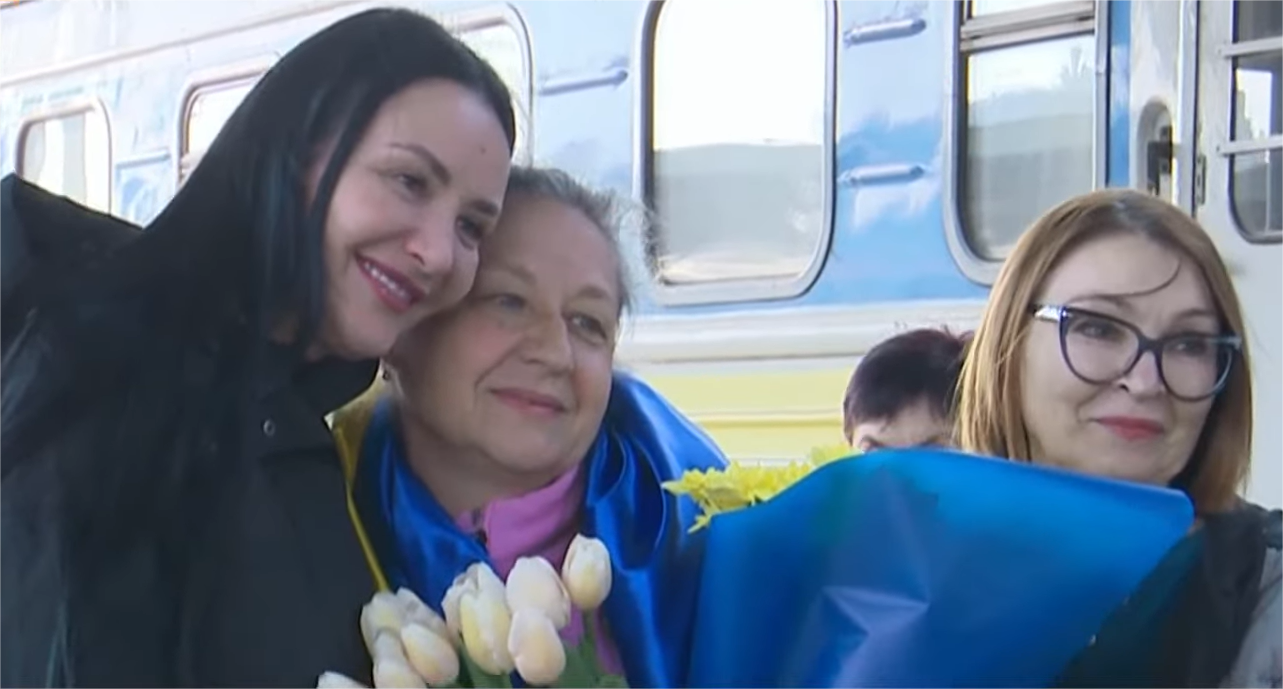
Natalia Vlasova is still held in Russian captivity. In December 2024, she was sentenced to 18 years in prison. When Natalia Shilo was released from the Donetsk SIZO (to be placed under house arrest) in 2023, Vlasova, thinking her friend was being taken for an exchange, shouted to her from the window cell: “Say hello to Kyiv!” Natalia Shilo kept her promise — but only after two years.
“Come on, sisters!”
Now Natalia Shilo herself goes out to meet women who have been freed from enemy captivity. She says that no one understands better than she does how important it is to see familiar, smiling faces in the first minutes on native soil. The public organization “Come on, sisters!” that Natalia joined cares for civilian women-Kremlin captives, both those who have been released and those still held.
"When we find out that civilian women will be exchanged, we go there immediately. We bring flags and something tasty... When we were behind bars at the Donetsk SIZO, we knew all the girls by name and tried to remember each one. When you return from there, you’re scared because everything has changed over the years of captivity... Take Yulia Panina, whom we just met. She says: ’I got off the bus, and everyone around me was a stranger... And then I saw you! I felt so warm!’ At Numo Sisters, we support women who have been liberated from captivity — morally and, when possible, financially — helping them to rebuild their lives..."
It is very difficult for civilians, especially those who have returned from captivity outside of an official exchange, to obtain the status of a person deprived of personal freedom due to aggression against Ukraine. People without this status receive no benefits or assistance from the government. Natalia has not yet achieved this status. The KHPG lawyers are assisting her in resolving this issue.
She is now working as a teacher again. In her free time, she knits toys and donates the money from their sales to the Ukrainian armed forces. Every morning at nine, she stands respectfully during the nationwide minute of silence. She ensures that her students also show respect for this symbolic moment. She once blocked the road to stop traffic at 9:00 a.m.
"The driver jumped out and started cursing. But I’ve been in prison, so what do I have to be afraid of? A minute of silence isn’t an empty phrase to me; it’s tears. My students died, my friends died, and my colleague who supported me when I was behind bars also died..."
Natalia Shilo aims to inform the world about what women experience in Russian captivity. And also — to attain justice: she is involved as a victim in several criminal cases involving kidnapping and sexual violence. She testified in the Donetsk pre-trial detention center (SIZO) case. The European Court on Human Rights is also aware of her.
"I was still in prison when my daughter and students lodged a complaint with the ECHR. At that time, Russia had not yet withdrawn from the European Convention on Human Rights (it did so on September 16, 2022 — ed.). My case is in Strasbourg, where I am suing Russia for kidnapping and unlawful deprivation of liberty."