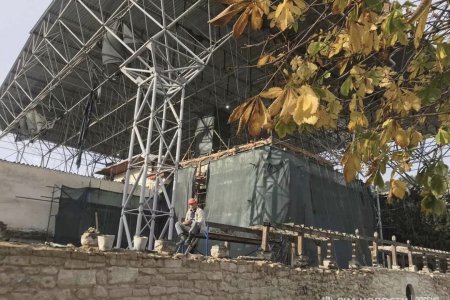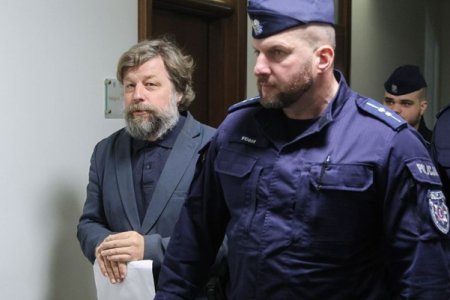
A Polish court has remanded Alexander Butyagin in custody for 40 days following a request from Ukraine for his extradition. The Russian archaeologist, who works for the Hermitage in St Petersburg is wanted by Ukraine over his role in excavations carried out without permission in occupied Crimea. These excavations, which are ongoing, have caused the partial destruction of Myrmēkion, an ancient Greek colony founded in the first half of the sixth century in what is now Kerch in Crimea.
Although Butyagin’s detention was only reported on 11 December, it seems he was arrested on 4 December on the basis of a request from Ukraine in November. Ukraine’s Prosecutor General reported on 15 November that notification of criminal charges had been issued to an unnamed Russian citizen, identified as the head of the section on ancient archaeology of Russia’s State Hermitage museum. He is accused of illegally carrying out archaeological searches on a site of Ukrainian cultural heritage, under Article 298 § 4 of Ukraine’s Criminal Code, with the excavations having begun after Russia’s invasion and annexation of Crimea and continuing.
Butyagin certainly knew of the charges and expressed “surprise” in an interview to Russia’s state ‘RIA Novosti that “at such a difficult time for Ukraine” prosecutors in Kyiv were involved in what he claimed to be “the persecution of archaeologists”.
Butyagin was, it seems, travelling from the Netherlands to a Baltic Republic when detained in Poland. It is not clear whether Poland’s authorities were the only ones asked to detain him. Russia has, predictably, claimed that the move is both “incomprehensible” and illegal.
Although damage to such a site can scarcely be defined in terms of financial cost, Ukraine’s prosecutors have told their counterparts in Poland that the estimated damage would come to over 200 thousand UAH (just over four thousand euros).
Ukraine’s Centre for Journalist Investigations reports that Butyagin was also involved in organizing an expedition by Russian leader Vladimir Putin to Kerch.
On all Ukrainian territory that has fallen under Russian occupation, Russia has violated international law by excavating, ‘renovating’ and often plundering places of Ukrainian heritage. In Crimea it has caused irreparable damage to at least one UNESCO site of World Heritage and has caused so much damage as to ensure that the Khan’s Palace in Bakhchysarai, which was on UNESCO’s World Heritage Tentative List has no chance of receiving the World Heritage recognition that it had undoubtedly deserved. In its report on the charges against the Hermitage archaeologist, Ukraine’s Prosecutor General pointed out that Russia was not just carrying out illegal excavations causing major damage to places of Ukrainian cultural heritage. It was also carrying out “unlawful restoration of such sites in order to distort Crimean history and demonstrate its [supposed] “Russian element’”.
Hansaray / Khan’s Palace in Bakhchysarai
Parts of this complex date back to the 16th century. Hansaray was built as the main residence of the monarchs of the Crimean Khanate - the state of the Crimean Tatar people – and was the political, religious and cultural centre of the Crimean Tatar community until the collapse of the Khanate in 1783. It was, therefore, hardly surprising that news of the barbaric ‘renovation’ of the complex in early 2018 was widely perceived as an attack by the invader on a monument of considerable historical and cultural importance for the Crimean Tatar People and for Ukraine. The following are just some of the examples of wanton destruction:
the replacement of all of the original, handmade ‘Tatarka’ tiles on the Palace roof with factory-made ‘old-looking’ Spanish tiles (there were then, and have since, been many examples of corruption, with it clear that this act of barbarism was partly aimed at providing the Russian elite with the original tiles for their dachas);
the completely unnecessary replacement of all of the oak beams on one of the roof coverings by glue composite planks put together using OSB {oriented strand board) technology (a solution rather like plywood!);
the use of hydraulic drills and other heavy construction equipment, with this causing vibration and leading to cracks in the walls and wall paintings and finishes being damaged or completely lost. In February 2022, for example, it was learned that a large crack has appeared on the wall of the Svitsky Corpus [Retinue Corps];
in early 2025, it was learned that a priceless fresco had been destroyed with this, purportedly, by the ordinary painters who had been left to their own devices (see: Russia destroys irreplaceable fresco in ongoing destruction of 16th century Crimean Tatar Khan’s Palace and further links below
Chersonese UNESCO World Heritage site
Russia has caused irreparable damage to this site as part of its grotesque attempts to rewrite history and stake its supposed ‘historical right to the territory’. It created something claimed to be a ‘historical-archaeological park’ on territory directly linked with the Ancient City of Tauric Chersonese and its Chora. This was no archaeological site, with heavy bulldozers first used on a site with a cultural layer of up to 10 metres in order for the Russian occupiers to build their ‘complex’.
Russia began causing damage to Chersonese soon after its invasion, with UNESCO prompted back in 2016 to urge “all parties concerned with the state of conservation of [the Ancient City of Tauric Chersonese and its Chora] to refrain from any action that would cause damages to it and to fulfil their obligations under international law by taking all possible measures to protect it. “*
This was totally ignored with the ensuing damage likely to result in Chersonese losing its World Heritage status.
See: Russia totally destroys Chersonese UNESCO site in grotesque attempt to justify Crimean occupation