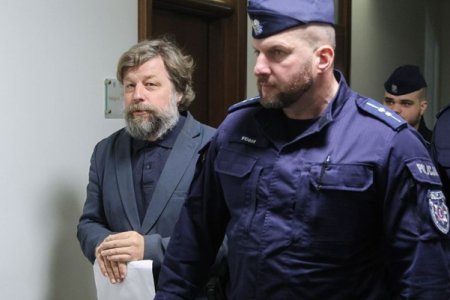
A Polish court of appeal has upheld the arrest in Poland of Russian archaeologist Alexander Butyagin, pending a decision on Ukraine’s request for his extradition to face charges over his illegal excavations in occupied Crimea. It is unclear when the ruling on whether his extradition is admissible will be made, but Butyagin’s arrest has clearly already had a chilling effect on academics in the Russian Federation. At the end of January 2026, they were advised by Russia’s ministry of science and higher education to carefully assess whether they should travel to what the current Russian regime views as ‘unfriendly countries’. By the latter is meant all of those countries in the EU, G7 and one or two others who have, in full accordance with international law, sanctioned Russia over its war of aggression against Ukraine.
Two appeals were lodged with only the appeal against the earlier term of detention, up till 14 January 2026, reviewed. A ruling is pending over the appeal against the extension of his detention until 4 March 2026. It is hard to see how that could reach a different conclusion as the decision on extradition has yet to be made and the same reasons for doubting that Butyagin would not try to flee to Russia or Belarus remain in place. Given Russia’s aggressive response, and its summoning of Poland’s ambassador in protest, there seems every reason to assume that the Russian embassy in Warsaw would help Butyagin to abscond.
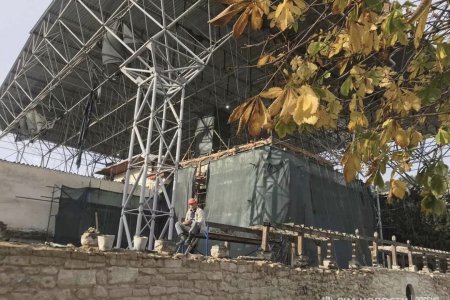
As reported, Butyagin was detained in Warsaw on 4 December 2025, having been placed on Ukraine’s wanted list in November 2024. He is accused by Ukraine of carrying out excavation work on a site of Ukrainian cultural heritage, namely Myrmēkion, an ancient Greek colony founded in the first half of the sixth century in what is now Kerch in Crimea, without the required permission (under Article 298 § 4 of Ukraine’s Criminal Code) and of causing its partial destruction. The notice of war sanctions, imposed by Ukraine points out that in 2022 he led an expedition which discovered and illegally seized for the Russian Federation thirty gold coins, of which 26 were inscribed with the name of Alexander the Great and 4 were minted during the reign of his brother Philip ΙΙΙ Arridaeus.
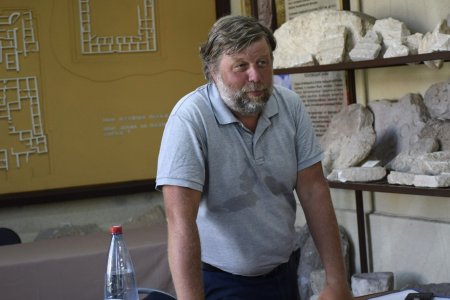
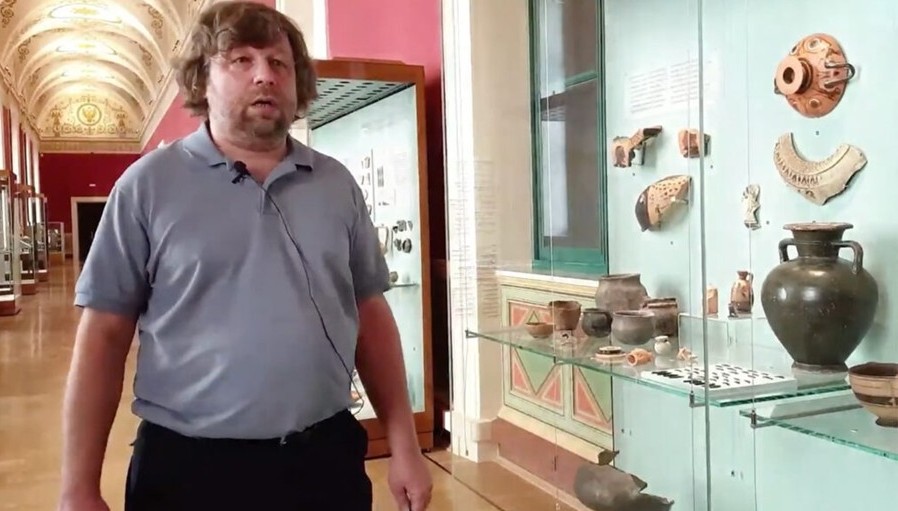
Alexander Butyagin (b. 1971) has headed expeditions from the Hermitage in St Petersburg to Myrmēkion since 1999. His work, however, undoubtedly became illegal in 2014, as he did not have permission from Ukraine to carry out such excavations. The latter were, as seen in 2022, used to carry out looting by the aggressor state illegally occupying the peninsula.
According to the 1999 Second Protocol to the Hague Convention for the Protection of Cultural Property in the Event of Armed Conflict, to which both Ukraine and Poland (but not Russia), are parties, Russia, as occupying power, is prohibited from carrying out almost any archaeological excavations.
Poland confirmed that it had formally received Ukraine’s extradition request on 23 December 2025, with this accompanied by an assessment from the Polish Prosecutor, supporting Ukraine’s application. If the court decides that Butyagin’s extradition would not run counter to the European Convention on Extradition, the decision whether or not to extradite him will ultimately be taken by Poland’s Minister of Justice.
This is the first time that a Russian archaeologist has been detained over illegal excavations on occupied Ukrainian territory, and the ruling is very important. Andriy Yakovlev, lawyer and legal expert for the Media Initiative for Human Rights [MIHR] stresses that Ukraine is fully within its rights to demand Butyagin’s extradition. Although the archaeologist’s arrest is unlikely to put a stop to the excavations, it will have a sobering effect on other Russians who will stop going to Poland or other so-called ‘unfriendly’ countries. Judging by the above-mentioned letter from Russia’s ministry of science and higher education, the effect has already been felt.
The fact that Butyagin had earlier taken part in excavations does not change anything, as the situation changed fundamentally with Russia’s invasion and annexation of Crimea in 2014. It is certainly true that Butyagin could not receive Ukraine’s permission to excavate on behalf of the invading state, but that does not remove his culpability. If, in 2014, it is just conceivable that he simply continued doing what he had done for the past 15 years, without any involvement in politics or state-sponsored propaganda, that was certainly not the case from 2022. It is telling that Butyagin even spoke about the charges which Ukraine had laid in an interview to Russia’s state-controlled propaganda agency RIA Novosti. He was sneering, claiming ‘surprise’ that “at such a difficult time for Ukraine” prosecutors in Kyiv were engaging in what he claimed was “the persecution of archaeologists”.
While Butyagin’s lawyers have tried to argue that their client’s life would, supposedly, be in danger if he was sent to Ukraine, Moscow’s official response included aggressive bluster. They claimed that Butyagin had been carrying out excavations on what they called ‘an inalienable part of the Russian Federation.” For that reason alone, it would be shocking if Poland simply returned Butyagin to Russia.
Yakovlev expects Poland to support Ukraine in the question of extradition but suggests that there are still problems. One difficulty is the fact that Butyagin’s life could, indeed, be in danger, although because of his compatriots bombing and otherwise attacking Ukraine. Butyagin’s lawyers may well argue that he should not be sent to Ukraine because of the bad conditions in Ukraine’s prisons and, especially, pre-trial detention centres, or SIZO. The fact that Russian SIZO and other penal institutions are at least as bad, and torture systematic in them of Ukrainian prisoners of war and civilian hostages does not, in principle, change the validity of such considerations.
The argument was, for example, used by Finland’s Supreme Court when, in December 2023, it said that Russian neo-Nazi and suspected war criminal, Yan Petrovsky, (/ ‘Voislav Torden) could not be extradited to Ukraine to face trial for war crimes in Luhansk oblast in 2014.
Petrovsky was, however, put on trial in Finland and was sentenced on 14 March 2025 to life imprisonment, with the Finnish court having found unanimously that he was guilty of four war crimes.
Yakovlev believes that a similar solution could be found here as well, if a Polish court decides that Butyagin should not be extradited to Ukraine because the latter cannot ensure his physical safety when the country is at war, nor the conditions in places of confinement. Ukraine could, he says, initiate the transfer of the criminal investigation and proceedings to Poland. Such transfer of jurisdiction would ensure that the principle of the inevitability of punishment is upheld, without compromising such requirements as the need to ensure physical safety.