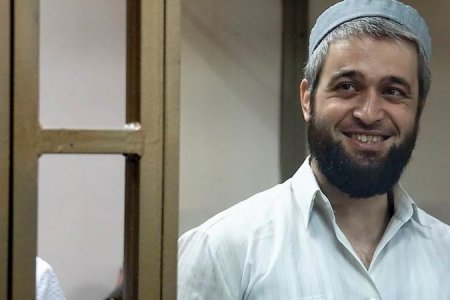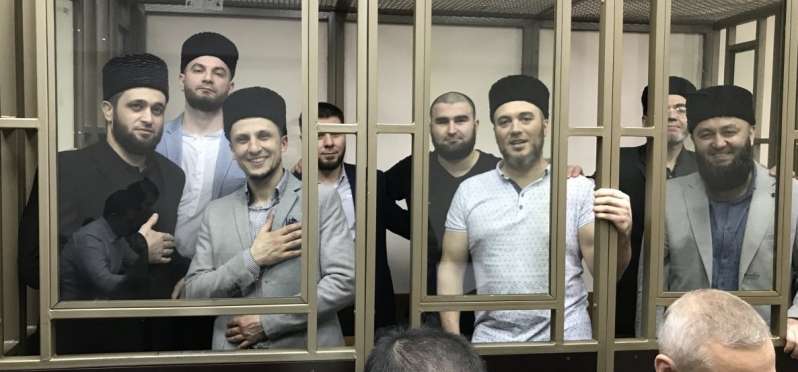
A cassation chamber of Russia’s supreme court has left unchanged huge sentences passed against seven recognized Crimean Tatar political prisoners: Marlen Asanov; Memet Belyaov; Timur Igragimov; Server Mustafayev; Seiran Saliyev; Edem Smailov and Server Zekiryaev. Most of them are civic journalists or activists of the Crimean Solidarity human rights movement and had refused to look the other way as Russia escalated its repression in occupied Crimea. The court’s rejection of the cassation appeal was expected, however, as lawyer Emil Kurbedinov pointed out, the men themselves, and their lawyers, were determined to demonstrate the glaring violations in their politically motivated ‘trial’.
The hearing took place from 11 to 5 p.m. on 18 December, although it seems clear that it lasted so long only because the men all asserted their right to address the court, not because the latter listened. Two of the men, renowned journalist and Crimean Solidarity Coordinator Server Mustafayev and Edem Smailov were prevented from giving their entire address, with the court claiming that they were “deviating from the subject”.
Server Mustafayev had, in fact, pointed to the huge number of violations of both procedural and substantive law, as well as to the evident bias of the court. These were seen both during the original trial before the Southern District Military Court in Rostov, and then, during the appeal hearings at the Military court of appeal in Vlasikha (Moscow region). The cassation appeal asked that both the original convictions and the appeal court ruling, upholding theses, be revoked and that the men be acquitted.
All of these arguments were ignored, as was the most fundamental and compelling, namely the profoundly flawed and illegal nature of the charges themselves.
Illegal charges
Although Russia is certainly in violation of international law through its arrests and ‘trials’ of Ukrainian nationals from occupied territory under Russian law, it is also in breach of its own legislation. The men in this case and a huge number of others were accused solely of unproven involvement in Hizb ut-Tahrir, a peaceful, if controversial, transnational Muslim organization, which is legal in Ukraine and not known to have carried out acts of terrorism anywhere in the world. The charges against them are based on a secretive and unexplained supreme court ruling from 2003 which outlawed Hizb ut-Tahrir as ‘a terrorist organization’. In occupied Crimea, Russia has used this ruling as excuse for conveyor-belt ‘trials’ and sentences of up to 20 years against Crimean Muslims, with the regime increasingly using these prosecutions to try to crush the Crimean Tatar human rights movement.
Emil Kurbedinov and other lawyers have pointed out that all such charges are illegal since the supreme court ruling pre-dated the introduction in 2006 of Russia’s law on countering terrorism. This clearly defines what is meant, according to Russian legislation, by ‘terrorism’ and ‘a terrorist organization’. Any indictment since then must name the specific articles and norms of the 2006 law which the defendants are alleged to have violated. The charges in occupied Crimea never do anything of kind, with the charges hinging purely on the fact of the 2003 supreme court ruling and on claims, based on flawed ‘expert assessments’ and ‘secret witnesses’, that a person was involved in Hizb ut-Tahrir.
Fabricated evidence: FSB-loyal ‘experts’ and fake ‘secret witnesses’
No proof of actual terrorist activities or intentions is ever required, nor, indeed, is any real proof of the alleged ‘involvement’ in Hizb ut-Tahrir. The charges were based on illicitly taped conversations in a mosque, during which there was not one mention of Hizb ut-Tahrir. As always, the FSB sent a transcript of these tapes to loyal ‘experts’ whom it can rely on to provide the claims of ‘proof’ required. None of the three ‘experts’ Yulia Fomina; Yelena Khazimulina and Timur Zakhirovich Urazumetov possessed the professional competence to provide such assessments. In the case of the two ‘linguists’, Fomina and Khazimulina, this was explained in a comprehensive report and then to the court by forensic linguist, Yelena Novozhilova.
This suspect ‘evidence’ as then backed by the even more dubious testimony of two ‘secret’ or anonymous witnesses. Russia essentially bases all its political trials of Crimean Tatars and other Ukrainians on such alleged witnesses, with this strongly criticized in the 2021 UN Secretary General’s Report on the Human Rights Situation “in the Autonomous Republic of Crimea and the city of Sevastopol, and found to violate a defendant’s right to justice by ECHR in 2020.
The ‘judges’ from the Southern District Military Court were well aware that these supposed anonymous witnesses are essentially working for the prosecution, as evidenced by the number of times they blocked questions from the defence aimed at demonstrating that the alleged ‘witnesses’ were lying.
In this case, as in very many ‘trials’ of Crimean Tatars from Bakhchysarai, the identity of both ‘secret witnesses’ was, in fact, known, as were their reasons for collaborating with the FSB. Konstantin Tumarevich is a Latvian citizen and fugitive from justice who could not risk being sent back to Latvia after his passport expired. He is believed to have been used by the FSB in several prosecutions. Narzulayev Salakhutdin was also living in occupied Crimea without the proper documents and did not want to be forcibly returned to his native Uzbekistan.
These are only the most egregious of countless violations in proceedings that have little, or nothing, in common with real trials. All were systematically ignored by prosecutor Yevgeny Kolpikov and judges Rizvan Zubairov (presiding); Roman Saprunov and Maxim Nikitin. On 16 September 2020, Zubairov; Saprunov and Nikitin passed huge sentences against seven of the men. four civic journalists Marlen Asanov (b. 1977) was sentenced to 19 years in a harsh regime prison colony; Timur Ibragimov (b. 1985) to 17 years; Seiran Saliyev (b. 1985) to 16 years (with this reduced by a year at appeal) and Server Mustafayev (b. 1986) to 14 years. Memet Belyalov (b. 1989) was sentenced to 18 years; Server Zekiryaev (b. 1973) and Edem Smailov (b. 1968) to 13 years.
The one and only acquittal to date of a Ukrainian political prisoner – civic journalist and photographer Ernes Ametov was swiftly challenged by the Russian prosecutor, and Ametov was later sentenced to 11 years. Although likely that the ‘acquittal’ was always viewed as a temporary measure, the ferocity of the new sentence was also almost certainly in revenge for Ametov having refused to give false testimony against others. The Vlasikha military court of appeal proved equally unperturbed by the flagrant violations in this case and, on 14 March 2022, allowed the prosecutor’s appeal against Ametov’s acquittal, and upheld all other convictions.
Russia has since used the same conversations, ‘experts’ and ‘secret witnesses’ to sentence Oleh Fedorov and Ernest Ibragimov to 13 years.
Please write to one or more of the political prisoners!
The letters are a lifeline to the men and send an important message to Moscow that its treatment of Ukrainian political prisoners is under scrutiny. Letters need to be in Russian, handwritten, and on ‘safe’ subjects. If that is a problem, use the sample letter below (copying it by hand), perhaps adding a picture or photo. Do add a return address so that the men can answer.
Sample letter
Привет,
Желаю Вам крепкого здоровья и надеюсь, Вы скоро вернетесь домой, к своим родным. Простите, что мало пишу – мне трудно писать по-русски, но мы все о Вас помним.
[Hi. I wish you good health and hope that you will soon be home, with your family. I’m sorry that this letter is short – it’s hard for me to write in Russian., but you are not forgotten. ]
Ernes Ametov
162562, Россия, Вологодская область, р. п. Шексна, ул. Шоссейная, д. 42, ФКУ ИК-12 УФСИН России по Вологодской области,
Аметову Эрнесу Сейяровичу 1985 г. р.
[In English: 162562 Russia, Vologda oblast, Sheksna, 42 Shosseinaya St. Prison Colony No. 12
Ametov, Ernes Seiyarovich, b. 1985 ]
Marlen Asanov
431120, Россия, ФКУ ИК-7 УФСИН России по Республике Мордовия, Зубово-Полянский район, п. Сосновка, ул. Центральная, д. 2.,
Асанову, Марлену Рифатовичу, 1977 г. р
[In English: 431120 Russian Federation, Mordovia, Prison Colony No. 7, Zubovo-Polyansky raion, Sosnovka, No. 2 Tsentralnya St.
Asanov, Marlen Rifatovich, b. 1977 ]
Memet Belyalov
175130 Россия, Новгородская обл., рп. Парфино, ФКУ ИК-9, ул. Народная, зд. 9.,
Белялову, Мемету Решатовичу, 1989 г.р.
[In English: 175130 Russian Federation, Novgorod oblast, Parfino, Prison Colony No. 9, Narodnaya St., bld 9
Belyalov, Memet Reshatovich, b. 1989 ]
Timur Ibragimov
391825, Россия, ФКУ ИК-5, Рязанская область, Скопинский район, с. Клекотки
Ибрагимову, Тимуру Изетовичу, 1985 г.р.
[In English: 391825 Russian Federation, Ryazan oblast, Klekotki, Prison Colony No. 5
Ibragimov, Timur Izetovich, b. 1985 ]
Server Mustafayev
392000, Россия, Тамбов, ул. Мичуринская, д. 57, ФКУ ИК-1
Мустафаеву, Серверу Рустемовичу, 1986 г.р.
[In English: 392000 Russian Federation, Tambov, Michurinskaya St., 57, Prison Colony No. 1
Mustafayev, Server Rustemovich, b. 1986 ]
Seiran Saliyev
301470, Россия, Тульская обл., Плавск, пос Белая Гора, ФКУ ИК-4
Салиеву, Сейрану Алимовичу, 1985 г.р.
[In English: 301470, Russian Federation, Tula oblast, Plavsk, Belaya Gora, Prison Colony No. 4
Saliyev, Seiran Alimovich, b. 1985 ]
Edem Smailov
156522, Россия, Костромская обл., Костромской район, пос. Бычиха-12, ФКУ ИК-7
Смаилову, Эдему Назимовичу, 1968 г.р.
[In English: 156522, Russian Federation, Kostroma oblast, Bychykha-12, Prison Colony No. 7
Smailov, Edem Nazimovich, b. 1968 ]
Server Zekiryaev
301781, Россия, Тульская область, г. Донской, мкр. Комсомольский, пр-д Димитрова, 1, ФКУ ИК-1, ,
Зекирьяеву, Серверу Зекиевичу, 1973 г.р.
[In English: 301781 Russian Federation, Tula oblast, Donskoy, Komsomolsky, pr-d Dimitrova 1, Prison Colony No. 1
Zekiryaev, Server Zekievich, b. 1973 ]