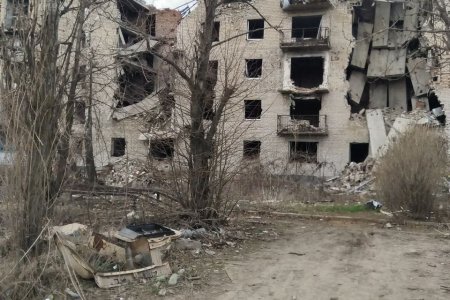
Russia needed only months in 2022 to cause devastation and carnage to vast areas of, among others, Luhansk oblast. Rebuilding is quite another matter, one clearly of no interest to the aggressor state. It is almost four years since the invading army seized control of the neighbouring Luhansk oblast cities of Rubizhne (occupied since 12 May 2022); Sievierodonetsk (since 25 June 2022) and Lysychansk (since 3 July 2022). Although Russia promised that the cities would be swiftly rebuilt, this has not happened, with the cities’ residents trying to survive, with little or no heating, electricity and drinking water, and deliberately isolated.
Over the past year, Russia has been systematically blocking forms of communication (WhatsApp and Telegram, in particular) which it cannot control and has been foisting its own MAX provider to ensure total surveillance. The situation in occupied Rubizhne, Sievierodonetsk and Lysychansk is even worse, however, with the invaders blocking all mobile communications and the Internet. They claim that this is needed because of the proximity to the front and admit that the blocking is on the demand of the FSB and Russian military. Since, even in Rubizhne, the most isolated, there is access “for the chosen”, it does seem likely that Moscow does not believe its own lies and assumes that Ukrainians will pass on information about the invading army’s movements, etc. to Ukraine’s Military Intelligence.
Oleksiy Kharchenko, Head of the Luhansk Regional Administration, reported on 5 January 2026 that residents of Lysychansk have, despite all the grandiose assurances, once again been left without any heating, with the temperature at present well below zero at night. Some of the residential areas are also without either drinking water or electricity. In neighbouring Sievierodonetsk, which was devastated by Russian bombing and shelling in 2022, most of the buildings that had supposedly undergone repairs have roofs that are leaking.
Donbas Realities recently scrutinized social media posts about the situation in the area. In all three cities, the greatest concern appears to be the lack of mobile communications and Internet.
The first post demands to know when they will finally turn on mobile communications in Sievierodonetsk and Lysychansk. “You have no conscience; people can’t call for an ambulance or fire engine. Elderly people are dying without receiving emergency care. If you go out of the city among ordinary trees you have a signal and the Internet, and here, we’re like outcasts, without a signal. Through the whole lpr [the so-called ‘Luhansk people’s republic’], there are mobile communications and we haven’t been deemed worthy. It’s interesting, why? If out of security concerns, then turn it off for the entire lpr, why just our cities? Have some conscience, turn on the signal. We can’t even call an ambulance for the children.”
Similar complaints are heard from a person in Rubizhne. People write about a fire, where the entire building burned down before the fire brigade appeared, and a young girl who was raped, with it taking the police three hours to come. Another woman also demanded to know when communications would be installed because of elderly parents. Her father had died because it took six hours for an ambulance to come.
There are very few people who can afford satellite Internet, with it generally pensioners who remained in the cities after the Russian invasion. The Starlink satellite terminals which do appear are brought in by Russian soldiers or members of Russian construction brigades. According to Valeria Melnyk, a journalist for the independent Ukrainian publication Tribune which is monitoring the situation in occupied Luhansk oblast, it is only these Russians who can afford such a luxury.
The occupation regime has installed some pay phones, but there are far too few for the area involved. Most importantly, these are still only for calls to others in the same city.
Leonid Pasechnyk, the Russian-appointed ‘head’ of occupied Luhansk oblast announced on 2 December 2025 plans to test local mobile communications, although once again this will only provide for calls within a specific city, and there is no information as to when this will begin.
The second problem in terms of importance is heating or the lack of such in all three cities. People write that in most apartment blocks, there has been no heating since the beginning of Russia’s full-scale invasion of Ukraine, with heating only in about 10% of the residential homes. Even in kindergartens and schools, there was no heating with children also forced to sit in coats.
There is also no lighting, with this a huge danger, especially in winter when it gets dark so early, and when, each year, a pretence is made of preparations for the ‘heating season’. Such ‘preparations’ invariably fizzle out, but only after digging for heating pipes has been carried out. People are, understandably, worried that they will fall into such pits, left without safety precautions and in the dark, due to the lack of heating. In a video for a local blogger, one pensioner from Sievierodonetsk said that she and her son sleep in their clothes, because of the cold, and that her husband had effectively died of the cold.
Valeria Melnyk reports that local residents reacted to a post from the occupation authorities which claimed that heating had been restored to Sievierodonetsk. They wrote that the workers had dug for around half a year but had not completed everything. There was still no heating, and the repair work had not been finished, it had been abandoned, they said.
In at least part of Lysychansk, there is also no water, with people forced to wait in queues to take water in bottles from tanks brought in.
Although hospitals and clinics are officially open in all three cities, there is a critical shortage of doctors and specialists of all kinds. You have to queue from the early hours to have any chance of seeing somebody, with this potentially getting you into trouble as the curfew on occupied territory is still in place.
Oleksiy Kharenko notes that the situation has deteriorated. Earlier doctors from Russia were paid to persuade them to work on occupied territory, now Russia has stopped paying. Oleksiy Artiukh, a journalist originally from Rubizhne and now the Chief Editor of Tribune, noted, in an interview to Realna Gazeta, that Russia does not now even have the money for the propaganda videos they made earlier. He recalled how, in 2022, the Russians would constantly turn up with their cameras at places where renovations had been carried out before Russia’s invasion and claim credit for this. They might change a lightbulb or a tile, to show that they’d done something, but would try to pass off all the former renovation as having been carried out by Russian brigades.
“Now the Russians essentially don’t even have the money for showing such propaganda videos. The builders who came are returning home”. Artiukh and his colleagues try to monitor what people are saying on social media, although this is limited by the above problems. He confirms, for example, that Rubizhne is totally cut off from the outside world.
Even this, however, needs to be qualified, as “there is Internet for the chosen”, Artiukh says, although getting connected is hugely expensive. “It’s all constantly jammed, supposedly for security reasons. They say, so that people don’t pass on information to the Ukrainian side.”
The same methods of plunder are seen here as in other occupied territory, with the Russian invaders having, for example, declared an entire section of an apartment block, with this containing about 20 apartments, ‘ownerless’ in order to seize them. They understand, he adds, that if people have pro-Ukrainian views, they will not return themselves to try to start such theft. He mentions one case at Sheremetyevo Airport in Moscow (the only way that Ukrainians can even hope to get to their own home cities in occupied Ukraine) where a woman was banned for 50 years because she had, in 2014, ‘liked’ a social media photo of a Ukrainian soldier, who was not, on the photo, even in uniform (See: Putin gives green light to expropriation of Ukrainians’ homes on occupied territory )
Artiukh has heard suggestions that Rubizhne could be turned into a military town. He cannot say how accurate this is, but thinks it entirely possible, given that the Russia’s are turning Donbas into a militarized zone, a platform for further military action.
What they can see, however, is that even those who welcomed the invaders’ so-called ‘Russian world’ are seriously disillusioned. All the promises have proven to be empty, and the socio-economic situation is catastrophic. Even those who supposedly found work, in clearing rubble at the beginning, or on building sites, have not ended up paid for their work.
Although it was mainly older people who remained in cities seized by the Russians in 2022, there are still young people and even children in these cities. Artiukh notes that there is nothing for young people to do, and their prospects are extremely bleak. He recalls that it was this age group, young people born after around the year 2000 who were most likely to be pro-Ukrainian in their views. Very many of these young people, he says, are now living in other European countries.
On all occupied territory, Russia has, from the first days of occupation, spent vast amounts of money and effort on indoctrination and militarization. Artiukh reports that one local resident told him that, “if earlier at least some time was devoted in schools to actually learning something, now it’s effectively constant propaganda. It’s reached the point that the mass wave of campaigning to (get people to sign) contracts to join Russia’s armed forces has been carried out in kindergartens. There were advertisements posted there. It’s clear that they were aimed at the parents, not at the children, but still – advertisements for contracts in the Russian army in kindergartens! We’ve seen the method guidelines issued by those in authority, with the teachers supposed to report on how much they had campaigned among the parents.
Children are constantly forced to fall into line, they have so-called ‘veterans of the special military operation’, former ‘LPR fighters’ brought to their lessons. They’re forced to draw postcards for Russian soldiers and sing ‘patriotic’ songs. They open military cadette classes and send children from occupied territories to various militaristic camps.
We understand that the Russians see a certain danger in the younger generation. Because young people normally received information from the Internet and are more resilient to propaganda than the older generation.”
See also:
Occupied Donbas residents ask Russia why it 'liberated' them from food and water