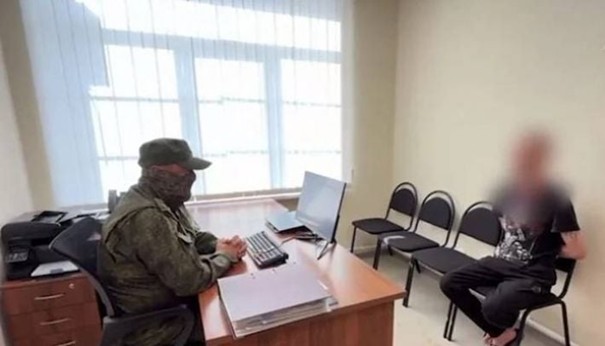
Russia’s latest monstrous sentence against a Ukrainian for defending his country has hit new depths. Not only was the former defender, almost certainly Dmytro Nosenko, charged with ‘terrorism’ under a Russian law only passed five years after he served in Ukraine’s Armed Forces’ Donbas Battalion, but he was obviously tortured into claiming that his service in defence of his country constituted ‘involvement in a terrorist organization.”
Although the Russian sources do not name the 42-year-old from occupied Enerhodar in Zaporizhzhia oblast, the report about the charges against him coincided with news of the inclusion of Dmytro Nosenko, born on 3 August 1983 in Enerhodar, on Russia’s notorious ‘list of terrorists and extremists’.
Russia invaded and occupied Enerhodar and the neighbouring Zaporizhzhia Nuclear Power Plant at the beginning of March 2022. It began abducting, torturing and imprisoning civilians immediately, with a typical target on any territory that falls to the invaders being men and women who have previously served in units of Ukraine’s Armed Forces. The extraordinary criminalization of such defence of one’s country was initiated on 2 August 2022 when Russia’s politically compliant Supreme court outlawed the Azov Regiment which had played a major role in Ukraine’s defence of Mariupol. The ruling claimed that the Azov Regiment, which is a part of Ukraine’s Armed Forces, is ‘a terrorist organization’. The ruling received widespread criticism, with it clear that it was aimed as a pretext for staging predetermined ‘trials’ against Ukrainian prisoners of war, claiming that their service towards Ukraine is ‘involvement in a terrorist organization’. Just over a year later, the Southern District Military Court was used for the same purpose, with identical rulings passed against the Ukrainian Armed Forces’ Donbas and Aidar Battalions. The Russian supreme court also outlawed the Noman Çelebicihan Battalion as ‘a terrorist organization’ in early June 2022. That ruling is also surreal for another reason, since the court was not at all clear what was being outlawed. This has not stopped Russian courts from passing several sentences of up to 20 years against Ukrainian prisoners of war serving in Ukraine’s 48th Separate Assault Battalion, named after Noman Çelebicihan.
Dmytro Nosenko served in the Donbas Battalion, seemingly in Luhansk oblast, in 2018-2019, five years before a Russian court was used to label the Donbas Battalion a ‘terrorist organization’. Russia is prohibited by international law from applying its legislation on occupied territory and is in violation of fundamental principles of law when it uses the law retrospectively and without jurisdiction against Ukrainians living on their own territory.
The charges in almost all such ‘trials’ are identical, with the prisoners of war or abducted civilians accused of ‘involvement in a terrorist organization’, under Article 205.4 § 2 of Russia’s criminal code and of ‘undergoing training in terrorist activities’, under Article 205.3. ‘Convictions’ and massive sentences, up to life imprisonment, are guaranteed despite the fact that almost all of the men and women became prisoners of war and / or served in the relevant military units long before the latter were labelled ‘terrorist’.
The situation in this case is especially disturbing as the report from Russia’s Investigative committee on 3 December 2024 was accompanied by a supposed ‘interrogation’ cum ‘confession’. On this, the man, whose face is blurred but is almost certainly Nosenko, says that he “took part in the terrorist Donbas Battalion’. He is asked by the masked individual carrying out this pseudo-interrogation whether they used weapons against the civilian population, and answers that they did.
Neither the Donbas Battalion nor any of the above-mentioned units are in any way ‘terrorist’ even according to Russia’s legislation which should not, in any case, be applied against Ukrainians living on their own territory. It is near certain that the Russians used torture or other forms of duress to force the Ukrainian to make such a grotesquely absurd ‘confession’.
Judging by the only sentence passed at the Southern District Military Court on 26 March where the defendant’s identity is concealed and where the charges are under Articles 205.4 § 2 and Article 205.3, there was no trial as such. The first ‘hearing’ was scheduled for 26 March, with this the day that ‘judge’ Pavel Yurievich Gubarev announced the guilty verdict and 19-year sentence in a maximum-security prison colony. Gubarev has taken part in many politically motivated ‘trials’ of Ukrainian prisoners of war or political prisoners. The sentence is not final, however even the identity of Nosenko’s lawyer has been concealed, and there is no way of knowing whether he will appeal.