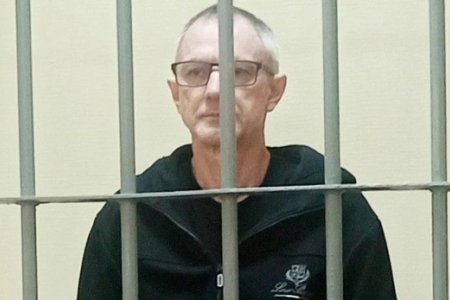
Russia’s Southern District Military Court has sentenced Andriy Diachenko to 20 years in the harshest of Russian penal institutions on ‘terrorism’ charges as cynical, as they are lawless. The aggressor state claimed that the 40-year-old Ukrainian from occupied Tokmak (Zaporizhzhia oblast) had planned to blow up the railway tracks that Russia is using for its war of aggression against Diachenko’s country and called this ‘terrorism’. There is no way of knowing whether Diachenko was involved in resistance activities, or was simply abducted, tortured and subjected to such a ‘trial’ so as to enable the Russian FSB to claim “success in thwarting an act of terrorism.” In either case, Russia is in flagrant violation of international law which prohibits an occupying state from staging any such ‘trials’ under Russian legislation.
The Memorial Support for Political Prisoners Project, which has added Andriy Diachenko (b. 9.08.1985) to its list of other victims of repression, reported in early September 2025 that he was one of 18 Ukrainians whose ‘cases’ had been passed to the Southern District Military Court in August 2025. Despite being accused of two ‘planned acts of terrorism’, there was no information as to when he had been taken prisoner. It is extremely likely that he was held incommunicado for some time before any official acknowledgement of his ‘arrest’ and formal charges.
Almost all information has come from occupation ‘Zaporizhzhia regional investigative committee’ and the court press service which, on 30 March 2026, announced that Diachenko had been found ‘guilty’ of ‘involvement in a terrorist organization’ (Article 205.4 § 2 of Russia’s criminal code); of ‘training in terrorist activities’ (Article 205.3); of two counts of ‘planning a terrorist act (Article 205 § 2a & c), as well as of explosives charges (under Articles 222.1 § 4 and 223.1 §3).
It was claimed that an unnamed “member of a terrorist organization created on Ukrainian territory” had proposed that Diachenko join this alleged ‘terrorist outfit; in order to obtain and possess various explosive substances, devices and their component so as to make homemade explosive devices and “to use them in carrying out terrorist acts on the territory of the Zaporizhzhia oblast.” He had supposedly agreed and joined in 2024, with this also entailing “undergoing training in terrorist activities” with the purported “terrorist acts” specified as being to cause explosions to a railway crossing and to the building of Russia’s illegal military commissariat in occupied Zaporizhzhia oblast.
The court press service asserts that he underwent such training on 26 January 2025, although this appears to have been through receiving links to websites which supposedly contained information on putting together such explosive devices, etc. The press service claims that Diachenko “illegally purchased five electronic detonators”, as well as components for explosive devices. There is no way of establishing whether any attempt was made during the trial to explain how Diachenko did this in the repressive conditions of Russian occupation.
Russia has been staging ‘trials’ on sabotage or terrorism charges on occupied territory since 2014, with the indictment almost invariably claiming that the planned actions were “thwarted” by the FSB. In those earlier cases where it was still possible to follow such trials, there were numerous indications that evidence was fabricated and that the cases hinged on allegations of ‘thwarted plans’ which could not be verified.
It seems very likely that this case is no exception. Diachenko was, nonetheless, sentenced to 20 years’ maximum-security imprisonment with the first five years in a prison, the harshest of Russian penal institutions. A massive 800 thousand rouble fine was also imposed.