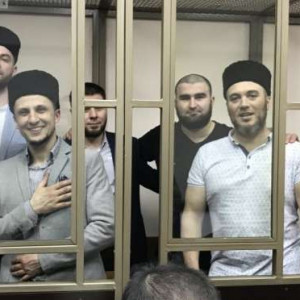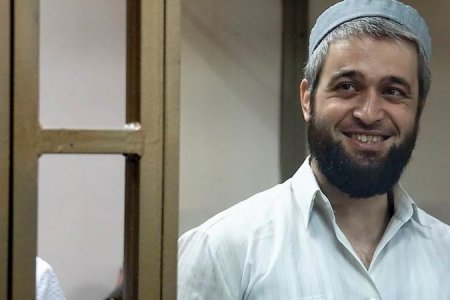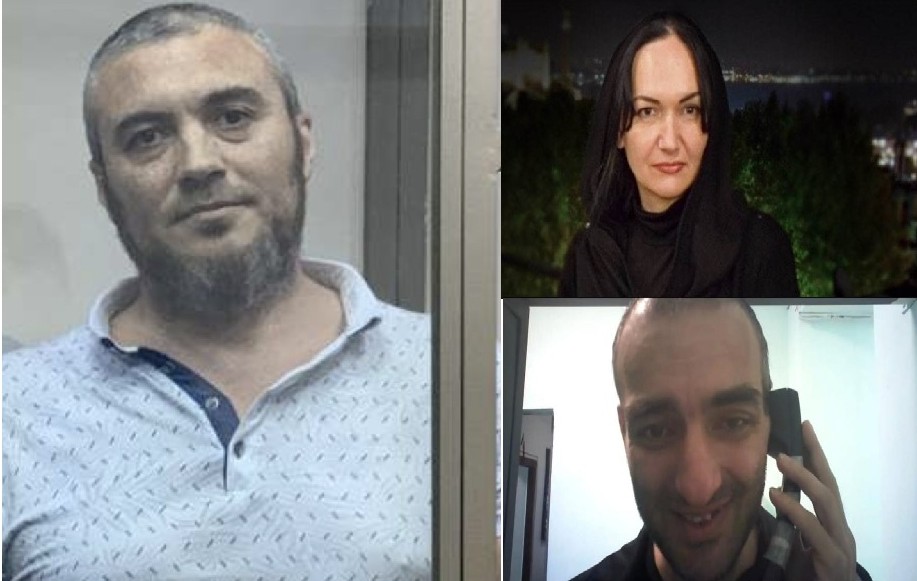
Crimean Tatar political prisoner Server Zekiryaev has a numb tongue and is coughing up blood, with such symptoms clearly requiring urgent medical examination and treatment. He is currently receiving neither in the Russian prison colony where the conditions are themselves tantamount to torture and a hazard to health. His wife’s report of Server’s condition has coincided with a stark and bitter warning from the sister of Iryna Danilovych, Crimean civic journalist, human rights defender and political prisoner, whom the Russian prison administration are also “driving to her grave”.
There are no grounds for disregarding such warnings. Russia has already caused the deaths during ‘arrest or in captivity of 83-year-old veteran of the Crimean Tatar national movement Vedzhie Kashka, Crimean Tatar civic activist Dzhemil Gafarov, as well as Kostiantyn Shyrinh. The lives of at least three Crimean Tatar political prisoners are in immediate danger, while Russia is applying medical torture through its imprisonment and / or failure to provide proper healthcare in several other cases. What is more. Russia has begun openly flouting its own legislation to ensure that Crimean political prisoners, persecuted for their civic journalism, activism or religious ‘dissidence’ are not freed Such brutality has clearly been commissioned from above, since local Russian courts initially passed entirely lawful rulings, ordering the release from imprisonment of 58-year-old Lenur Khalilov, who has stage IV liver cancer, which is spreading, and of 41-year-old Oleksandr Sizikov, who is totally blind. In both cases, a Russian prosecutor challenged the rulings, with Russian ‘judges’ clearly understanding what was demanded of them and, tragically, providing it. The lawful rulings were, accordingly, revoked and the two men taken back into custody. In Lenur Khalilov’s case, he was not only prevented from continuing critically urgent chemotherapy but was sent back to a Russian prison without any of his medication.
Russia is also refusing to release gravely ill Crimean Solidarity civic journalist Amet Suleimanov, although his grave medical condition meant that he should never have been placed in detention at all (see: Brutal Russian roulette with the life of gravely ill Crimean Tatar political prisoner ).
Then, when it seems as if there is no lower that Russia’s persecutors can fall, they prove you wrong. Tofik Abdulgaziev is one of the 25 Crimean Tatar civic journalists and activists arrested in Russia’s worst attack to date on the Crimean Tatar human rights movement (including Dzemil Gafarov). Russia refused to release him two years ago, when he became gravely ill with tuberculosis contracted in the Russian prison conditions. He is now, almost certainly, dying of a malignant brain tumour. Not only have they not taken any measures to release Tofik, so that he can be with his family. The prison doctors recently issued a totally fake ‘bill of health’ which they forced him to sign (see: Crimean Tatar political prisoner with a malignant brain tumour forced to sign a fake ‘clean bill of health’).
Russia’s persecution of Crimean Tatar and other Ukrainian political prisoners began back in 2014, with one result being the emergence of the vital Crimean Solidarity human rights movement. Russia’s response was savage, with a significant percentage of the Crimean Muslims arrested and sentenced to huge terms of imprisonment being civic journalists and activists who helped ensured that the world knew about the mounting repression in occupied Crimea.
Server Zekiryaev (b. 1.04.1973) was arrested in Russia’s first open attack on Crimean Solidarity. On 11 October 2017, four Crimean Tatar civic journalists were arrested: Seiran Saliyev (b. 1985) Ernes Ametov (b. 1985); Marlen (Suleiman) Asanov (b. 1977); and Timur Ibragimov (b. 1985); as well as Zekiryaev and Memet Belyalov (b. 1989), both of whom were Crimean Solidarity civic activists. Although clear then that Russia was seeking to silence the human rights movement in occupied Crimea, it was the arrest on 21 May 2018 of Crimean Solidarity coordinator and civic journalist Server Mustafayev (b. 1986) and Edem Smailov (b. 1968) that provoked the most international condemnation.
The men were not accused of any recognizable crime, merely of totally unproven ‘involvement’ in Hizb ut-Tahrir, a peaceful, if controversial, transnational Muslim organization which is legal in Ukraine, and which is not known to have committed any acts of terror anywhere in the world. On the basis of a flawed and suspiciously secretive Supreme Court ruling from February 2003 which declared Hizb ut-Tahrir to be ‘terrorist’, Russian courts are passing sentences of up to 20 years’ maximum-security imprisonment against Crimean Tatar and other Ukrainian Muslims, the vast majority of whom have been active in the Crimean Tatar human rights movement.
Zekiryaev was sentenced to 13 years’ with all of these sentences involving the political prisoners being held in Russian prisons or prison colonies thousands of kilometres from their families.
According to Zarema Zekiryaeva, her husband’s alarming systems come after three years in which he has been held in the even worse conditions of Russian prison cells, or ‘SUS’ [‘severe conditions of imprisonment’]. The ‘punishments’ are typically on fabricated charges or over trivia, with very many Crimean Tatar and other Ukrainian political prisoners often held most of the time in these worse conditions. Zekiryaev has been held in a building which is right next to sewage manholes, with the cell reeking all the time of ammonium and carbon dioxide. Server has explained that the manholes are around 2-3 metres from the window of his cell, with this causing hellish conditions, constant nausea, vomiting, bitterness in the throat and constant dizziness He has had the numbness in his tongue over the past year, and has been coughing up blood for the last month. The prison doctor did even promise to take a sample for testing, and Zekiryaev himself made a formal request for a blood toxicology test. Instead, Zekiryaev was yet again placed in a punishment cell [SHIZO], this time until 8 April. He has also been systematically refused the chance to see his wife and children. According to Zarema, her requests for such meetings keep being turned down on various formal pretexts, with the last time they saw each other in September 2022. Server Zekiryaev has been held in prison colony No. 1 in Donskoy since September 2022, with the first penalty used as pretext for putting him in punishment conditions in February 2023. They have come thick and fast ever since, with the lawyer who visited him reporting that the problems began with the appearance of a new head of the colony, Ivan Davydenko. The latter appears to want to make life difficult for all of those imprisoned on the same charges as Zekiryaev. The same type of treatment has been meted out to many other Crimean Tatar political prisoners, many of whom have also been held almost all the time in the truly shocking conditions of Russian punishment cells.
Iryna Danilovych
Although officially women are held in medium-security prison colonies, the conditions in them are also shocking. In July 2025, Iryna spoke of the “Gestapo-like” treatment in the women’s prison where she was held. The torment she is now being forced to endure from music played extremely loudly from early morning is directly linked with the treatment and medical torture she was forced to endure during the first year after her abduction and politically motivated ‘trial in reprisal for her civic activism and journalist. She was then denied any proper treatment for an excruciating ear infection which has left her deaf in one ear, and with an acute sensitivity to loud noises.
See:
Russia has killed two Ukrainian political prisoners and is endangering at least 21 others