Russia’s Southern District Military Court has sentenced 63-year-old Serhiy Obushny from Kerch in occupied Crimea to six years’ imprisonment for comments on social media almost certainly in reaction to Russia’s war of attrition against Ukraine.
Serhiy Obushny (b. 23.08.1962) is originally from Cherkasy and is variously described by Russian state media as being a former Ukrainian border guard or as having previously worked for Ukraine’s Security Service.
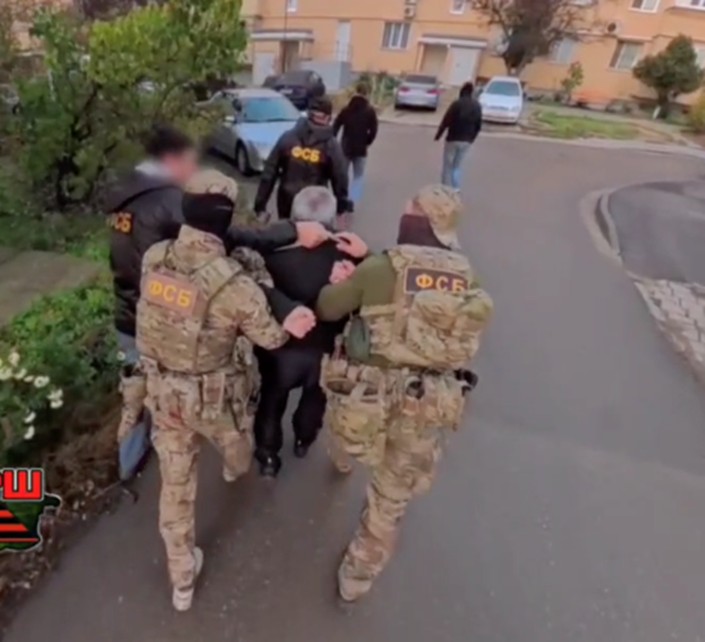
His ‘arrest’ was first reported, together with FSB video, on 16 December 2025, although he was in fact seized on 25 November, and remanded in custody two days later. Russia showed typical haste in adding him to its notorious ‘list of extremists and terrorists’ on 10 December. The charges against him were of ‘calls to terrorism’ under Article 205.2 § 2 of Russia’s criminal code, and of ‘calls to extremism on the Internet’ (Article 280 § 2). The only grounds reported for these charges were comments on a Telegram chat in which Obushny allegedly “called to carry out drone strikes on Red Square during the Victory Day military parade on 9 May.
There is no way of checking the actual post, however Russia uses its legislation very selectively, with Russian propagandists, politicians and public figures able to publicly incite genocide, call for whole Ukrainian cities to be bombed, etc. with total impunity. Obushny’s alleged comments spoke of a strike on military hardware and personnel used by the aggressor state against Ukraine. It is quite possible that the comments were in response to a particular drone attack on residential buildings or other civilian targets in Ukraine. In 2025, the UN’s Independent International Commission of Inquiry on Ukraine identified Russia’s constant drone attacks on civilians, first in Kherson oblast, and then over a much wider area, as both war crimes and crimes against humanity.
The indictment against Obushny was passed to the Southern District Military Court on 24 February 2026. There were enough hearings to suggest that Obushny denied the surreal charges. Acquittals in such political ‘trials’ are essentially unheard of, and on 23 April 2026, ‘judge’ Valery Sergeevich Opanasenko sentenced Obushny to six years’ medium-security imprisonment.
This is one of an ever-increasing number of real sentences over social media comments or posts. On 30 March 2026, Arslan Ivanovich Zhaginov from the same Southern District Military Court sentenced Serhiy Tubolets from occupied Sevastopol to five and a half years’ imprisonment for comments on social media which were claimed to have ‘publicly justified terrorism’.
On 12 November 2025, a Crimean occupation ‘court’ sentenced 38-year-old Kateryna Fomenko to five and a half years’ imprisonment in the first case involving so-called ‘military fakes’ (Article 207.3 § 2 of Russia’s criminal code) in the occupied peninsula.
In March, Crimean Tribunal reported that there had been a sharp decrease in the number of Telegram posts, together with videoed ‘repentance’, about Crimeans accused of ‘discrediting the Russian army’. As reported, these are most often associated with collaborator Alexander Talipov and his notorious ‘Crimean SMERSH’. Although this is claimed to be a ‘civic organization’, it clearly worked in very close collaboration with the Russian occupation enforcement bodies, and posted a regular stream of videos, in which clearly terrorised Ukrainians were forced to ‘apologise’ for pro-Ukrainian posts, or even for displaying the Ukrainian flag.
Irade human rights activists have analysed changes over the winter in occupied Crimea. They report that the videoed ‘apologies’ for pro-Ukrainian comments, etc. have virtually stopped. At the same time, however, there has been a sharp increase in the number of videos showing Crimeans being ‘arrested’ on charges of so-called ‘extremism’ or ‘justification of terrorism’. Since the summer of 2025 when persecution under Articles 280 and 205.2 began, Irade concluded that such cases had quadrupled – from two such ‘trials’ every three months, to eight or nine. One of the reasons for such an increase is Russia’s criminalization of comments in support of Ukraine’s military action.